
US housing starts fell 2.6% in August to an annualized 1.275 million units, below the 1.3 million consensus and the 4.9% monthly gain economists expected, with weakness concentrated in multifamily construction.
US housing starts fell 2.6% in August to an annualized 1.275 million units, below the 1.3 million consensus and the 4.9% monthly gain economists expected, with weakness concentrated in multifamily construction.
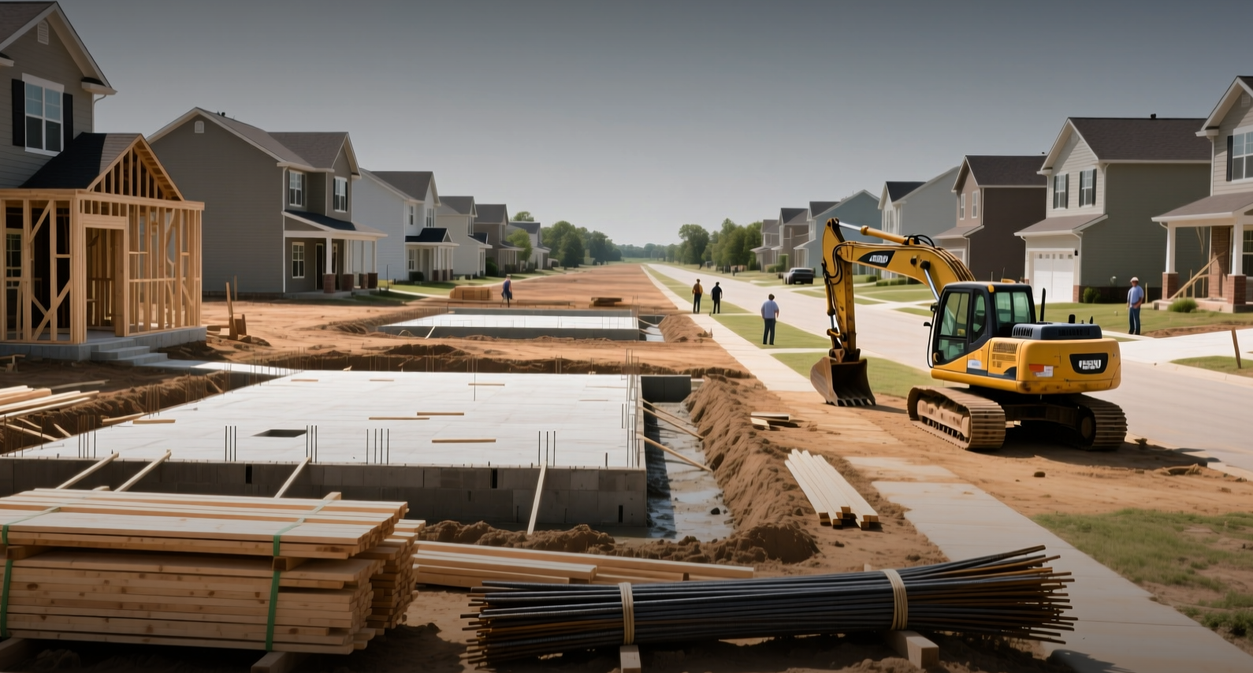
Residential construction in the United States contracted last month, with housing starts dropping to an annualized 1.275 million units — a 2.6 percent decline that landed well short of the 1.3 million economists had penciled in and reversed the 4.9 percent monthly gain they had expected. The miss, reported by the Census Bureau on Sept. 17, is the sharpest signal yet that the residential side of the economy is losing momentum heading into the fourth quarter.
"The starts number is the first hard data point that says the rate-sensitive parts of the economy are still adjusting, not recovering," said James Okafor, macro strategist covering rates and central bank policy. "Builders do not break ground on a forecast. They break ground on a mortgage quote, and those quotes have not moved enough to change the math."
The headline decline understates the divergence inside the report. Single-family construction, the segment that drives builder revenue and building-materials demand, rose unexpectedly in August, while the weakness was concentrated in multifamily projects, where financing costs and elevated completions continue to weigh on new groundbreakings. That split matters for the read-through: single-family strength supports near-term revenue for homebuilders, but the broader starts trend — now running below the 1.3 million consensus for the month — points to slower residential investment in the GDP calculation for the third quarter.
The transmission into rates was immediate and modest. Weaker construction activity feeds directly into the growth assumptions that underpin the Federal Reserve's policy path, and traders used the print to nudge up the probability of additional easing at coming meetings. The move was small because housing starts are a volatile series and one month rarely changes the policy outlook on its own, but it adds to a run of softer cyclical data that has been building since the summer. Treasury yields, which set the floor for the 30-year fixed mortgage rate, remain the binding constraint: with the 10-year note recently near 4.88 percent and 30-year fixed mortgages around 6.76 percent, the spread between them sits near 1.88 percentage points, historically wide and a direct tax on builder volume.
Homebuilder and building-materials equities carry the most direct exposure to the print. Construction volumes determine lumber, gypsum, and concrete demand, and they set the pace of closings that convert backlog into revenue. When starts undershoot consensus by 25,000 annualized units, the effect is not a single quarter's earnings miss — it is a slower drawdown of the backlog that builders have been leaning on to protect margins while affordability stays stretched.
The historical pattern is instructive. Housing starts have undershot consensus in clusters rather than in isolation over the past two years, and in each of the prior episodes the initial equity reaction in the sector faded within weeks unless the miss was confirmed by a weak permits reading in the following release. That makes the September data — permits and starts, both due in mid-October — the real test of whether August was noise or the start of a leg down.
The policy arithmetic is where the story gets its leverage. Deloitte's global economics team expects the Fed to raise rates once more before year-end on stronger inflation and solid payroll growth, then cut before the end of 2027, with the 10-year Treasury yield easing from 4.20 percent in 2027 to 4.00 percent by 2029. Goldman Sachs analysts see the 10-year rising to 4.5 percent by 2035, and the Congressional Budget Office projects 4.1 percent by the end of 2026 drifting to about 4.3 percent by 2030. Every one of those paths implies mortgage rates that stay well above the pre-pandemic range, which caps how much a single soft starts print can do for builder sentiment.
For the Fed, the August figure is a supporting argument rather than a decisive one. Housing is roughly 4 percent of GDP but a far larger share of the interest-rate transmission mechanism, and a sustained decline in starts would show up in residential investment, durable-goods demand, and eventually employment in construction trades. The next scheduled catalysts are the September starts and permits release in mid-October and the Fed's following policy meeting, where the market-implied path will be repriced against whatever the housing data shows.
This article is for informational purposes only and does not constitute investment advice.