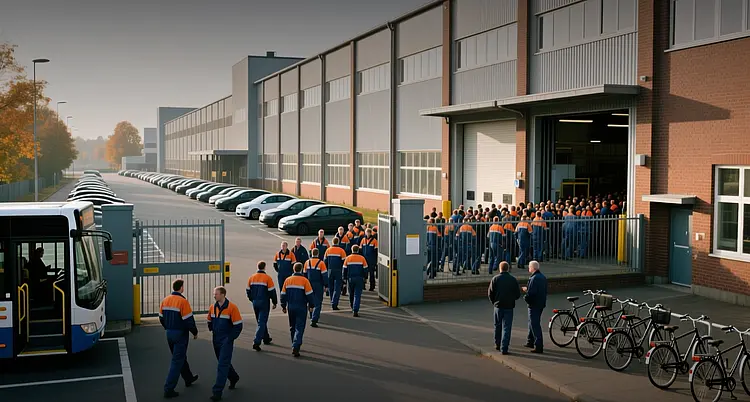
Germany's largest industrial union will sit down with employers on Oct. 7 asking for 5% more money across 3.7 million metal and electrical jobs, a claim that runs straight into the European Central Bank's December decision on whether to lift its deposit rate to 2.75%.
"We are heading into the negotiations with combative realism," IG Metall Chair Christiane Benner said in Frankfurt. "Instead of crisis rhetoric, attacks on social standards and doom-mongering, employees expect secure jobs, compensation for higher prices and a fair share of company profits."
The claim covers a 12-month term and adds profit-sharing for staff at "boom companies," protections for jobs and sites, and a demand that employers commit to Germany as a production base. Existing collective agreements expire Oct. 31, and because this round carries no post-expiry peace obligation, warning strikes are possible from Nov. 1. IG Metall mobilized about 175,000 workers in a nationwide day of action on Sept. 21 to protest planned cuts.
The stakes run through Frankfurt, not just Stuttgart. Euro-area negotiated wage growth ran at 3.3% in the second quarter, a pace the ECB reads as broadly consistent with its 2% inflation target. A German settlement at or near 5% would push that measure back up and strengthen the case for a third tightening of 2026, after two hikes already delivered this year to stop the energy shock from the Iran war from becoming embedded in prices. Economists currently expect the December move to lift the deposit rate to 2.75%.
Employers say survival, not distribution, is the issue
Gesamtmetall, the employers' association, rejected the demand outright. "For too many of our companies, their very survival is at stake," its president, Udo Dinglreiter, said, adding that cutting costs is the priority. He accused the union of ignoring the scale and depth of the industry's crisis.
The numbers behind that argument are stark. Volkswagen is cutting about 100,000 jobs globally and has warned on profit; BMW is removing roughly 8,000 positions; Robert Bosch and ZF Friedrichshafen are both shrinking. Mercedes-Benz has said German production is not competitive and has threatened to close two plants if costs do not fall. Supervisory board member Martin Brudermüller drew worker anger by suggesting a return to a 40-hour week at unchanged pay — a direct challenge to the 35-hour standard that Benner called unacceptable.
The sector is not uniformly weak, which is why the union believes it has room. Automotive and mechanical engineering are under pressure, but the electrical industry, medical technology, aerospace and other vehicle manufacturing — the last lifted by state defense spending — are performing well. "Metal and electrical is more than the automotive industry," Benner said.
Why the ECB cannot look away
Bundesbank President Joachim Nagel said Wednesday that preventing energy costs from spreading into broader inflation is essential, while noting that today's environment differs from the post-2022 period, when years of wage restraint had created room for large catch-up increases. The implication is that a 5% claim now carries less justification than the 2024 round, when IG Metall demanded 7% and won 5.1% in two steps — a deal struck when conditions across the sector were better.
The last time euro-area negotiated wages accelerated above 4%, in 2023, the ECB was still raising rates and the German 10-year Bund yield climbed toward 3%. Bund yields now sit near 3.50%, and the euro traded at about $1.139 against the dollar on Wednesday, leaving little cushion if wage data surprise higher.
The transmission is straightforward: a large German settlement lifts euro-area wage growth, keeps services inflation sticky, and locks in market pricing for a December hike. A modest outcome — or a long strike that damages output and weakens the growth outlook — would cut the other way. Either path lands on the same date. The ECB's December meeting is the decision point, and the first regional bargaining sessions on Oct. 7 are where the answer starts to form.
This article is for informational purposes only and does not constitute investment advice.