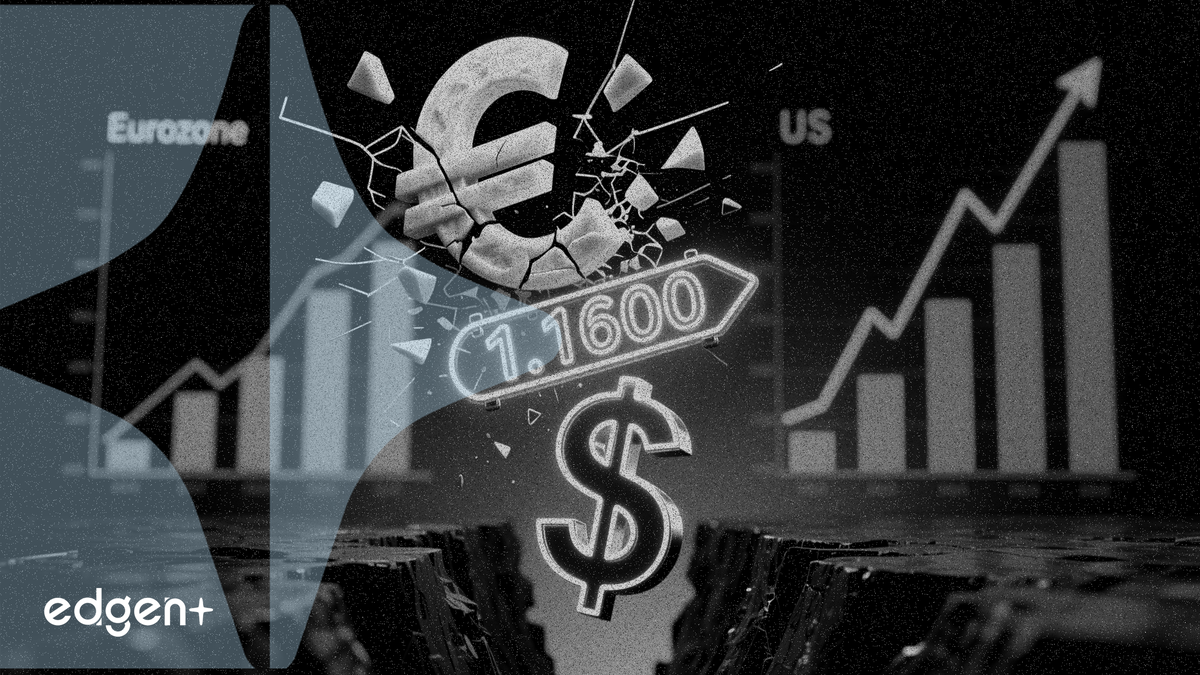
The euro's failure to hold 1.1600 marks a bearish turn as diverging economic fortunes between the US and Eurozone overwhelm the support of hawkish ECB rate expectations.
EUR/USD slipped below 1.1600 for the first time in three weeks after the US services sector accelerated to 54.5 in May while the Eurozone composite PMI sank deeper into contraction at 48.9, widening the growth chasm between the two economies. The euro traded at 1.1582 in early Asian trading on June 7, down 0.3% on the session.
"The market is increasingly pricing the growth differential rather than the rate differential," said James Knightley, chief international economist at ING. "Hiking into an energy-driven supply shock risks repeating the Trichet playbook — higher rates, weaker growth, and a currency that fails to benefit."
The US ISM services index rose to 54.5 in May from 51.6, with new orders and inventories surging as businesses front-ran potential supply disruptions. Across the Atlantic, the Eurozone composite PMI fell to 48.9, deepening its contraction after April's 49.2 reading. Citi's economic surprise indices underscore the divide: the US gauge climbed to its highest since late 2023 while the Eurozone equivalent remains mired in negative territory, indicating data consistently beats forecasts in the US and disappoints in Europe.
The breakdown threatens to accelerate toward the March swing low at 1.1412, a move that would erase the euro's gains from the past four months. With markets pricing nearly three ECB rate hikes by April 2027 — far exceeding the additional tightening expected from the Federal Reserve — the euro's inability to rally on hawkish central bank bets suggests investors are questioning whether tighter policy can support a currency in a slowing economy. The ECB's current deposit rate stands at 3.25% after the last 25-basis-point increase in March, with OIS markets pricing a full quarter-point hike at the June 18 meeting.
The divergence reflects structural advantages that extend beyond a single month of data. The US remains one of the world's largest energy producers, benefiting from abundant domestic supply and an artificial-intelligence infrastructure boom that now accounts for more than 2 percentage points of GDP in hyperscaler spending on data centers and power generation. That provides a cushion against the surge in global energy prices triggered by the Middle East conflict.
The Eurozone sits on the opposite side of that ledger. Heavily reliant on imported energy and already struggling to generate momentum before the latest jump in fuel prices, the bloc faces a stagflationary mix that leaves it more exposed to supply shocks. The European Central Bank's response — raising rates into what is primarily an energy-driven inflation spike — echoes the 2011 playbook of then-ECB President Jean-Claude Trichet, who hiked twice that year only to reverse course as the euro-area debt crisis deepened.
ECB Tightening Meets Diminishing Returns
Overnight-index-swap markets price a full 25-basis-point rate increase at the ECB's June 18 meeting and nearly three hikes by April 2027, a trajectory that exceeds the additional tightening expected from the Federal Reserve over the same period. Yet EUR/USD has failed to respond, with the pair's correlation to short-term rate differentials weakening as investors focus on growth and energy security instead.
"If the ECB hikes into a slowdown, the euro doesn't benefit — it becomes a liability," Knightley said. "You're raising rates to fight inflation that comes from oil prices, not demand. That doesn't attract capital; it repels it."
Technical Breakdown in Focus
From a chart perspective, EUR/USD continues to coil within a compression structure below 1.1670, a zone that also houses the 50-, 100- and 200-day moving averages alongside the 38.2% Fibonacci retracement of the January-March selloff. The pair tested support beneath 1.1600 in early Asian trading on June 7 after failing on multiple attempts to clear that resistance band.
The RSI (14) and MACD both confirm building downside momentum. A decisive break below the compression structure would open a path to the March swing low at 1.1412, with only minor support at the 23.6% Fibonacci retracement near 1.1450 standing in between. A failure to hold 1.1412 would mark the euro's lowest level since January.
The next major test for the pair comes with the ECB's June 18 rate decision, where a quarter-point hike is fully priced. The question is whether tighter policy can support the euro when the broader economic picture points in the opposite direction.
This article is for informational purposes only and does not constitute investment advice.