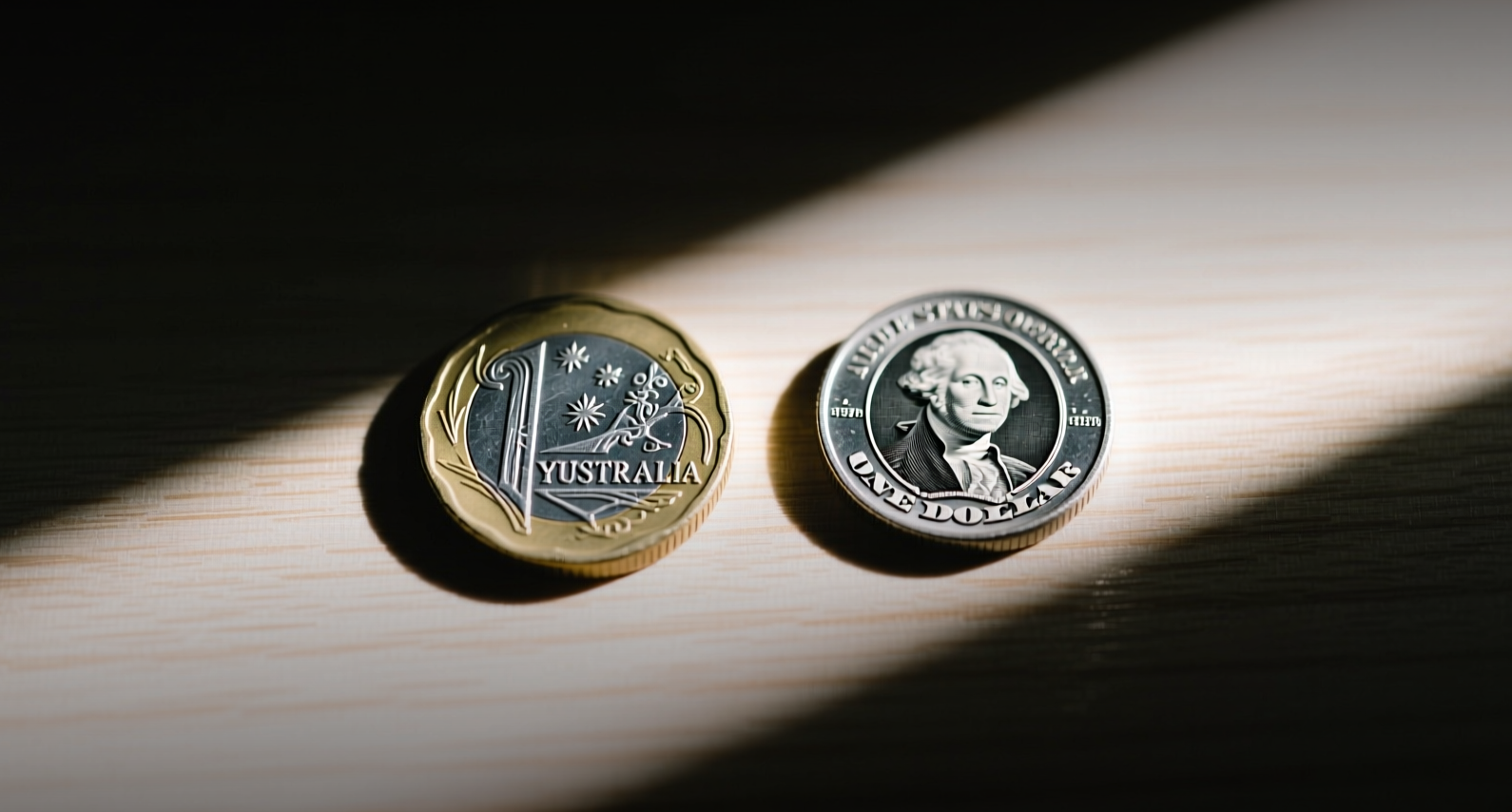
The Australian dollar faces its biggest test of the second quarter as inflation data from both sides of the Pacific will determine whether the 0.70 level holds or breaks.
The Australian dollar held near 0.7011 Friday, with traders bracing for a week that will pit Australia's monthly CPI against the US core PCE deflator — two readings that could widen or close the policy gap between the Reserve Bank of Australia and the Federal Reserve.
"The market is pricing two very different inflation trajectories, and whichever data point surprises first will dictate the near-term direction for AUD/USD," said James Okafor, macro strategist at Edgen. "A hot US PCE reading breaks 0.70. A sticky Australian CPI holds it."
The RBA held its cash rate at 4.35 percent in June after three consecutive hikes in February, March and May, while the Fed maintained its target range at 3.50 to 3.75 percent but shifted its dot plot to signal a potential hike by year-end. The interest rate differential between the two central banks has narrowed to 60 basis points, down from 85 basis points in March, and could compress further if the Fed tightens while the RBA pauses.
The stakes are binary. If Australian CPI prints above the 3.4 percent consensus, the RBA's pause looks temporary and the AUD holds support. If US core PCE exceeds the 2.7 percent forecast, the dollar strengthens and AUD/USD breaks below 0.70 for the first time since April. The next RBA meeting is Aug. 4; the Fed meets July 28-29.
Australia's monthly CPI indicator, due Wednesday, will be the first major data point since the RBA's June hold. The central bank's own forecasts show inflation returning to the 2-3 percent target band by late 2027, but fuel and commodity costs tied to Middle East tensions have kept price pressures elevated. The jobs-to-applicants ratio improved in May, though consumer confidence remained weak — a mixed signal that gives Governor Michele Bullock room to hold without committing to a peak.
The US core PCE deflator, the Fed's preferred inflation gauge, lands Thursday alongside the final reading of first-quarter GDP. Markets are pricing a 42 percent probability of a hike by December, according to CME FedWatch, up from 18 percent in May. Goldman Sachs pushed its next expected cut to 2027, while Citi now forecasts reductions in October and December 2026. Standard Chartered expects the Fed to hold through year-end before delivering a single 25-basis-point cut in the first half of 2027.
Rate Differentials Narrow to 60bps
The compression in the Australia-US rate differential has been the dominant driver of AUD/USD this quarter. The pair traded above 0.72 in April when the RBA was actively hiking and the Fed was still signaling cuts. That gap has since narrowed as the Fed turned hawkish and the RBA indicated a potential end to its tightening cycle.
Technically, the pair is testing the 20-day simple moving average near 0.7091 from below, with the relative strength index at 37 — below the neutral 50 — suggesting bearish momentum. Support sits at 0.6963, with a break below that opening a path to the 200-day SMA at 0.6852. The average directional index near 31 indicates the current trend is gaining strength rather than fading.
The last time the rate differential compressed to current levels was in October 2025, when AUD/USD fell from 0.69 to 0.66 over six weeks as the Fed held firm and the RBA cut rates. A repeat of that move would put 0.66 in play by September if both inflation prints surprise to the upside in the US and downside in Australia.
China Adds a Third Variable
The Australian dollar's sensitivity to Chinese data adds another layer of uncertainty. The People's Bank of China is due to set its one-year loan prime rate next week, with markets expecting a hold after the economy showed mixed signals in May. Industrial output rose 6.2 percent year-over-year, beating estimates, but consumer spending remained subdued. A PBoC cut would support iron ore demand and, by extension, the AUD; a hold would leave the currency exposed to the US-driven narrative.
For Australian investors, the implications extend beyond FX. A sustained break below 0.70 would boost AUD-denominated earnings for resource exporters such as BHP Group and Rio Tinto, which sell in US dollars and report in Australian dollars. Conversely, it would raise import costs for retailers and consumer discretionary names already squeezed by 4.35 percent domestic rates.
This article is for informational purposes only and does not constitute investment advice.