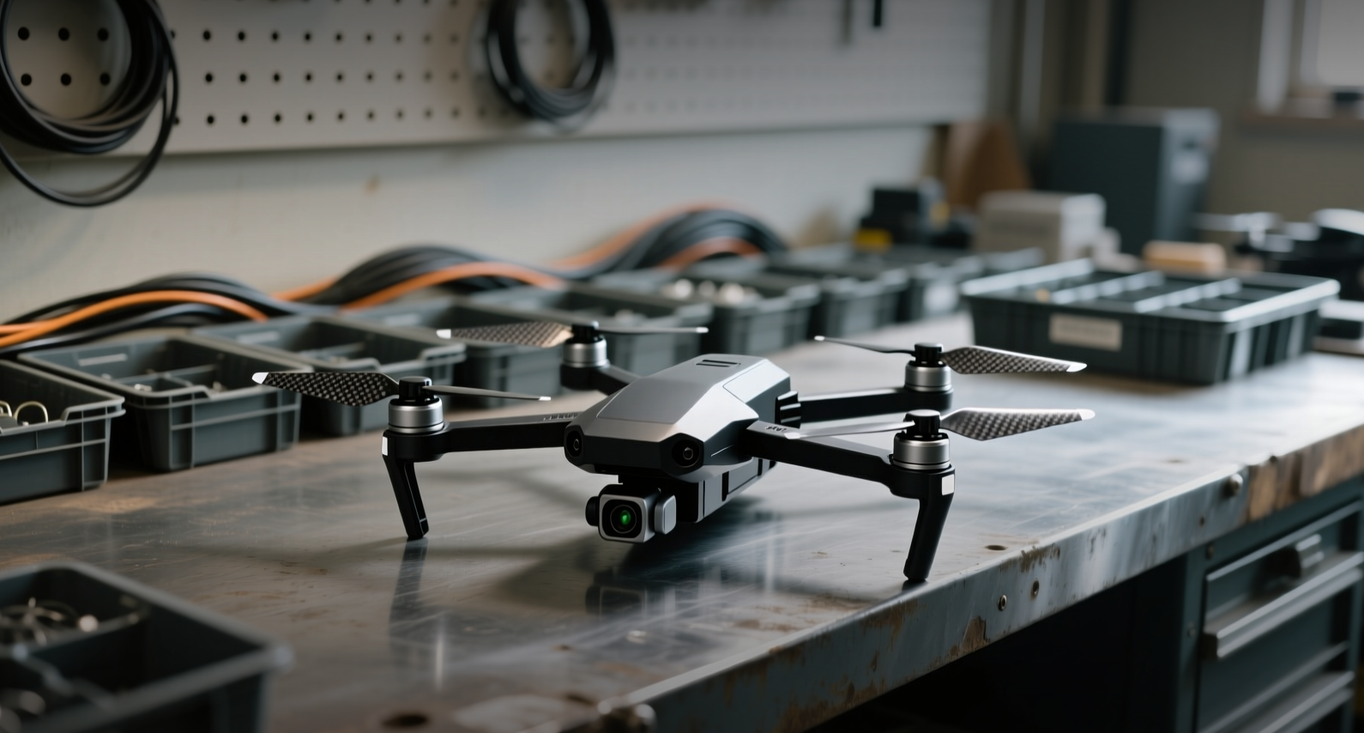
XTEND AI Robotics advanced to Phase III of U.S. Special Operations Command's Modular Kinetic Lethal Drone program, a development milestone that lands days after the company placed third in the close-quarters battle segment of the Pentagon's $1 billion Drone Dominance Program.
The award, announced Sept. 23, 2026, covers a modular, recoverable and reusable precision-strike capability built around three XTEND airframes — Striker, Scorpio 500 and Scorpio 1000 — tied together by a common Ground Control Station and the company's XOS operating system. USSOCOM has not disclosed the dollar value of the Phase III tranche.
"Phase III is an important milestone in our continued work with the U.S. Special Operations community," Aviv Shapira, chief executive and co-founder of XTEND, said. "Our focus is on giving Warfighters adaptable robotic capabilities that extend their reach and effectiveness while shifting risk from the operator to unmanned systems."
The two programs measure different things. MKLD is a development track: Phase III matures a capability that has already absorbed prior USSOCOM investment, testing and operational feedback, with no guarantee of a production order. Drone Dominance is a procurement funnel. XTEND delivered and demonstrated 120 STRIKER systems at Fort Carson, Colorado, on Sept. 16, scoring 80.2 in the close-quarters battle category and finishing behind Neros and Orqa US on a leaderboard that also included Vector and ModalAI.
That placement matters more than the podium. The Department of War selected 10 companies as Gauntlet II finalists for prototype contracts and plans to buy roughly 60,000 drones from the resulting vendor pool. XTEND is one of a handful of vendors positioned in both a special-operations development program and the conventional-force buying pipeline — a combination that gives it two independent routes to revenue rather than a single award to defend.
XOS is the connective tissue. The operating system is designed for confined, complex and GNSS-denied environments where GPS is jammed or unavailable, a requirement set that has moved from niche to baseline as electronic warfare has spread across the battlefield in Ukraine. The same software stack now spans the STRIKER drone family and XTEND's AtlasROVER ground robots, which means each new platform win amortizes development spending across a wider installed base.
The competitive field is crowded and mostly private. Neros, Orqa US, Vector and ModalAI all finished in the top five at Gauntlet II, and each is chasing the same prototype contracts. XTEND's differentiator is the listed-company structure: it trades on the New York Stock Exchange under the ticker XTND, giving public-market investors direct exposure to a segment where most rivals remain venture-backed and opaque.
That structure cuts both ways. XTEND AI Robotics operates two distinct businesses — the defense robotics unit through subsidiary XTEND Reality Expansion Ltd., and a commercial and residential construction arm through JFB Construction Holdings. The company has said it intends to apply its drone technology to jobsite security, land surveying and building inspections on JFB projects, and to use JFB's construction expertise to lower the cost of its U.S. manufacturing expansion. Investors buying XTND for the defense thesis are also holding a homebuilder.
The forward catalysts are concrete. Gauntlet II finalists are competing for prototype awards that are not guaranteed, and the 60,000-drone procurement will be allocated across the vendor pool rather than to a single supplier. MKLD Phase III must still convert into production orders for the special-operations work to register in revenue. XTEND's next disclosure on program revenue and backlog will show whether the two selections are translating into contracted dollars or remain, for now, positioning.
This article is for informational purposes only and does not constitute investment advice.