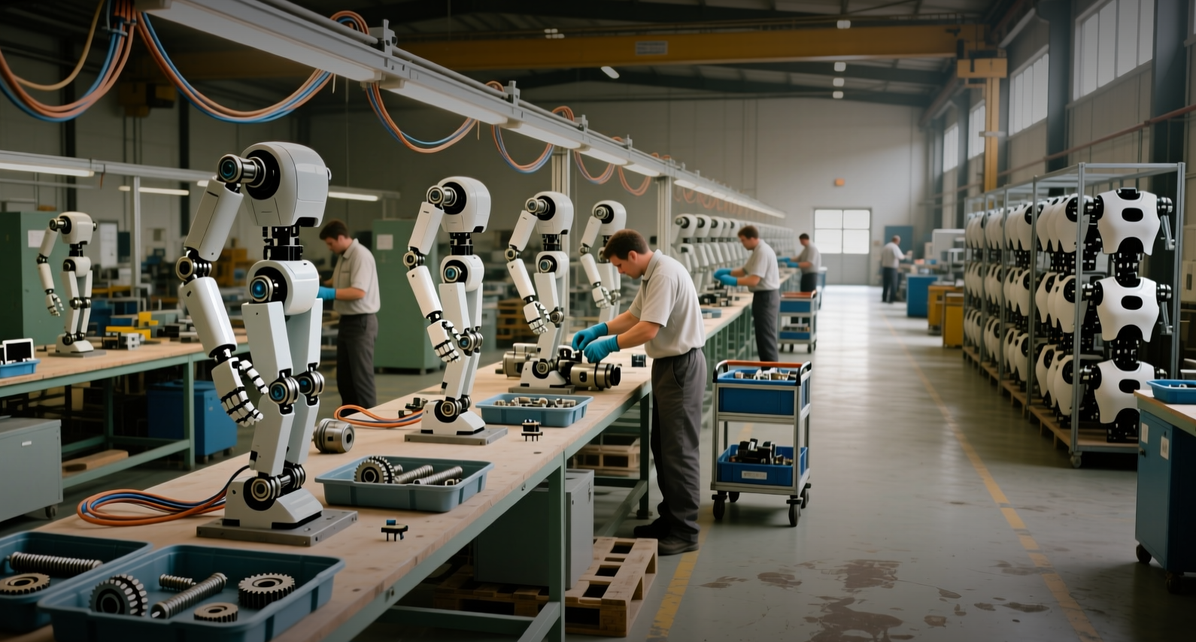
XPeng has cleared the qualification stage of its humanoid robot buildout, locking in a defined vendor chain for actuators, dexterous hands, sensors and AI chips. The Guangzhou-based automaker convened its first robot supply chain partner conference on Sept. 22, drawing suppliers across those four component categories, The Paper reported, citing people familiar with the arrangements.
The designations matter because they convert a research program into a procurement schedule. In humanoid robots, actuators and dexterous hands account for the majority of bill-of-materials cost, and a supplier that passes a factory audit typically holds its slot through the first production run. XPeng did not disclose the names of the designated vendors, the number of suppliers per component category, or the volume commitments attached to the designations.
"Supplier designation is the point where a robot program stops being a demo and starts being a manufacturing plan," said Lian Jie, a senior analyst covering China's automation supply chain at a Shenzhen-based brokerage. "The audit is the gate. Once you pass it, you are tooling up."
The overlap with Tesla is the part investors are trading. Tesla's robot team has separately visited Chinese supply chain companies for factory audits, and sources indicated the two programs share a relatively high degree of overlap at the core supplier level, according to the same report. Tesla has begun auditing suppliers across the Yangtze River Delta as it pushes its third-generation Optimus toward volume manufacturing, The Paper reported on Sept. 21, naming Tuopu Group (601689), Sanhua Intelligent Controls (002050) and Joyson Electronics (600699) as companies under review. Those three make joint modules, actuators and precision structural components, and each had already received Optimus orders of varying volumes before the audits began, per the report.
That overlap cuts both ways. A component maker qualified for both programs spreads its tooling and engineering costs across two customers, which compresses unit economics for everyone. It also means XPeng and Tesla are competing for the same constrained capacity in harmonic reducers, planetary roller screws and force-torque sensors — the parts where Chinese suppliers currently hold the deepest cost advantage.
Why the vendor conference is the real signal
A first-ever partner conference is an operational milestone, not a marketing one. Automakers hold supplier days when they need vendors to commit capital to capacity ahead of orders. XPeng's decision to gather actuator, dexterous hand, sensor and AI chip suppliers in one room implies the company is preparing to place volume purchase orders rather than sample requests.
The component list itself is a roadmap. Actuators determine joint torque and payload; dexterous hands set manipulation capability and are the single hardest subsystem to manufacture at cost; sensors cover force feedback and vision; AI chips handle on-robot inference. Each category has a different supplier base and a different qualification timeline, which is why designations are announced as a group rather than sequentially.
For scale calibration, Tesla has said it plans to build several thousand Optimus units this year, with the third-generation model described as its first designed for volume manufacturing. The Paper put Tesla's long-term per-unit cost target at $20,000 to $30,000 and reported that the company converted its former Model S/X production line into a dedicated Optimus line planned for 1 million units per year, with a second line at the Texas Gigafactory prepared for a long-term designed 10 million units annually. Tesla has not confirmed the audits, the order volumes or the capacity figures.
XPeng has not published a comparable unit target or cost curve for its robot program. That gap is the central unknown: without a disclosed volume plan, the designated suppliers cannot be valued on robot revenue, only on optionality.
The short sellers are not convinced
Positioning around the story is contested. Short selling in XPENG-W (09868.HK) totaled US$44.93 million as of 12:25 on Sept. 22, equal to 38.104% of turnover in the stock, according to AASTOCKS data. The shares traded at HK$40.72, up HK$0.24 or 0.593%, on a session where the short ratio sat well above the levels typically seen in large-cap Hong Kong industrials.
A 38% short ratio on a single session is not a verdict on the robot program — it reflects hedging, index activity and directional bets mixed together. But it does show that the market is not paying a uniform robotics premium for XPeng. The bull case rests on the supplier designations converting into disclosed orders; the bear case rests on the absence of any volume, cost or revenue guidance attached to them.
The next checkpoints are concrete. Investors should watch whether XPeng names its designated suppliers and attaches order volumes, whether Tesla confirms its own audit program or announces the formal start of Optimus mass production, and whether the shared vendors disclose robot-related revenue in their next quarterly filings. Until at least one of those lands, the humanoid supply chain trade in Hong Kong and Shenzhen is being priced on conference invitations and audit visits rather than on purchase orders.
This article is for informational purposes only and does not constitute investment advice.