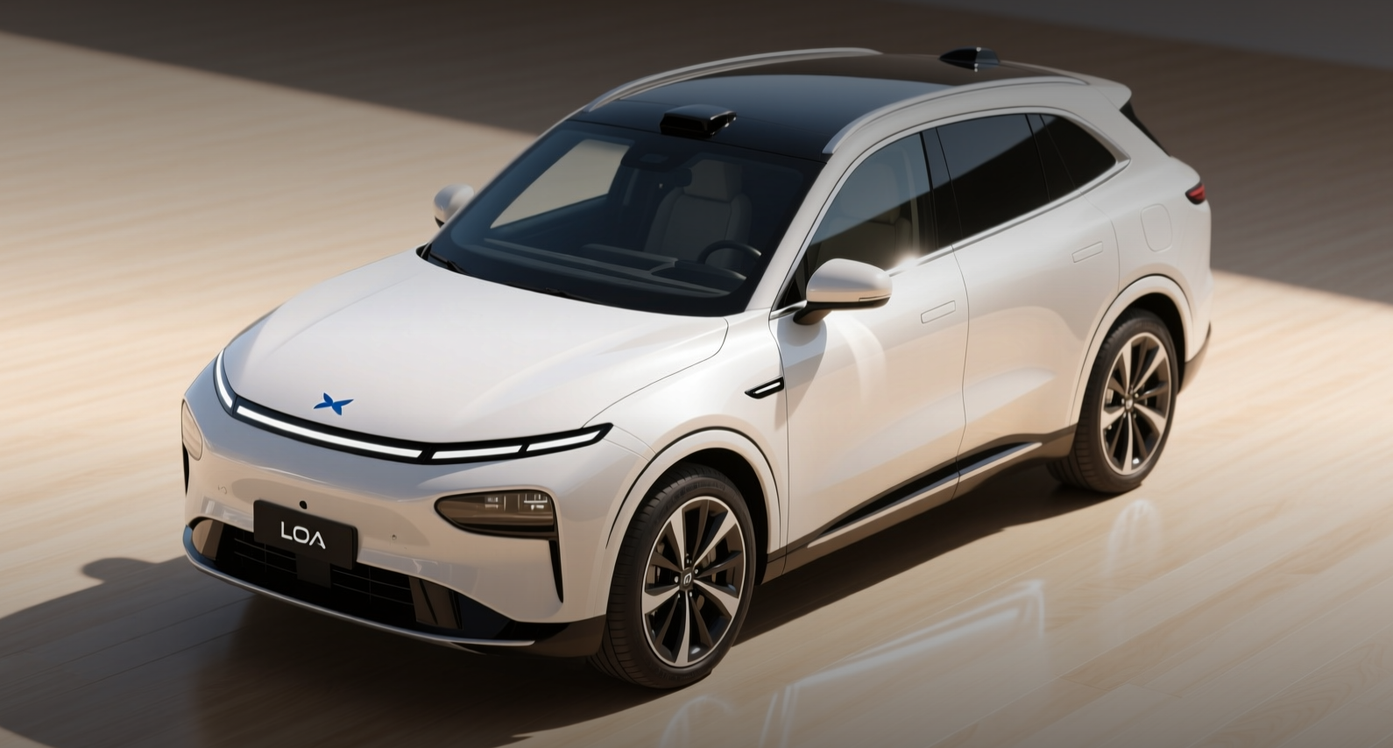
XPENG's MONA L03 brings flagship-level autonomous driving hardware to the mass-market SUV segment at a starting price of RMB 143,800.
XPENG's MONA L03, the first SUV in its mass-market MONA series, opened pre-sales at RMB 143,800 ($21,200) with an in-house Turing AI chip delivering up to 1,500 TOPS of compute power — performance typically found in vehicles costing twice as much.
"The L03 is young people's first smart and stylish SUV," XPENG said at the Beijing launch event on July 2, positioning the model to replicate the M03 sedan's dominance in the RMB 100,000-200,000 segment.
The L03 is available in six variants spanning pure electric and extended-range powertrains. The BEV versions offer CLTC ranges of 525 km and 625 km with power consumption of 11.9 kWh per 100 km and 3C fast charging from 10% to 80% in 19.1 minutes. The EREV version delivers a combined 1,330 km range with 315 km on electric-only power and WLTC combined fuel consumption of 5.16 liters per 100 km. Both powertrains accelerate from 0 to 100 km/h in 6.6 seconds (BEV) and 6.8 seconds (EREV).
The L03 arrives as XPENG's sales recover — 40,126 vehicles delivered in June, up 15.93 percent year-on-year, ending five consecutive months of declines. But the M03 sedan, which accounted for 40.91 percent of XPENG's 2025 deliveries with 175,689 units, has seen momentum fade: cumulative deliveries in the first five months of 2026 reached 48,291, down 33.15 percent from a year earlier. The L03 must fill that gap while competing against BYD's Yuan Plus and Song Pro, Li Auto's L6, and NIO's Onvo L60 in China's most contested price bracket.
Turing AI chip as a differentiator
The entire L03 lineup carries XPENG's self-developed Turing AI chip, a strategic move that brings advanced driver-assistance hardware to a price point where rivals typically offer less capable systems. The Max versions use a single Turing chip with 750 TOPS and a distilled version of XPENG's second-generation Vision-Language-Action (VLA) system, rolling out in the third quarter. The Ultra SE versions pack dual chips delivering 1,500 TOPS with the full VLA system, enabling handling of narrow urban roads, campus lanes, and poor weather conditions — capabilities usually reserved for vehicles above RMB 250,000.
Standard safety equipment includes automatic emergency braking at up to 150 km/h, automatic emergency steering at up to 130 km/h, and seven airbags. The vehicle is designed to meet five-star safety standards for China, Europe, and Australia.
Design and interior specs
Designed by a global team led by JuanMa Lopez, a former Ferrari exterior designer, the L03 achieves a drag coefficient of Cd 0.228 — among the lowest for a production SUV. The coupe-SUV profile measures 4,650 mm in length, 1,920 mm in width, and 1,600 mm in height on a 2,850 mm wheelbase.
Inside, the cabin features a 26.8-inch head-up display, a 15.6-inch 2.5K central touchscreen, and a 20-speaker AI-enhanced audio system. Cargo capacity reaches 539 liters standard and 1,640 liters with the rear seats folded, plus a 102-liter front trunk. A ROAM special edition developed with brand ambassador Ouyang Nana targets younger buyers.
XPENG will hold the global launch in Munich, Germany, on July 16, with sales beginning in 64 countries and regions worldwide in 2026.
XPENG shares traded at HK$50.85 on the Hong Kong Stock Exchange on July 3, down 1.74 percent. The stock has declined about 30 percent year-to-date as the company navigates the price war that has compressed margins across China's EV industry. BYD, Li Auto, and NIO have all cut prices on competing models in recent months, raising the stakes for the L03's commercial performance. If the L03 can sustain the M03's early sales trajectory, it could help XPENG regain the delivery growth that investors have been pricing in a recovery premium for.
This article is for informational purposes only and does not constitute investment advice.