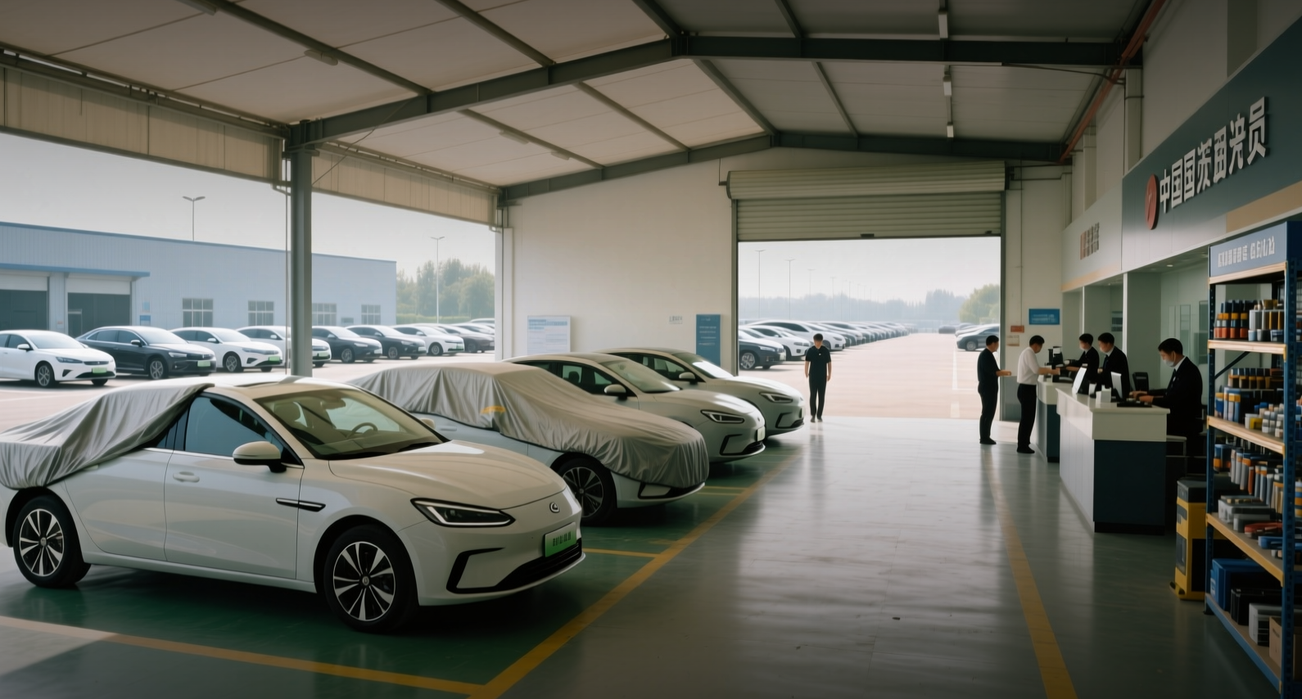
Xiaomi Corp. will begin nationwide deliveries of its Pengcheng model on Sept. 11 across 75 Chinese cities, a fulfillment test for an EV division that lost RMB3.1 billion ($430 million) in the first quarter and now has to prove volume can carry its fixed costs.
"Xiaomi Pengcheng national deliveries begin tomorrow, covering 75 cities nationwide," Chairman Lei Jun said in a Sept. 10 statement. The company did not disclose the number of vehicles staged for delivery, the model's starting price, or the split between the Pengcheng and its existing SU7 sedan and YU7 SUV lines.
The 75-city footprint is the widest launch Xiaomi has attempted. Its first car, the SU7 sedan, arrived on March 28, 2024, and the YU7 SUV followed on June 26, 2025, drawing roughly 300,000 lock-in orders in 72 hours and selling out into 2027. Xiaomi delivered about 411,837 vehicles in 2025, beating a raised 350,000-unit target more than a month early, and crossed 600,000 cumulative deliveries in February 2026, 22 months after its first handover. The first half of 2026 added 185,055 units, leaving roughly 365,000 to go against the company's 550,000-unit full-year goal.
The margin arithmetic is the harder problem. Xiaomi's EV and AI segment swung to a RMB3.1 billion operating loss in the first quarter of 2026, about RMB5,600 per car, after fewer high-margin SU7 Ultra sales and rising input costs. EV gross margin was 20.1% in the quarter, down from the level that let the division post its first full-year operating profit of roughly RMB900 million in 2025, when auto revenue topped RMB100 billion for the first time. A model priced below the SU7 Ultra mix dilutes margin further unless volume absorbs it.
The price war sets the benchmark
Xiaomi is launching into a market where peers are already scaling. NIO delivered a record 40,597 vehicles in June 2026 and 107,658 in the second quarter, with first-quarter revenue of RMB25.5 billion, up 112% year over year, an 18.8% vehicle margin and a first positive operating profit of RMB66.8 million. XPeng delivered 429,445 vehicles in 2025, up 125.9%, and 40,126 in June 2026, though it posted a RMB1.78 billion net loss in the first quarter on a 20.6% gross margin. Zeekr's June deliveries rose 110.6% to 35,169, and its first-half total of 178,370 was up 96.6%.
Li Auto is the cautionary case. It delivered 406,343 vehicles in 2025, down 18.8%, swung to a RMB2.3 billion net loss in the first quarter of 2026 and saw gross margin collapse to 7.9% as extended-range competition intensified and its battery-electric transition dragged. Li Auto's 2026 target of about 550,000 units is almost identical to Xiaomi's, putting the two directly against each other for the same buyers.
Capacity is not the constraint. Xiaomi builds at a two-phase Beijing plant rated for roughly 300,000 vehicles a year, with a Beijing Phase 3 site and a planned Wuhan factory pushing toward more than 1 million units of annual capacity. The company has also secured regulatory approval to build extended-range electric vehicles, the gasoline-backed format that powered Li Auto's rise and remains the fastest-growing segment in China's new-energy market. Xiaomi has confirmed a 2027 European entry starting with Germany.
What the ramp has to prove
The Pengcheng launch matters less as a product event than as a test of whether Xiaomi's order book converts into delivered, revenue-recognized units at a cost per car that stops bleeding. Xiaomi's December 2025 monthly record of more than 50,000 units shows the plant can run at that pace; sustaining it across 75 cities requires a distribution and service network the company has been building for less than three years.
For investors, the read-through runs in two directions. Xiaomi shares on HKEX (1810.HK) carry the EV division as an option on a hardware business that already sells phones and connected devices at scale, so a clean delivery ramp supports the case that the segment returns to profit in 2026. A miss on the 550,000-unit target, or another quarter of per-car losses near RMB5,600, would put the segment back in the same bucket as Li Auto's margin collapse. The next hard datapoint is Xiaomi's third-quarter delivery and segment-margin disclosure, which will cover the first weeks of Pengcheng handovers.
This article is for informational purposes only and does not constitute investment advice.