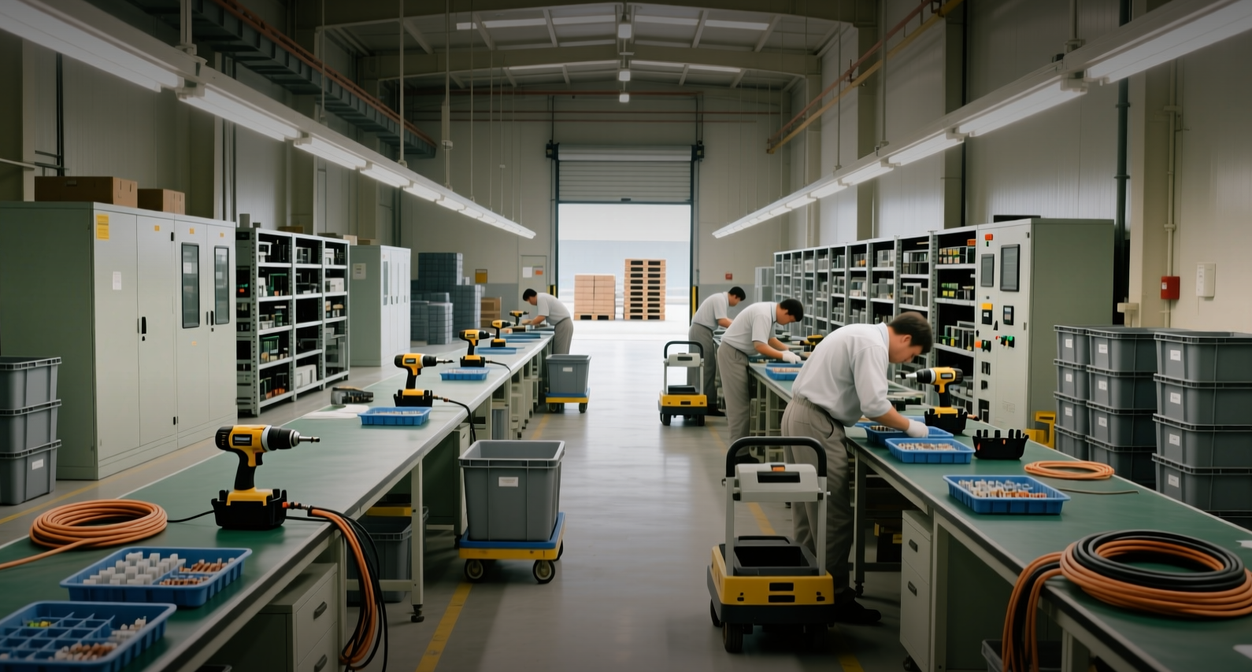
President Xi Jinping told a national conference in Beijing that China must keep expanding advanced manufacturing and raise the "autonomous and controllable" level of its industrial chains, an instruction that directs state credit and policy support toward automation, robotics and semiconductor equipment makers.
"Efforts should be made to ensure both high-quality development and greater security, pursue smart, green and integrated development, and make the country's industrial chains more self-supporting and risk-resilient," Xi said in the instruction, conveyed at the National Advanced Manufacturing Conference held in Beijing on Sept. 16 and 17, according to Xinhua.
The instruction, Xi's most explicit manufacturing directive since the conference cycle began, sets the policy frame for the fourth quarter. Premier Li Qiang told the same gathering that China should focus on next-generation intelligent manufacturing, accelerate digital and AI-driven industrial upgrades, and strengthen its push for indigenous high-end technologies. Beijing has spent several years shifting credit and resources out of property and into advanced manufacturing to build technological self-reliance, a reallocation that has lifted industrial output without yet producing stronger household incomes or consumption.
The transmission channel runs through state-directed credit rather than interest rates. Policy banks and the central bank's structural lending facilities have been the primary vehicles for funding manufacturing upgrades, which is why the instruction matters more for sector-level capital allocation than for the benchmark loan prime rate. The People's Bank of China has held the 1-year loan prime rate at 3.0 percent and the 5-year at 3.5 percent since May 2025, leaving targeted credit tools as the main lever for steering funds toward the equipment and automation supply chain.
Robotics and chip equipment sit at the center of the mandate
The phrase "autonomous and controllable" has become the operative test for which companies receive preferential treatment. In practice it favors domestic suppliers of industrial robots, machine vision, high-end CNC tools and semiconductor manufacturing equipment — the segments where China remains most exposed to foreign technology restrictions. The United States has kept curbs on exports of the most advanced AI chips to China, and Washington has separately restricted sales of advanced semiconductor manufacturing tools, constraints that give the self-sufficiency language immediate operational weight.
The demand-side case for the export leg of the story is already being marked up. Daiwa forecast that BYD's overseas sales will reach 1.8 million vehicles in 2026 and 2.5 million in 2027, a trajectory that depends on the same domestic supply chain the policy is designed to deepen. BYD's export volumes have become the clearest single gauge of whether Chinese manufacturing capacity can be absorbed abroad as domestic price competition compresses margins.
The last time Beijing used language this explicit about industrial-chain control was at the 2023 Central Economic Work Conference, which named "new productive forces" as the priority for the following year. Industrial automation and semiconductor equipment indices on the A-share market outperformed the CSI 300 over the subsequent two quarters before giving back gains as earnings failed to keep pace with the policy narrative. That pattern is the key risk for investors positioning on this instruction: policy language moves valuations faster than order books move revenue.
What the instruction changes for positioning
For global investors, the practical read is that the policy bias now favors domestic substitution over import-dependent capacity. Companies with a high share of locally sourced components, and those selling into state-backed upgrade programs, are structurally advantaged relative to peers reliant on foreign tooling. The European Commission's concern about a second wave of Chinese export competition in electric vehicles and green technology is the external mirror of the same policy: capacity built for self-sufficiency also produces surplus for export.
The next checkpoints are the Politburo's December economic work meeting, which typically converts conference language into budgeted priorities, and the March National People's Congress session, where the manufacturing upgrade programs receive their funding lines. Between those dates, quarterly industrial profit data from the National Bureau of Statistics will show whether the credit already directed into advanced manufacturing is translating into margins or merely into capacity.
This article is for informational purposes only and does not constitute investment advice.