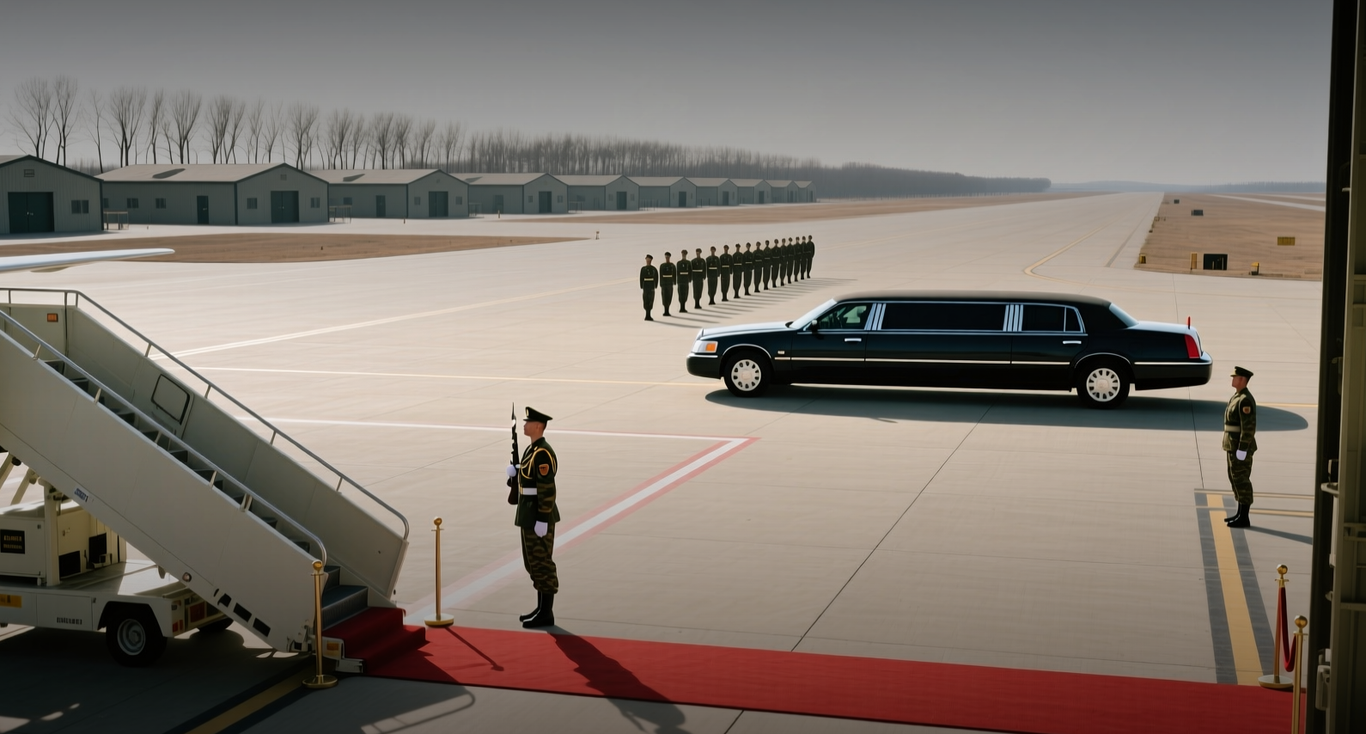
Chinese President Xi Jinping arrived at Joint Base Andrews on Wednesday for a three-day state visit, opening the first Washington summit with a US president since 2015 and putting a proposed $30 billion mutual tariff-reduction framework at the center of talks that carry a November deadline.
"The idea that we would not interact with them at the highest levels is irresponsible. It's outrageous. We have to," Secretary of State Marco Rubio told reporters in New York on Wednesday, defending the engagement as necessary between "the two largest economies in the world."
Trump and first lady Melania Trump traveled by Marine One to the Maryland air base to greet Xi and his wife, Peng Liyuan, a planeside reception that US presidents rarely extend to visiting leaders. The gesture reciprocates Trump's May trip to Beijing, where Vice President Han Zheng met Air Force One instead. A formal arrival ceremony, troop review and black-tie state dinner in the East Room follow on Thursday, with a guest list that includes Nvidia's Jensen Huang, Tesla's Elon Musk, Apple's Tim Cook, Amazon's Jeff Bezos, OpenAI's Sam Altman and Google's Sundar Pichai.
The substance is narrower than the ceremony. Chinese Vice Premier He Lifeng has led a trade delegation through preliminary consultations in Washington, and negotiators are working toward a framework covering roughly $30 billion of goods in mutual tariff reductions. Both sides are pressing to extend the tariff truce struck in Busan, which lapses in November 2026 — the same month the US-China trade agreement reached last year expires. Beijing wants energy and rare earth supply guarantees; Washington wants to shield domestic manufacturers from Chinese surplus capacity without reigniting inflation ahead of the midterm elections.
Rare earths, LNG and a $14 billion Taiwan chip
Specific deliverables under discussion include increased Chinese purchases of US liquefied natural gas, agricultural products and aircraft, plus export licenses for rare earth minerals. Negotiators have also floated allowing Chinese electric vehicle factories to be built on US soil, subject to national security conditions. On the technology side, the agenda covers AI regulation and export controls on advanced semiconductors — the issue that drew the sharpest domestic pushback.
Senate Democratic leader Chuck Schumer and three colleagues held a press conference warning against loosening controls on advanced chipmaking equipment, arguing it would erode the US lead in artificial intelligence. "We can and must both maintain our lead on AI by restricting China's access to our technology and put up guardrails to mitigate AI's risk," Schumer said. Republican senators Mitch McConnell and three others sent a letter urging the administration to proceed with aid and arms sales to Taiwan, noting the US paused a record $14 billion package after the May Beijing summit — a package Trump has described as a "very good negotiating chip."
The domestic criticism has been loud enough to constrain the outcome. Senator Roger Wicker, the Republican chairman of the Senate Armed Services Committee, said on the Senate floor Tuesday that he would have advised against inviting Xi at all "based on all of the troubling issues we have with President Xi and the Chinese Communist Party," adding that "during every minute of dialogue, our commander in chief should keep in mind that his guest is a brutal, unelected, and oppressive dictator."
Iran sits underneath the trade file. Washington has accused Beijing of propping up Tehran's economy and supplying components and intelligence, and wants China — the largest buyer of Iranian oil — to press its leverage. Iranian Foreign Minister Abbas Araqchi visited Beijing on September 16 to signal Tehran's willingness to return to diplomacy, days before Xi's departure.
The precedent for reading this summit is the May meeting in Beijing, which produced a pause in Taiwan arms sales and no tariff relief. Markets have historically traded the ceremony rather than the communiqué: after the Busan truce was announced, the tariff-sensitive complex rallied on the headline and gave back part of the move once the terms were published. The same asymmetry applies now. If Thursday's closed-door session yields a signed framework on the $30 billion basket and a Busan extension, the de-escalation trade has room to run into November. If it produces only a commitment to keep talking, the November expiry becomes a live risk event with no cushion — and the $14 billion Taiwan package remains the most obvious lever either side can pull.
This article is for informational purposes only and does not constitute investment advice.