
Key Takeaways: The Canadian dollar weakened to its lowest level in six months as Brent crude fell through the $90-a-barrel threshold, a dual move reflecting diverging demand expectations and supply risks.
Key Takeaways: The Canadian dollar weakened to its lowest level in six months as Brent crude fell through the $90-a-barrel threshold, a dual move reflecting diverging demand expectations and supply risks.
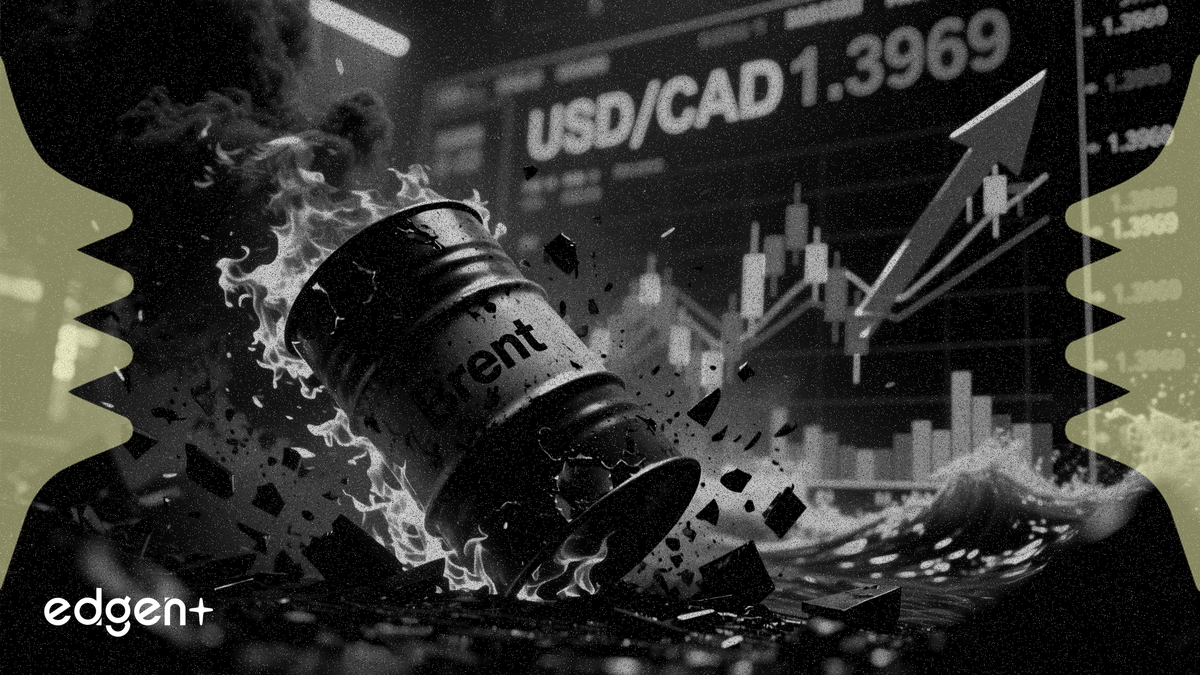
USD/CAD climbed to 1.3969 on Monday, the highest since December 2025, as Brent crude slid below $90 a barrel for the first time in three months on demand concerns from China and shifting supply expectations tied to the Strait of Hormuz blockade.
"The oil market may be underpricing near- and medium-term risks, with weeks of enforced well shut-ins threatening irreversible damage to production capacity," CITIC Securities said in a note, warning that pricing power has shifted to the Middle East and that low US drilling levels mean the country cannot step in to compensate.
The loonie's decline accelerated as Canada's commodity-linked currency tracked crude lower. Brent fell more than 4% to trade below $90, extending a slide from last week's $94.25 close. China's seaborne crude imports fell to 6.36 million barrels a day in May, the weakest level in nearly a decade, according to Reuters. Goldman Sachs estimated global crude oil demand has fallen 4% to 5%, with 4 million to 5 million barrels a day lost in April alone because of the Hormuz disruption.
The breakdown below $90 threatens to squeeze Canadian energy producers already facing margin pressure from a stronger dollar. For the Federal Reserve, a sustained decline in crude would remove a key inflation headwind and potentially accelerate the timeline for rate cuts — a scenario that would likely widen the USD/CAD divergence further, with the pair testing the 1.40 level.
The divergence between physical tightness and falling spot prices has created what analysts describe as two-way risk. US crude stockpiles, including the Strategic Petroleum Reserve, have fallen to about 1.5 billion barrels, the lowest since 2004, while stocks at Cushing, Oklahoma, have dropped to 22.4 million barrels — near the 20 million minimum needed for efficient operations, Reuters reported. The International Energy Agency has warned that inventories could hit critical levels before peak summer demand arrives, and that reopening the Strait of Hormuz would take six to eight months even if a resolution is reached.
"The turning point could be when someone really needs those physical molecules and the physical molecules just aren't there to buy," Tom Baker, managing director for Bahrain at commodity trading house Vitol, told the S&P Global Energy Middle East Petroleum and Gas Conference on June 2.
For Canada, the world's fourth-largest oil producer, the weaker loonie provides some buffer for exporters receiving US-dollar-denominated revenue. But a sustained crude price below $90 would compress margins for oil sands producers, whose breakeven costs have risen with inflation. The S&P/TSX energy sector fell as much as 2.5% in early trading, while the broader index declined 0.8%.
The selloff in crude added to a broader risk-off tone across Asian markets. Japan's Nikkei 225 fell more than 2,600 points on Monday, breaking below the 64,000 level, as AI-related stocks were sold off following a 4% decline in the Nasdaq on Friday. The stronger US dollar, supported by robust May nonfarm payroll data, has added pressure on commodity-linked currencies across the board.
The Federal Reserve's next policy decision on July 29 will be closely watched. Vanguard senior economist Adam Schickling has estimated that crude holding near $120 for a year would cost the US economy about 0.4 percentage points in growth. A move below $90, by contrast, would ease inflation pressures and potentially accelerate the timeline for rate cuts that markets have been anticipating.
This article is for informational purposes only and does not constitute investment advice.
