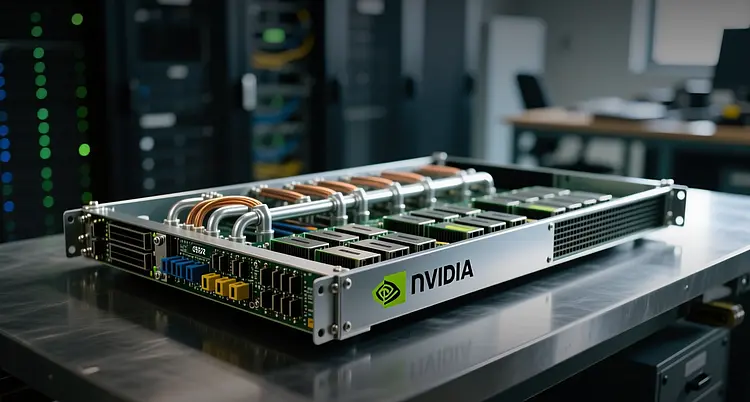
Morgan Stanley raised its estimate of the US data center power shortfall to 57 gigawatts for 2026 through 2028, a roughly 50% increase from its prior 38GW figure, after the industry's shift to 72-GPU rack architectures reset per-rack power assumptions.
The revision is not a demand forecast change so much as a physics change. Moving from eight-GPU servers to Nvidia's NVL72 rack format means each unit now integrates high-speed interconnect, memory, liquid cooling and power management alongside the accelerators, so rack draw scales faster than chip count. Morgan Stanley analysts lifted their per-rack IT power estimates accordingly: Vera Rubin from 149 kilowatts to 234kW, Rubin Ultra from 415kW to 600kW, and Feynman to 1,100kW. Those assumptions pushed the bank's 2027 and 2028 US power demand forecasts up 38% and 69% respectively.
"Any 'fast power' provider that can deliver electricity to data center developers in 2027 to 2028 will be able to sign highly attractive contracts," the analysts wrote, adding that the urgency with which AI players are competing for power "far exceeds market recognition."
The arithmetic behind the 57GW figure is a subtraction problem. Cumulative US data center power demand for the three-year window totals 97GW. Against that sit 21GW from data centers already under construction and 19GW of available grid capacity, leaving 57GW uncovered before any solution is counted. Morgan Stanley's low, base and high scenarios put the net gap at 42GW, 33GW and zero; the 33GW base case, which the analysts call the most likely outcome, equals 34% of US data center power demand over the period. In their framing, the shortfall is equivalent to the basic electricity consumption of six New York Cities.
Behind-the-meter gas and fuel cells close 24GW of the gap
The bank credits "fast power" — generation that bypasses the interconnection queue — with a probability-weighted 24GW, cutting the gross 57GW hole to the 33GW net figure. Behind-the-meter gas turbines and reciprocating engines account for 19GW of that, Bloom Energy fuel cells for 6GW, and data centers sited next to operating nuclear plants for 3GW. Crypto mining sites converted to higher-value uses are folded into the under-construction and behind-the-meter buckets rather than counted twice.
The mechanism matters more than the megawatts. On-site generation sidesteps a grid interconnection process the report describes as typically long and uncertain, while fuel cells can supply power before grid hookups are complete. Sites that already hold interconnection rights can be converted into high-performance computing campuses. Morgan Stanley expects more behind-the-meter deals in the coming months, concentrated in West Texas.
That constraint is structural, not cyclical. With 97GW of demand chasing 19GW of available grid capacity, the binding limit is the queue itself, and the report notes the industry's primary question is shifting from whether there is enough floor space to whether each rack can get enough power and cooling.
One year earlier is worth $4.5 a watt
Scarcity has a price, and Morgan Stanley puts it at roughly $4.5 per watt for one year of earlier energization — 5.9 times the annual cost of the electricity itself. The logic is that multi-billion-dollar hardware sitting unpowered is an idle asset, and delayed energization means delayed compute revenue and a missed window on the current generation of chips.
Former bitcoin miners that have become powered shell providers are the clearest beneficiaries. These companies build data center shells at $10 to $12 per watt, sign 15- to 25-year fixed-price contracts, and earn unlevered free cash flow yields of 15% to 19%. At 15 times EV/EBITDA, Morgan Stanley calculates net value creation of about $1.55 billion per gigawatt — roughly 15 times the economics of a renewable energy power purchase agreement. Powered shell provider deal count in 2026 has already exceeded the full-year 2025 total.
The read-through extends beyond the shell builders. Turbine and reciprocating engine suppliers, Bloom Energy and operators of sites adjacent to running nuclear plants all sit on the supply side of the same gap, as do utilities and independent power producers with interconnection rights in constrained markets. Nvidia's rack roadmap is the demand-side driver: the denser each rack, the more of the 97GW arrives as concentrated load that only on-site or already-interconnected generation can serve.
The counterweight is timing risk. The 33GW base case assumes 24GW of fast power actually materializes on schedule, and the low scenario leaves 42GW unfilled. If interconnection delays or equipment lead times slip, hyperscalers face a choice between paying up for speed-to-power or moving workloads abroad — Morgan Stanley flags the Nordics, the Iberian Peninsula, Australia, ASEAN and India as markets that could absorb incremental demand. For investors, the tradeable signal is that power availability, not chip supply, now sets the pace of AI capacity additions through 2028.
This article is for informational purposes only and does not constitute investment advice.