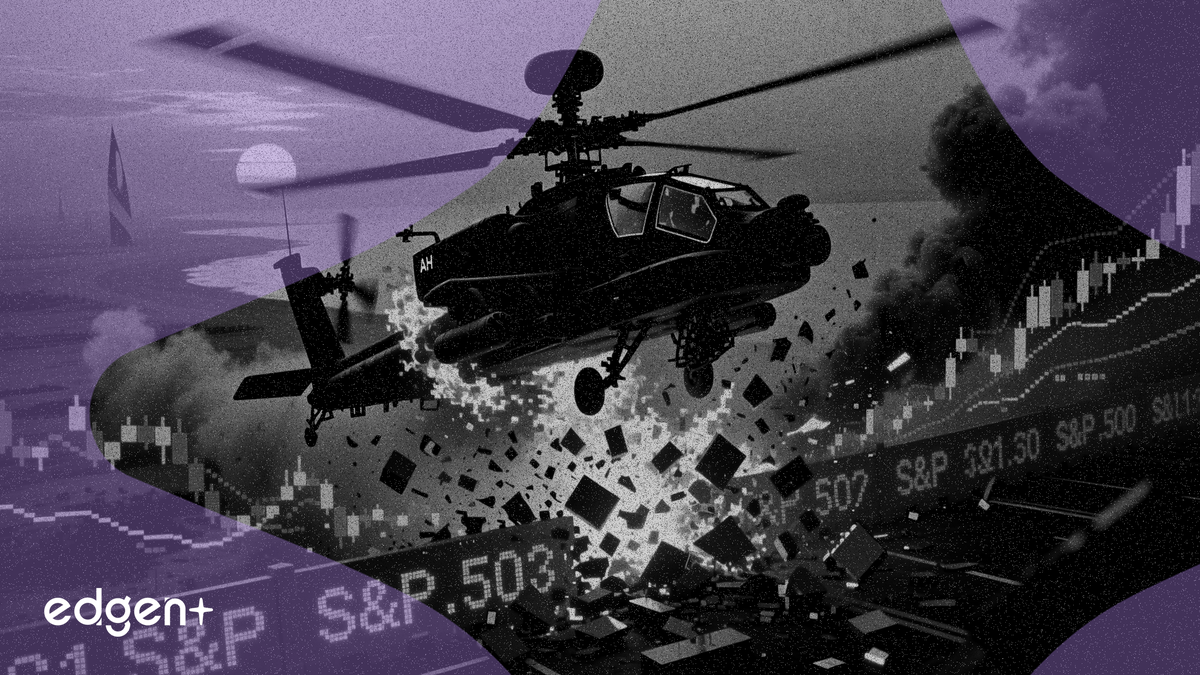
A US Army Apache attack helicopter crashed near the Strait of Hormuz after an Iranian drone strike, sending US equities into a risk-off selloff that erased more than $400 billion in market value.
An Iranian drone struck a US Army Apache helicopter near the Strait of Hormuz on Monday, triggering a sharp risk-off selloff that pushed the S&P 500 down 1.5% and the Nasdaq more than 2.5% lower. The two crew members were rescued and are in good condition, President Donald Trump confirmed.
"Both pilots are fine," Trump told reporters in New York on Monday night, adding that his administration will issue a full report on the incident Tuesday. The Pentagon and US Central Command have not yet commented on whether the crash resulted from hostile fire or a mechanical failure, though Axios reported the Iranian drone struck the aircraft directly. US investigators have not determined if the strike was intentional.
The S&P 500 pared losses to trade 1.5% lower by the close, while the Nasdaq fell more than 2.5% as investors rotated out of risk assets. The selloff was the sharpest single-day equity decline since the Iran conflict began earlier this year, when the index fell 2.8% on the first day of hostilities. The VIX rose above its 20-day moving average as options skew shifted toward tail-risk protection, while defense sector stocks outperformed the broader market.
The Strait of Hormuz handles about 21% of global oil trade, making any military incident in the waterway a direct threat to energy supply chains. Brent crude futures rose on the news, with traders pricing in the risk of further escalation that could disrupt the 17 million barrels per day that transit the chokepoint. The last time a military incident occurred near the strait — during the 2019 tanker attacks — Brent crude spiked 15% over two weeks before settling.
A Theater of Escalating Risk
The Apache is the latest US aircraft loss in the conflict with Iran, which began earlier this year. Iran has shot down nearly 30 MQ-9 Reaper attack drones, one A-10 ground attack aircraft, and four F-15E Strike Eagles — three of which were lost in a friendly fire incident over Kuwait. Iran has also damaged or destroyed several US aircraft on the ground at airbases across the Gulf, including KC-135 aerial refueling tankers and an E-3 airborne early warning radar jet.
The US military has used Apache helicopters to enforce a blockade of Iranian ports in the Persian Gulf, a mission that keeps attack aircraft operating in close proximity to Iranian air defenses and drone patrols. The crew was rescued by drone in what analysts described as a potential first for combat search-and-rescue operations, according to reports.
The incident comes as the US and Iran have shown tentative signs of de-escalation in recent weeks. Earlier this month, Iran shot down a US MQ-1 Predator drone over the Persian Gulf, prompting CENTCOM to strike Iranian drone control and missile launch sites. Each exchange raises the probability of a broader confrontation that could draw in regional allies and disrupt global energy markets.
For markets, the key variable is whether the crash was intentional. An intentional strike would represent a significant escalation beyond the pattern of drone-on-drone engagements that have characterized much of the conflict. The equity selloff accelerated through the afternoon session as traders assessed the geopolitical implications, with the S&P 500's decline widening from 0.8% in early trading to 1.5% by the close.
This article is for informational purposes only and does not constitute investment advice.