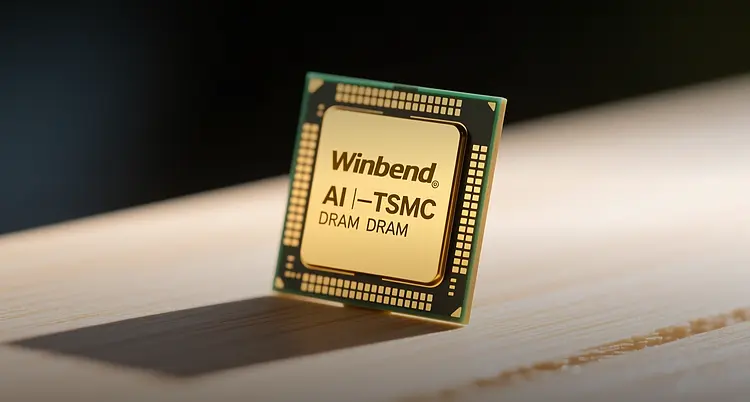
TSMC's partnership with Winbond breaks the HBM memory monopoly — but the AI pie is big enough for everyone.
The supply chain shortage in high-bandwidth memory (HBM) chips has propelled SK Hynix, Samsung, and Micron Technology to triple-digit returns in 2026, as the three companies control the entire global HBM market. Taiwan Semiconductor Manufacturing Co. just announced a collaboration with Taichung-based Winbond to supply DRAM and HBM memory chips for AI applications, creating a potential third supplier that could ease the bottleneck without cannibalizing the incumbents.
"This is insurance, not domination," said Rachel Kim, semiconductor supply chain analyst at Edgen. "TSMC needs guaranteed memory supply for its AI chip customers, and Winbond's CUBE architecture integrates directly with TSMC's Wafer-on-Wafer process. The Big 3 aren't losing share — the market is simply too large."
Winbond will provide DRAM wafers using its proprietary CUBE (Customized Ultra-Bandwidth Elements) architecture, a 3D caching-as-a-service design that scales from 256Mb to 8Gb per die. TSMC will integrate these wafers into its next-generation WoW (Wafer-on-Wafer) and SoIC 3D-stacking technologies, which use hybrid bonding to create millions of micro-copper interconnects between logic and memory layers. The result is shorter data paths, lower latency, and higher bandwidth compared to conventional packaging. TSMC has not disclosed production timelines or volume commitments.
Why TSMC Needed a Third Option
SK Hynix controls 60% of the global HBM market, followed by Samsung at 30% and Micron at 10%. The South Korean government recently announced a $590 billion investment toward HBM and AI-related production expansion, but those results are not expected for five years. Meanwhile, Micron's most recent earnings showed record profitability with revenue quintupling year over year, and the company has signed 16 strategic customer agreements representing a minimum of $100 billion in long-term commitments.
TSMC's previous memory technology suppliers for AI foundry work were exclusively SK Hynix, Samsung, and Micron. By bringing Winbond into its AI memory supply chain, TSMC reduces its dependence on the three incumbents for future memory needs. Winbond's selection was not arbitrary — the company has mature 12-inch wafer mass-production capability, high yields, and specialized process experience in specialty DRAM and NOR flash memory, according to analysts covering the deal.
The collaboration also carries geopolitical weight. TSMC accounts for 68% of global chip foundry output and 90% of the world's most advanced logic chips. With TSMC building four factories in Arizona under the Trump administration's tariff waiver incentives, some political analysts have questioned whether the US strategic imperative to defend Taiwan has weakened. A growing Taiwanese memory industry that is also critical to AI production helps reinforce the island's indispensability in the global semiconductor supply chain.
What It Means for Chip ETFs and Investors
For investors, the deal creates a new vector in the memory supply chain without threatening the incumbents' near-term dominance. SK Hynix, Samsung, and Micron are unlikely to see revenue erosion because AI demand for HBM continues to outstrip supply by a wide margin. Micron, trading near $975, has a 12-month price target of $1,725 per Seeking Alpha, implying roughly 77% upside even with a new competitor entering the fray.
ETFs with large TSMC positions — including the VanEck Semiconductor ETF (NASDAQ: SMH), the iShares MSCI Taiwan ETF (NYSE: EWT), and the Roundhill Memory ETF (CBOE: DRAM), which holds one of the largest US-listed stakes in Winbond — may benefit as the market prices in a more diversified memory supply chain. TSMC shares have already priced in some of the supply chain risk, but a confirmed production timeline from the Winbond partnership could trigger further upside.
The key question is timing. If TSMC and Winbond announce mass production dates before the South Korean capacity expansion comes online in the early 2030s, the partnership could capture meaningful market share in the interim. If not, it remains what analysts describe as a strategic hedge — valuable insurance that may never need to be fully deployed.
This article is for informational purposes only and does not constitute investment advice.