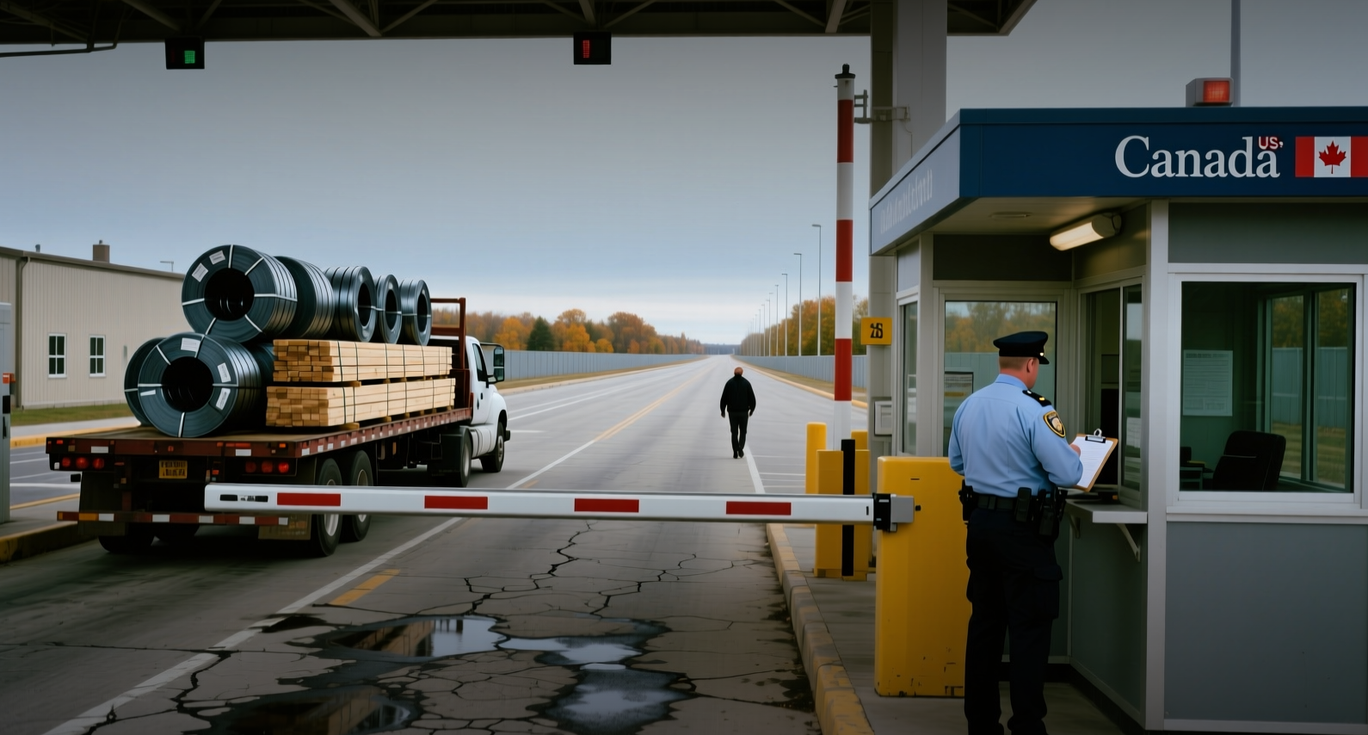
A 50% US tariff on roughly $20 billion of Canadian goods, matched dollar-for-dollar by Ottawa since September 8, has turned two Cook Political Report toss-up Senate races into a referendum on tariff pass-through — and Republican candidates in Maine and Michigan are answering it in opposite ways.
"The tariff is a tax on Maine businesses and Maine families, and I said so from the start," Senator Susan Collins, the Republican incumbent in Maine, said in a statement after writing to the administration to seek relief for her state's importers. Road salt and cement were subsequently carved out of the tariff schedule.
Collins' Democratic opponent, Troy Jackson, has argued that piecemeal exemptions leave the underlying cost structure intact, and has pressed her to seek removal of duties on Canadian auto parts and fertilizer as well. In Michigan, Republican candidate Mike Rogers has taken the reverse position, backing the president's tariff agenda and presenting his relationship with the White House as leverage to win trade treatment favorable to the state's automakers. Democrat Abdul El-Sayed has built his counter-argument around the resulting cost pressure.
The dispute dates to August 21, when bilateral talks collapsed. Washington imposed the 50% duty the following day under Section 338 of the Trade Act, a provision that had not previously been used, covering autos, steel and consumer goods. Ottawa's counter-tariffs of 15% to 50% on a matching $20 billion of US exports took effect September 8. The Section 338 measure exempted energy, potash, fish, critical minerals and goods already covered by Section 232 — a carve-out that shows which Canadian exports Washington judged too essential to touch even at the peak of the fight.
A 4-to-1 blame split that constrains the sales pitch
The political difficulty is measurable. A Reuters/Ipsos poll found Americans blame Washington rather than Ottawa for the rupture by roughly 4 to 1, with only 20% of respondents supporting tariffs on Canadian goods. That is an unusually unfavorable reading for an incumbent administration's signature policy in a midterm year, and it leaves Republican candidates in cross-border states with no clean message: they must hold the president's coalition while answering voters who mostly oppose the specific measure.
The economics behind that polling are not abstract. Canada supplies more than half the aluminum used in US manufacturing, autos and defense production, and Canadian smelters shipped roughly half as much aluminum south between July 2025 and July 2026 as they had a year earlier, according to Bank of Canada figures. Canadian industry groups have argued that US manufacturers, not Canadian producers, are absorbing the cost, paying $1,500 to $2,000 more per tonne than European competitors. More than 80% of US potash imports originate in Saskatchewan, with no substitute available at scale — which is why fertilizer stayed off the tariff list.
For Maine, the exposure runs through lumber, seafood, wild blueberries and construction materials. For Michigan, it runs through vehicle assembly and parts, where a 50% duty on a cross-border component is not a cost most supply chains can absorb without restructuring. Boston College political scientist David Hopkins said both candidates need independent voters, and that tariff-driven cost increases push economic issues further up the ballot.
What the exemption list tells you about duration
The scope of the tariff, not its headline rate, is the variable that matters from here. Washington has already narrowed it twice — first through the Section 232 carve-outs, then through the removal of toilet paper, bedsheets and fishing rods from the target list after Ottawa's retaliation. Each removal is a concession that the duty's cost lands domestically as well as in Canada.
The next hard date is September 29, when the US ban on Canadian whey, most alcoholic beverages and motorcycles and mopeds is scheduled to take effect. Inu Manak, senior fellow at the Peterson Institute for International Economics, said that gap gives both sides room to resume talks: "This is not going to happen for three weeks. So it's like, 'We're going to retaliate, but not yet.' There could be a way out of this."
President Donald Trump said September 12 that a deal with Canada could come "fairly soon," and Prime Minister Mark Carney has said Canada is ready to sit down without preconditions on who moves first. Carney has simultaneously pursued a target of attracting C$1 trillion in investment to reduce Canada's reliance on a market that has historically taken about three-quarters of its exports.
The last comparable rupture — the 2018 Section 232 steel and aluminum tariffs — was resolved within roughly a year through the USMCA side letters that committed Washington not to reimpose them. Those assurances held for six years. The scheduled USMCA joint review on July 1, 2026 produced no renewal commitment, and the pact now runs on annual review cycles, which means the tariff's duration is tied to a trade framework that no longer has a fixed end date.
For the two Senate races, that is the operative fact. Every product removed from the list is a cost that does not reach a Maine or Michigan household before November 3; every product that stays on it is a price increase that does. The candidates are not debating tariff theory. They are debating which side of that ledger their state lands on.
This article is for informational purposes only and does not constitute investment advice.