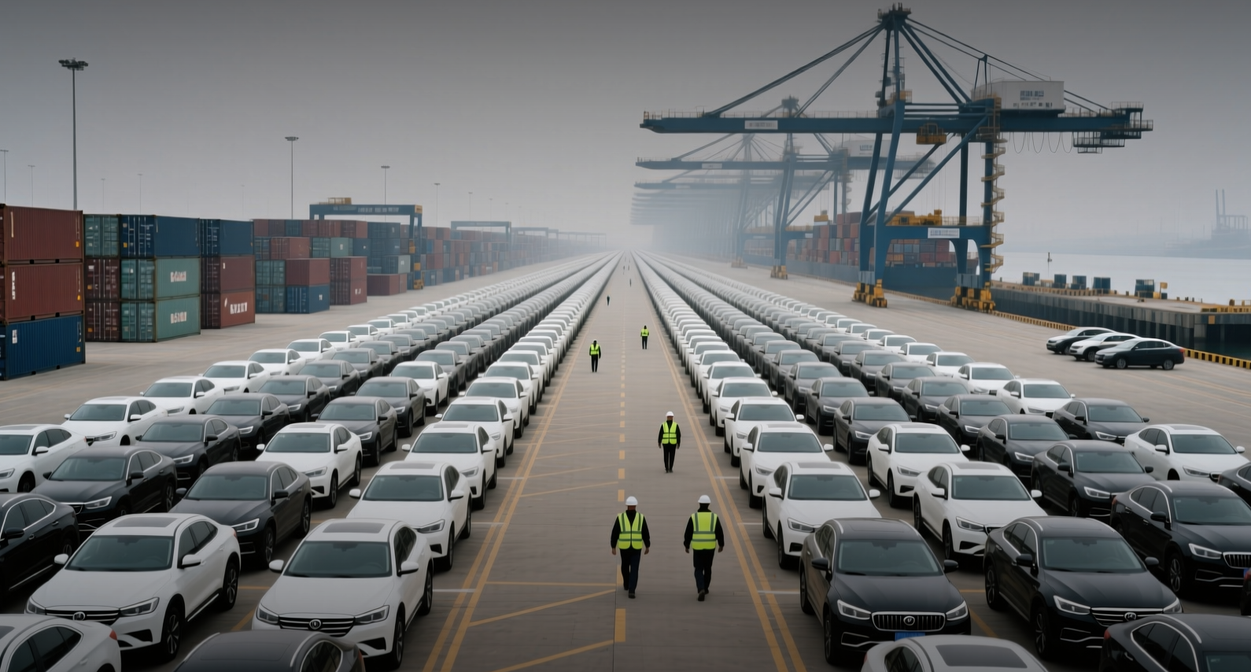
President Donald Trump is weighing whether to let Chinese automakers build and sell cars in the United States, a decision that would put at risk an American light-vehicle market worth roughly 15 million annual sales and a domestic manufacturing base that supports about 1 million direct assembly jobs.
"It's not at this point a partisan issue," Senator Elissa Slotkin, Democrat of Michigan, told reporters in Detroit on Wednesday. "It's about whether we want to make cars in America and whether we want a manufacturing base that can pivot when we need it. If we want that, we shouldn't let them in our country."
Trump said earlier this month he might be "OK" with Chinese companies producing vehicles on US soil, a remark that drew a joint objection from a consortium of auto trade groups representing manufacturers, franchised dealers and suppliers — an unusually unified front for an industry that splits on fuel-economy rules, EV mandates and emissions standards. More than two dozen Democratic lawmakers followed with a letter urging the administration to hold existing restrictions in place, while bipartisan bills to bar Chinese automakers from the US market advance through Congress.
The summit is the venue where that pressure gets tested. Trump hosts Xi Jinping and a Chinese delegation on Thursday and Friday, with a state dinner that Reuters reported will include General Motors chief executive Mary Barra and Tesla chief executive Elon Musk. Ford declined to say whether chief executive Jim Farley would attend, after the Department of Transportation criticized the company's China ties, including a licensing agreement with battery maker CATL. Stellantis said chief executive Antonio Filosa is out of the country and has no plans to attend.
Europe's 12% is the number Detroit is watching
The case against opening the market rests less on Chinese product quality than on the pace of its export push. Global market share for Chinese brands jumped nearly 70% between 2020 and 2025, according to market research firm GlobalData. In Europe, Chinese brands held virtually nothing in 2020 and reached 12% of sales in August, according to Germany-based Dataforce.
Michael Dunne, a China auto industry specialist and former General Motors executive, said the concern is not exaggerated. Chinese automakers would "quickly overwhelm America's auto industry, just as it is now ravaging Europe," he wrote in a newsletter post on Monday, adding that "China's scores of automakers are currently engaged in a fight-to-the-death price war at home" and that "access to the U.S., by far the most lucrative car market in the world, is like a giant tank of life-saving oxygen."
That price war is the mechanism. BYD, China's largest automaker, and Geely compete in a domestic market where government support has funded capacity well beyond local demand, pushing manufacturers to export to keep plants utilized. Christian Meunier, Nissan Motor's chairman of the Americas, described the competition as a structural mismatch. "They have decent product but it's all dumping," he told CNBC. "We know we're not competing with [automakers], we're competing against the governments."
The tariff arithmetic explains why the US market is the prize. Peak baseline US tariffs reached 145% during last year's trade battle, matched by Chinese reciprocal levies of 125%, before the two sides met in South Korea and the average US rate fell to roughly 47% while China charged an average in the mid-30s. The Supreme Court overturned many of Trump's tariffs in February, leaving the taxes on Chinese goods with more variation. The one-year truce, set to expire Nov. 10, was extended by two months on Wednesday.
What a shift would cost, and what it would hand over
For GM, Ford and Stellantis, the exposure is concentrated in the compact and mid-size segments where Chinese manufacturers have proven most competitive in Europe, and in the dealer and supplier networks that depend on those volumes. For BYD and CATL — whose founder, Robin Zeng, is expected in the delegation alongside BYD founder Wang Chuanfu — a US opening would convert the world's most profitable vehicle market from a closed door into an addressable one.
The last time Washington faced a comparable decision on Japanese imports, the 1981 voluntary export restraint capped Japanese shipments at 1.68 million vehicles a year and reshaped where those manufacturers built their plants. Chinese manufacturers have already signaled the same playbook: local production in exchange for access, which is precisely the structure Trump floated this month and the structure the industry's trade groups rejected.
Neither outcome is priced. If the summit produces no change in the restriction regime, the bipartisan bills in Congress become the binding constraint and US incumbents keep their pricing power through the midterm elections in November. If Trump signals openness to Chinese plants on US soil, the negotiation shifts to investment terms — ownership caps, battery sourcing rules, union labor conditions — and the auto trade groups' unified front becomes the first casualty. Treasury Secretary Scott Bessent said Wednesday the two sides could reach a larger agreement by January, or simply extend the truce again.
This article is for informational purposes only and does not constitute investment advice.