A driver told Harris County investigators his Tesla was on Autopilot before it crashed through a Katy, Texas home on June 20, killing a 76-year-old woman — a claim that lands inside the most consequential federal probe of Tesla's driver-assistance technology, covering 3.2 million vehicles.
"The cause of the crash has not been determined. We're digging into that," Sgt. Alex Turman, accident investigator and public information officer at the Harris County Sheriff's Office, told Covering Katy News. "That's a line of investigation for sure."
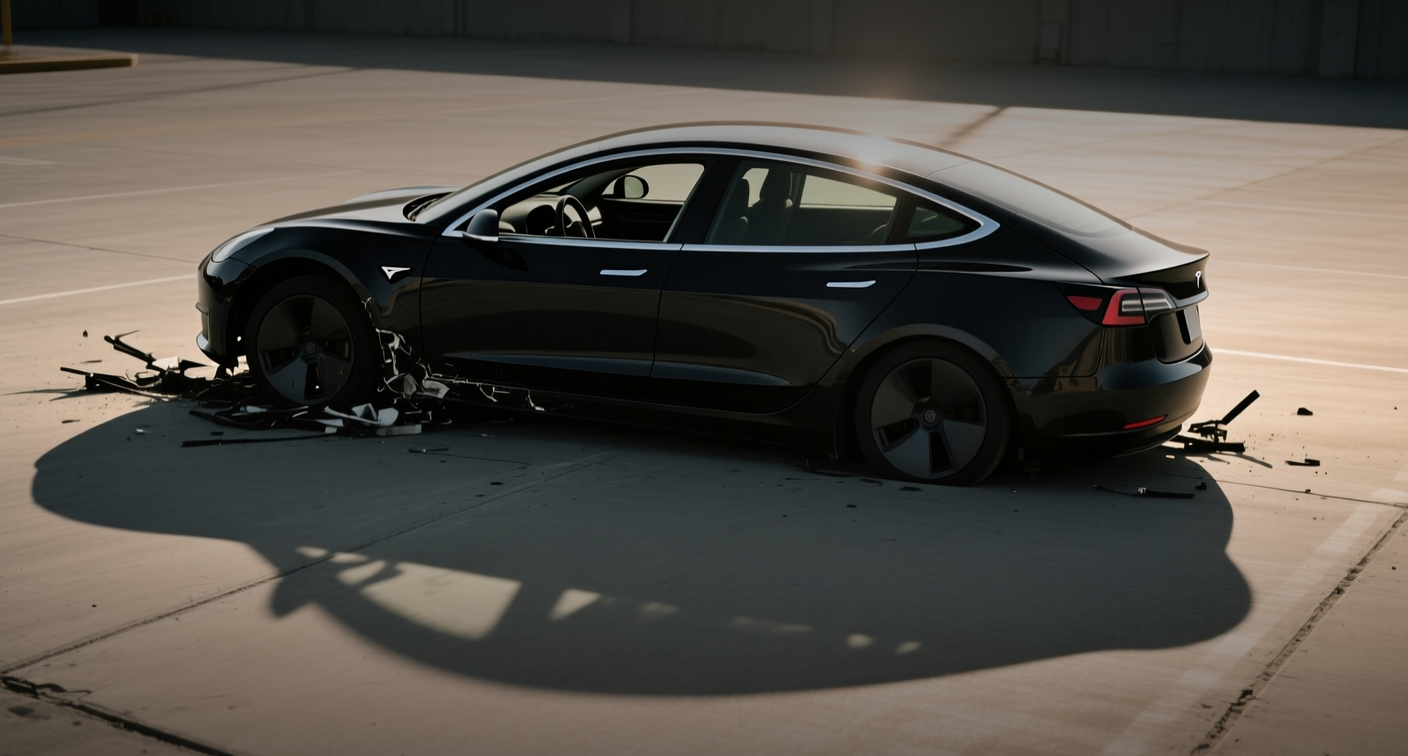
The Tesla Model 3 failed to make a right turn at an intersection on Rose Hollow Lane around 8 p.m. Friday, continued forward at high speed, struck a curb, and drove through the brick facade of a home on Blooming Park Lane, according to the Harris County Precinct 5 Constable's Office. Martha Avila Mantilla, 76, was standing in the front room when the vehicle entered the home. She was airlifted by Life Flight to Memorial Hermann hospital, where she was later pronounced dead. The driver, Michael Butler, 44, was taken to a hospital by ambulance. Investigators said he showed no signs of intoxication and has been cooperating. No charges had been filed as of Sunday.
The crash arrives as NHTSA's Engineering Analysis EA26002 — opened March 18, 2026, and covering an estimated 3.2 million Tesla vehicles including 2017-through-2026 Model 3 sedans — examines whether FSD's degradation detection system fails to identify when cameras are blinded by sun glare, fog, or airborne dust. A separate NHTSA Preliminary Evaluation, PE25012, covering approximately 2.88 million vehicles, focuses on FSD running red lights and crossing into opposing lanes, with 80 documented instances catalogued as of December 2025. If NHTSA determines a defect exists, it can demand a mandatory recall across the affected vehicle population — a process that typically concludes within 12 to 18 months of an Engineering Analysis opening.
The Driver's Account and the Data That Will Test It
Butler told deputies the Tesla was on Autopilot at the time of the crash, according to the Harris County Constable Precinct 5. Investigators have not specified whether the system was Tesla's legacy Autopilot — lane centering combined with adaptive cruise control — or the more capable Full Self-Driving (Supervised) software. Both are Level 2 systems under SAE's classification framework, meaning the driver bears legal responsibility for the vehicle's actions at all times.
Tesla discontinued Autopilot as a product for new vehicles in the U.S. and Canada in January 2026, after a California administrative law judge ruled in December 2025 that the term violated state consumer protection law. The company filed a lawsuit against the California DMV in February 2026 seeking to reverse the ruling. However, millions of existing Tesla vehicles still carry the software. If the Model 3 involved in the crash was purchased before January 2026, Autopilot could have been active even after Tesla stopped selling it.
Investigators with the Harris County Sheriff's Office Vehicular Crimes Division are expected to examine the vehicle's event data recorder, onboard logs, and camera footage to determine whether an automated driving system was engaged, at what speed, and whether any driver input was recorded in the seconds before impact. Tesla's data retention windows create time pressure on investigators and potential litigants.
A System Under Mounting Legal and Regulatory Pressure
The Katy crash is not the first fatal incident involving Tesla's driver-assistance technology to draw regulatory scrutiny. In August 2025, a Miami federal jury awarded $243 million in a wrongful death case stemming from a 2019 Autopilot crash in Key Largo, Florida, that killed 22-year-old Naibel Benavides Leon. The jury found Tesla 33% liable, citing the system's design and the company's marketing as contributing factors. In February 2026, U.S. District Judge Beth Bloom rejected Tesla's bid to overturn that ruling, finding that evidence admitted at trial more than supported the jury verdict. Tesla is pursuing an appeal to the Eleventh Circuit.
Tesla's camera-only architecture — no radar, no lidar — is central to the regulatory debate. Competitors including Waymo use sensor-fusion designs combining cameras with lidar and radar, creating overlapping coverage so that failure in any single sensor type does not blind the system. NHTSA's EA26002 investigation targets precisely this vulnerability: the gap in FSD's ability to detect and communicate when its cameras are impaired.
The Katy crash does not appear to involve the low-visibility failure mode at the center of EA26002 — it occurred in the evening on a residential street, not in fog or sun glare. But it arrives in the public record at the moment regulators are examining whether Tesla's system can be trusted in any condition that exceeds its design parameters. A driver claiming a Tesla drove itself into a house on a residential street is a concrete, fatal example of the gap between what Level 2 branding implies and what Level 2 systems actually require.
Tesla has not responded to requests for comment. The company dissolved its media relations team years ago and does not typically respond to press inquiries. NHTSA's Engineering Analysis is expected to run until approximately September 2027, at which point the agency will either close the investigation, issue an influence letter requesting voluntary recall action, or push for a mandatory recall across the 3.2-million-vehicle population.
This article is for informational purposes only and does not constitute investment advice.