

Tencent's AI now generates the majority of the company's code, freeing engineers to focus on architecture as China claims global leadership in AI cost optimization.
Tencent's AI now generates the majority of the company's code, freeing engineers to focus on architecture as China claims global leadership in AI cost optimization.
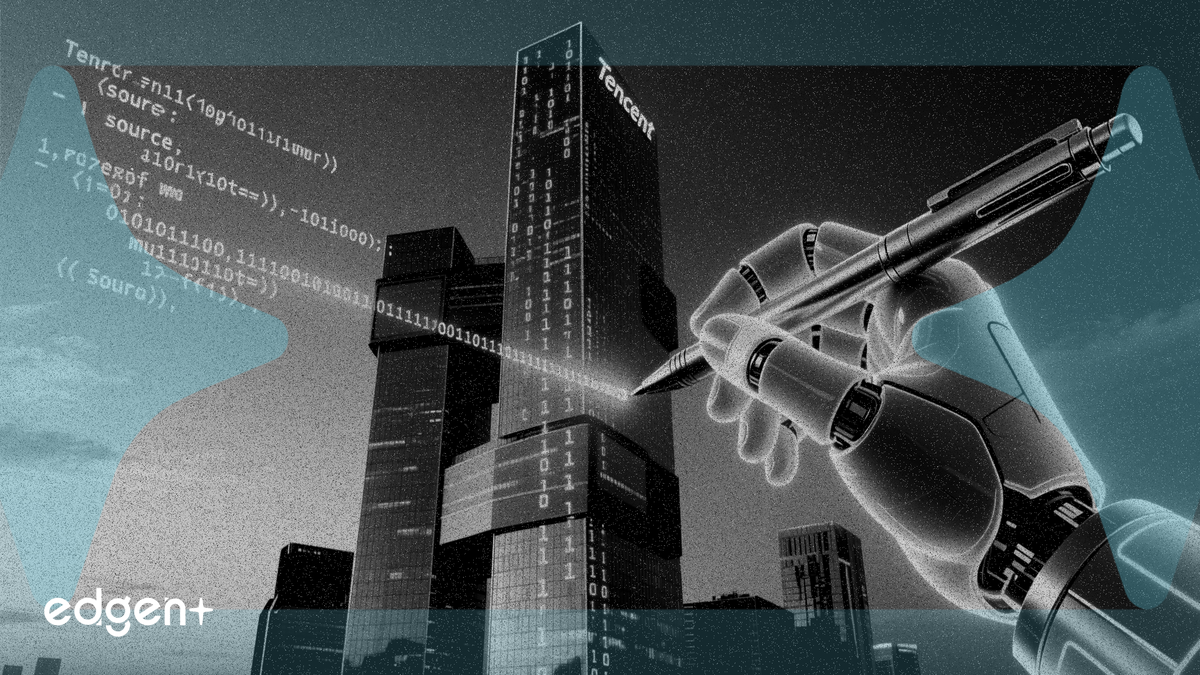
Tencent's AI now generates the majority of the company's code, freeing engineers to focus on architecture as China claims global leadership in AI cost optimization.
Tencent's AI now generates the majority of the company's code this year, shifting engineers from writing code to architectural design and oversight, executives said at the Tencent Cloud AI Industry Application Conference on June 5. The shift represents one of the most aggressive adoptions of AI-assisted development by a major technology company, with implications for productivity across Tencent's product portfolio spanning WeChat, gaming, cloud services and enterprise software.
"Cost-effectiveness primarily depends on performance. If performance is inadequate, cost-effectiveness will be weak," Yao Shunyu, Chief AI Scientist at Tencent, said. He added that China already leads the world in AI cost optimization.
Yao said one of the most important factors in cost control is using smaller models to accomplish higher-value tasks effectively, with further architectural innovation still required. Dowson Tong, Senior Executive Vice President at Tencent, participated in the dialogue. Tencent shares edged down 0.1% on the day, with short selling volume reaching $2.33 billion, or 17.5% of total turnover.
The shift toward AI-generated code and cost leadership could strengthen Tencent's competitive position against Baidu and Alibaba in the AI race. Tencent's approach — using AI to handle routine coding while engineers focus on system architecture — mirrors a broader industry trend as Chinese technology companies race to reduce AI deployment costs. Baidu's Ernie Bot and Alibaba's Tongyi Qianwen have also focused on cost reduction, but Tencent's claim of global leadership in cost optimization sets it apart from both domestic and international peers such as OpenAI and Google's DeepMind.
The cost optimization focus comes as the global AI market is projected to reach $1.3 trillion by 2032, according to Bloomberg Intelligence, making efficiency a key competitive differentiator. Tencent's strategy of deploying smaller, more efficient models for specific tasks rather than relying on large general-purpose models could reduce inference costs significantly — a critical advantage as AI adoption scales across its WeChat platform of more than 1.3 billion monthly active users.
Morgan Stanley recently identified Tencent's WeChat AI Agent as a key catalyst for the stock, while Haitong International reiterated its "Outperform" rating, citing WeChat AI Agent testing as supportive for the share price. Tencent's ability to reduce coding costs while maintaining quality through human oversight of AI output may improve margins across its cloud and enterprise software businesses. The company's AI-driven efficiency gains come as Chinese tech firms collectively spend tens of billions of dollars on AI infrastructure, making cost optimization a critical competitive differentiator that could influence investor sentiment toward the sector.
This article is for informational purposes only and does not constitute investment advice.
