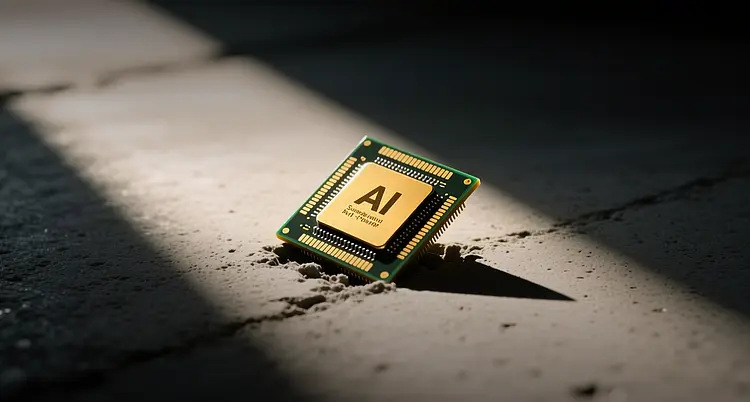
More than two-thirds of technology stocks have fallen at least 20% from their recent highs, as investors cash out of AI winners following a blockbuster second quarter.
Over two-thirds of tech stocks have fallen at least 20% from highs, with semiconductor names leading the decline as investors locked in gains after a strong Q2.
"Corrections present opportunities for investors with extra cash on the sidelines, especially in high-potential industries like technology," Marc Guberti, an analyst at The Motley Fool, said.
Nvidia has dropped almost 20% from its 2026 highs despite reporting 85% year-over-year revenue growth in its fiscal 2027 first quarter, according to company filings. Meta Platforms is down more than 10% from its all-time high, trading at 22 times earnings even as first-quarter revenue rose 33% from a year earlier. Micron Technology has corrected 20% from its peak after more than tripling year to date, leaving it at a forward price-to-earnings ratio of 7, per company data.
The selloff extends beyond mega-cap names. Sterling Infrastructure, a builder of AI data centers, has fallen more than 30% from its all-time high and more than 20% over the past month alone. Iren, a neocloud provider, shed more than 30% in a single month after its co-CEOs received $687 million in stock grants. The breadth of the decline — affecting companies across the AI supply chain from chipmakers to infrastructure builders — suggests the market is reassessing valuations driven by artificial intelligence enthusiasm.
Semiconductor Rout Deepens as Profit-Taking Accelerates
Nvidia's recently announced $80 billion stock buyback program and a new revenue-sharing model — in which AI start-ups receive free compute in exchange for giving Nvidia a percentage of their revenue — have done little to stem the decline. The company trades at 30 times earnings, a discount to its historical average, according to published financial data. Meta Platforms is diversifying beyond advertising revenue into AI cloud services and AI glasses, though these segments are not yet generating meaningful revenue. The company is constrained by compute capacity and has been limited in its use of Alphabet's Gemini AI models, per company disclosures.
The correction has also swept up infrastructure names. Sterling Infrastructure's e-infrastructure segment — focused on AI data centers and advanced manufacturing — saw revenue surge 174% year over year in the first quarter, with a $5.15 billion backlog offering multi-year visibility. Yet the stock has fallen more than 30% from its highs, tracking the broader tech selloff rather than its own fundamentals. Iren has doubled its gigawatt pipeline year to date to nearly 6 gigawatts, with expansion into Europe and Australia. The company recently raised its annualized revenue run rate from $3.7 billion to $4.4 billion. But dilution fears and a $687 million stock grant to its co-CEOs have weighed on the stock, which is flat year to date after shedding more than 30% in a single month.
The divergence between fundamentals and stock prices across the AI ecosystem suggests the market is in a broad de-rating phase rather than a company-specific correction. With the Federal Reserve's next policy meeting on July 30-31 and second-quarter earnings season approaching, investors face a critical test of whether AI-driven growth can justify current valuations after the recent pullback.
This article is for informational purposes only and does not constitute investment advice.