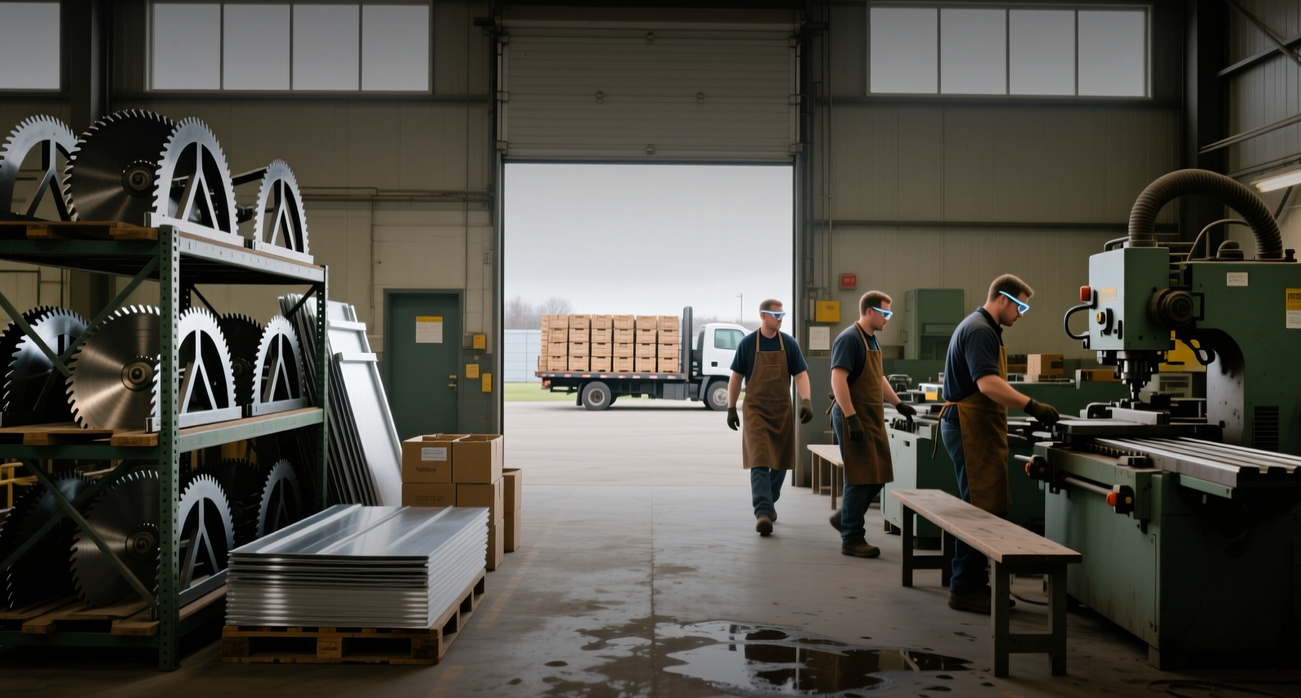
A bracket that cost $42 in June now bills at $87, and that single line item explains why Allen Eden is warehousing inventory he cannot yet afford to sell. The 56-year-old runs Original Saw Co., a 25-person industrial power-saw maker in Britt, Iowa, and he is absorbing three cost shocks at once: tariffs on aluminum, steel and imported parts; record diesel prices tied to the Iran war; and the Federal Reserve's first rate increase in three years, which lifted the cost of financing the stock he is now holding longer.
"It's awful," Eden said. "[I'm] just trying to keep more of the stuff around because I don't know if we can get it down the road."
The squeeze is not evenly distributed, and that asymmetry is the story. Smaller firms borrow short, so Fed hikes pass into their cost base almost immediately, JPMorgan Chase global strategy head Dubravko Lakos-Bujas wrote in a Sept. 14 note. Capital-intensive sectors — manufacturing, equipment supply, trucking fleets and commercial real estate — carry the heaviest exposure to both higher rates and higher fuel. "The combination of higher rates and higher fuel prices means that sectors with heavy exposure to both are first in the line of fire," said Gregory Daco, chief economist at EY-Parthenon.
The arithmetic is already visible in earnings. Growth measured by earnings before interest and taxes for the top 100 auto suppliers fell to 4.2% last year from more than 6% in 2021, according to consulting firm Berylls by AlixPartners. Among the top 10 automakers, the same measure slipped to 5.2% from nearly 8% in 2022. Lucerne International, a privately held Detroit-area parts maker, halted US manufacturing and canceled a $50 million aluminum forging plant in Michigan. "The onset of the Trump tariffs 2.0 has just really torn holes in our global supply chains and increased costs significantly," CEO Mary Buchzeiger said. Spanish supplier Grupo Antolin, which ships components to Ford, General Motors, Volkswagen and Stellantis, filed for Chapter 15 bankruptcy protection in the US in July, citing tariffs, higher raw-material and energy costs, and supply-chain disruption.
What separates survivors from casualties is pricing power, and the gap is widening. Airlines have it: fares rose more than 23% in August from a year earlier, and carriers are simply deleting unprofitable routes rather than absorbing fuel. "The consumer has been incredibly, incredibly resilient," United chief financial officer Mike Leskinen said at a Morgan Stanley conference in Laguna Beach, California. "But there's some marginal routes that don't make sense in a higher fuel environment. So we cut them." Industrial chemicals maker Eastman Chemical found the same lever, though less comfortably. "Everyone had their back against the wall and had no room to absorb these increases," CEO Mark Costa said in May. "Everyone is very quickly raising prices faster than I've ever seen in 20 years."
Retailers sit in the middle, and the offsets are not covering the gap. Home Depot chief financial officer Richard McPhail said last month that unexpected energy and raw-material costs will "fully offset" the benefit of $730 million in tariff refunds. "There's just so much uncertainty right now," he said at a conference last week. "You think inflation, interest rates, fuel prices."
The Fed's problem is that its tool does not address the cause. Chair Warsh raised the benchmark rate against President Donald Trump's wishes and signaled another increase is possible this year, but higher rates do nothing about the Iran war, the administration's tariffs, or the artificial intelligence buildout that has driven up prices for electricity, memory chips, copper and land. Raising rates to slow the economy risks slowing it too much. "The economy is resilient, but it's exposed to growing pockets of risk," Daco said. "A shock could materialize faster than we all think."
For now, the aggregate picture still looks healthy. Profit margins for major companies hover near historic highs, supported by productivity gains, contained labor costs and surging AI investment. The vulnerability is concentrated in the middle of the market, where firms lack both the cash reserves and the long-dated debt that insulate the S&P 500's technology and finance giants. Lakos-Bujas puts the breaking point at a 10-year Treasury yield of 6%, up from roughly 5% now — a threshold derived from 80 years of data. Persistent inflation and heavy US government borrowing are both pushing yields in that direction.
The next test arrives with third-quarter earnings, when middle-market manufacturers, auto suppliers and trucking fleets report into a rate environment that has already tightened once and may tighten again. Watch the guidance language as closely as the numbers: if companies that previously passed costs through start describing price increases as demand-destroying, the squeeze has moved from margin problem to volume problem.
This article is for informational purposes only and does not constitute investment advice.