

Key Takeaways:
- SoftBank's $6 billion OpenAI margin loan talks have stalled with creditors
- The company faces a $40 billion bridge loan repayment due by March 2027
- OpenAI's confidential IPO filing could eventually resolve the valuation impasse
Key Takeaways:
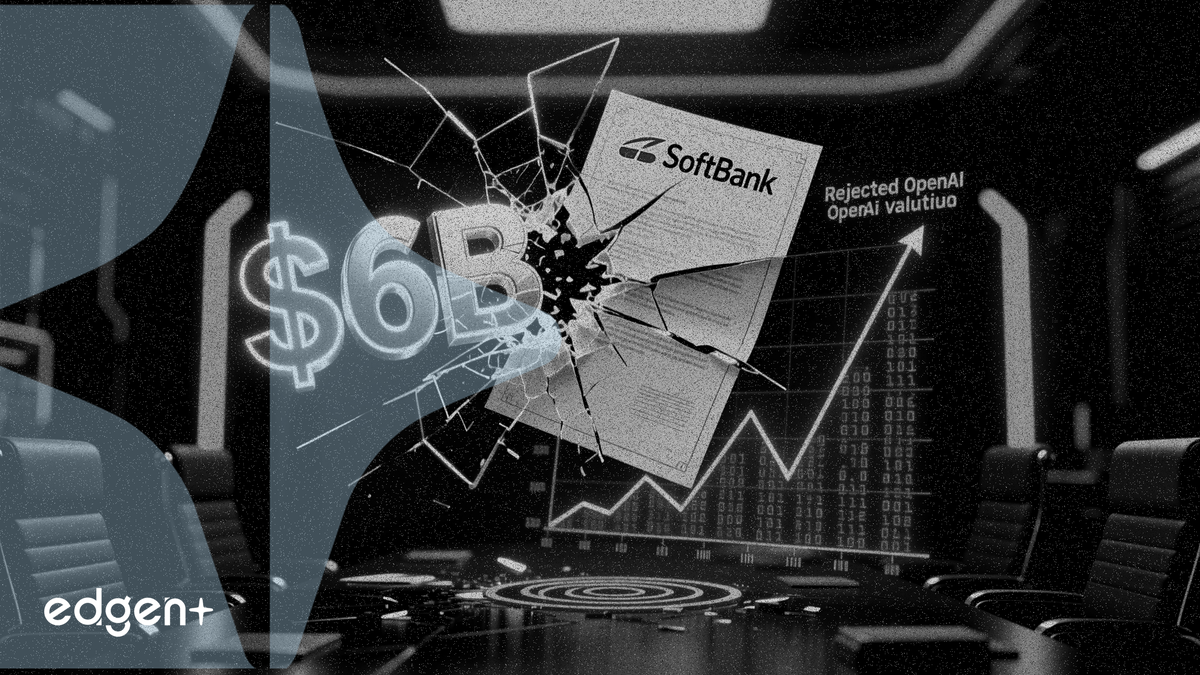
SoftBank Group's attempt to borrow at least $6 billion against its OpenAI stake has stalled, exposing the gap between private AI valuations and what credit markets will accept.
SoftBank Group's talks with creditors to raise at least $6 billion from a margin loan backed by its OpenAI stake have stalled, people familiar with the matter said, as lenders balked at valuing the unlisted ChatGPT developer at its $852 billion paper price.
"Margin loans are just one piece of a larger puzzle — we wouldn't view this as a standalone red flag unless SoftBank's broader funding capacity deteriorates," said Hua Cheng, Asia credit research head at AllianceBernstein.
SoftBank had already cut its target from $10 billion to $6 billion last month after some creditors hesitated over OpenAI's valuation, Bloomberg reported. The company secured roughly $5 billion in indicative commitments before talks stalled, though those commitments were not binding, according to people familiar. SoftBank shares fell as much as 9.7 percent in Tokyo trading Wednesday, though the stock remains up about 45 percent year to date.
The stalled loan compounds a larger debt challenge: SoftBank must repay a $40 billion unsecured bridge loan by March 2027 that it used to fund OpenAI investments. The company has said it may repay the facility by utilizing existing assets and other financing means, but the margin loan setback raises questions about its ability to monetize private holdings. OpenAI's eventual IPO — filed confidentially with Goldman Sachs and Morgan Stanley — could provide an exit, but until then, SoftBank is asking creditors to accept a private valuation as if it were public-market collateral.
SoftBank's financing difficulties reflect a broader tension in AI markets. The Japanese conglomerate committed $22.5 billion to OpenAI, funding part of that by selling its entire $5.8 billion Nvidia stake, reducing its T-Mobile exposure, and slowing most Vision Fund deals above $50 million unless Chief Executive Officer Masayoshi Son approved them directly, according to previous reports.
The margin loan structure was straightforward in concept but complex in execution. SoftBank was pledging all of its OpenAI stock — worth more than $60 billion on paper after OpenAI's $852 billion valuation in its March 31 funding round — to borrow just $6 billion, an implied loan-to-value ratio of roughly 10 percent. Even that conservative ratio was not enough to close the deal.
The $40 billion bridge loan, arranged by JPMorgan Chase, Goldman Sachs, Mizuho Bank, Sumitomo Mitsui Banking Corp. and MUFG Bank in March, matures in less than 12 months. SoftBank's publicly traded holdings — including Arm Holdings, up 197 percent year to date, and Intel, up 192 percent — could theoretically serve as collateral for alternative financing. But if OpenAI's core equity stake could not unlock $6 billion on acceptable terms, other assets may command even less favorable conditions.
Son has not scaled back his ambitions. Last month, SoftBank announced plans to invest as much as 750 billion euros in French AI data center infrastructure — a figure that far exceeds the company's available cash and has renewed scrutiny of its capital discipline. The founder, who nearly lost his company during the dot-com bust, is placing larger bets this time, and creditor patience appears to be thinning.
OpenAI's confidential IPO filing, disclosed Monday, could eventually resolve the valuation impasse. A public listing would give banks a clear market price, a visible exit route, and cleaner collateral mechanics. The company is working with Goldman Sachs and Morgan Stanley and could list as soon as this fall, people familiar have said.
"If OpenAI completes its IPO this year, SoftBank could sell part of its stake to repay debt — that's the best-case scenario for credit investors," Cheng said.
Until then, SoftBank faces a balance-sheet contradiction: its OpenAI stake drives reported investment gains, but it remains difficult to use as spendable liquidity. The message from lenders is blunt — even a $60 billion-plus paper stake was not persuasive enough to unlock $6 billion on acceptable terms.
This article is for informational purposes only and does not constitute investment advice.
