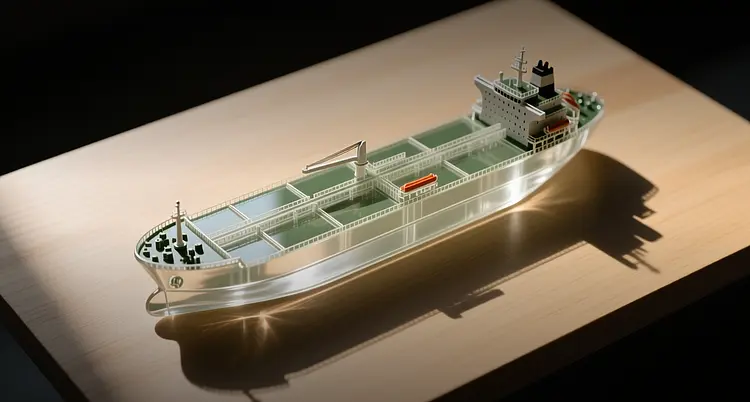
A Korean shipping tycoon's $7 billion bet on supertankers before the US-Iran war is delivering record returns as the Strait of Hormuz crisis reshapes global oil flows.
Sinokor, the South Korean shipping company controlled by Ga-Hyun Chung, amassed more than 160 oil tankers — nearly half of them very large crude carriers capable of hauling 2 million barrels each — in the months before the Feb. 28 outbreak of hostilities between the US, Israel and Iran. The bet, financed in part by Mediterranean Shipping Co. billionaire Gianluigi Aponte, gave Sinokor the largest self-owned VLCC fleet in the world, according to shipbroker estimates.
"The scale of Sinokor's pre-positioning was unprecedented in modern tanker markets — they effectively cornered a meaningful slice of VLCC supply just as the Strait became impassable," said Eirini Diamantara, a senior analyst at Greek brokerage Xclusiv Shipbrokers. "That timing was either extraordinary luck or the most calculated trade in shipping history."
When the Strait of Hormuz — a chokepoint for about a fifth of global oil consumption — saw traffic collapse by more than 90 percent at the height of the disruption, VLCC daily charter rates exploded to more than $385,000 in March, the highest since Clarksons began tracking the data in 2000 and far above the 2016-2025 average. The windfall came as Asian buyers scrambled for alternative supplies from Europe and the US, forcing tankers onto longer routes that absorbed available capacity.
The bet carries echoes of earlier shipping gambles that ended badly. Taiwanese tycoon Nobu Su built a vast dry bulk fleet in the 2000s before the 2008 financial crisis wiped him out. But for now, Chung's wager is paying off. Sinokor's fleet, which includes VLCCs pre-deployed near the Strait as floating storage and shuttle vessels, has been earning rates that would generate annualized revenue of more than $140 million per ship at peak levels.
Ballast Flows Signal Recovery, But Cargo Lags
Ship tracking data shows a growing convoy of empty tankers re-entering the Arabian Gulf, including LNG carriers linked to Qatar that resumed Hormuz voyages for the first time since the conflict began. Ballast movements — empty vessels heading into the Gulf to load — are a leading indicator of forward expectations, and the signal is flashing strongly.
But laden export flows remain constrained at roughly half of pre-conflict crude levels, according to Reuters ship tracking data. The gap between ballast arrivals and actual cargo loadings reflects persistent security concerns, elevated war-risk insurance costs and regulatory ambiguity that continue to limit the pace of recovery.
VLCC earnings on the benchmark Middle East-to-China route have fallen to about $287,000 a day from more than $500,000 shortly before the Trump-brokered peace accord was announced. Yet that remains well above historical norms and reflects the lingering dislocation in global tanker deployment. In a mirror-image dynamic, rates for smaller product tankers on routes outside the Gulf have climbed sharply — the Nigeria-to-Netherlands fuel route jumped to about $112,000 a day from $63,000 in mid-June — as the concentration of vessels around the Arabian Gulf tightened capacity elsewhere.
What Comes Next
The partial reopening of the Strait is creating a two-speed market. Fleet managers are dispatching vessels back to the Middle East in anticipation of a sustained recovery in Gulf exports, while actual cargo throughput remains constrained by operational limits and the slow unwinding of a massive shipping backlog. Hundreds of vessels remain stuck in or around the Gulf, a bottleneck that could take weeks to clear even under stable conditions.
Sinokor's position is uniquely advantaged. With an estimated 10 percent share of the global VLCC fleet, the company has the scale to influence spot market pricing by controlling how many of its vessels it releases for charter. The same strategy that generated windfall profits during the crisis could sustain elevated earnings during the recovery — as long as demand for tankers remains strong and regulators do not intervene.
The last time a single player attempted to dominate a shipping segment at this scale, the outcome was a cautionary tale. But for Chung, whose fleet is now positioned to capture both the residual crisis premium and the recovery upside, the bet on war-torn waters has made him the undisputed king of the VLCC market.
This article is for informational purposes only and does not constitute investment advice.