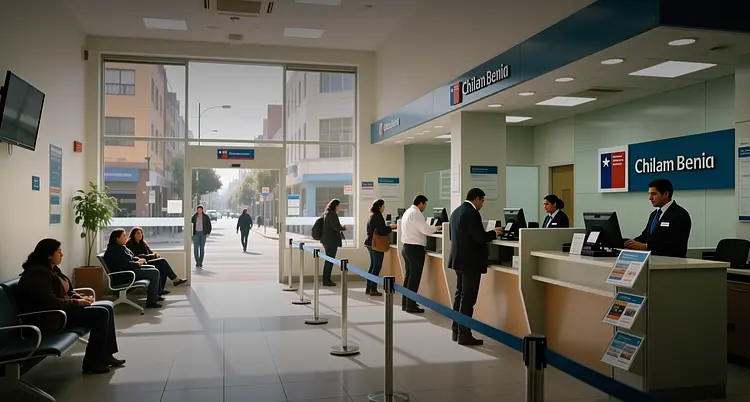
Banco Santander SA will spend US$800 million in Chile over a multi-year horizon, a commitment executive chair Ana Botín tied directly to the country's competitiveness agenda at ChileDay Madrid 2026 — a sum equal to roughly 2.5 times the group's entire quarterly net profit, and one that will be released in tranches rather than at once.
"Chile offers the conditions to translate its capabilities into investment and growth," Botín said at the Madrid event, where she set out the group's strategy and framed the Andean economy's competitiveness as the case for the allocation.
The plan lands against a softer near-term earnings backdrop. Santander reported second-quarter earnings of $0.27 per share on July 22, missing the $0.29 consensus by $0.02, on revenue of $17.93 billion that narrowly beat the $17.90 billion estimate. Net margin was 26.94% and return on equity 12.43%. Erste Group Bank analyst H. Engel cut the FY2026 EPS estimate to $1.19 from $1.20 on Sept. 8, below the $1.25 consensus, while lifting the FY2027 figure to $1.43.
That gap between a long-dated capital pledge and a flat current-year earnings trajectory is the tension investors will have to price. At a market capitalization of $219.28 billion and a price-to-earnings ratio of 12.14, Santander trades at a P/E/G of 0.74 — a discount that implies the market is not yet paying for Latin American growth optionality. The stock opened at $14.93, above its 50-day moving average of $14.29 and well clear of its 200-day average of $12.91, and sits near the top of a 12-month range of $9.62 to $15.05.
Chile is one of nine established franchise markets Santander lists alongside Spain, the U.K., Portugal, Poland, Brazil, Mexico, Argentina and the U.S. The US$800 million is therefore a franchise-deepening commitment rather than a new-market entry, which matters for how the spend should be read: it is more likely to fund digital infrastructure, branch and platform modernization, and lending capacity than an acquisition.
What $800 million buys in a franchise market
For scale, the commitment is equivalent to about 4.5% of Santander's quarterly revenue of $17.93 billion, and it will be spread across several years — meaning the annual earnings drag is modest and the revenue contribution, if any, arrives late. Banks typically phase such programs so that technology and compliance spending front-loads and revenue-generating capacity follows. Santander has not disclosed the annual tranche schedule, the split between capital expenditure and operating expense, or the expected revenue or loan-growth contribution. Those figures are not yet disclosed.
The rate environment shapes the payoff. Santander's 12.43% return on equity and 26.94% net margin give it the internal capital generation to fund the plan without a capital raise, and a beta of 0.74 means the shares have historically moved less than the broader market — a profile that suits a multi-year infrastructure spend rather than a cyclical bet. Chile's central bank policy path will determine whether the deployed capital earns a spread wide enough to clear the group's cost of equity; a sustained easing cycle would compress lending margins on new Chilean assets even as it supports borrower demand.
Analyst sentiment on the group is mixed but leans positive. Six research analysts rate the shares Buy, three Hold and one Sell, for an average "Moderate Buy" rating, according to MarketBeat data. Wall Street Zen downgraded the stock to Hold from Buy on July 18, and Weiss Ratings lowered its grade to buy (b+) from buy (a-) on July 29 — both before the Chile announcement.
The read-through extends beyond Santander. A top-tier eurozone bank committing fresh capital to an Andean franchise is a signal about perceived country risk in Chile relative to Brazil and Mexico, and it puts peer lenders with Chilean exposure — including Banco de Chile and Itaú Unibanco's regional operations — under comparison on where incremental Latin American capital is going. Institutional ownership of Santander stands at 9.19%, with AQR Capital Management raising its position 77.4% in the first quarter to 419,635 shares worth $2,812,000.
What to watch next is deployment, not the headline number. The first concrete markers will be Santander Chile's quarterly loan growth and cost disclosures, any update to group capital expenditure guidance at the next earnings report, and whether the bank names specific programs — digital onboarding, payments, or small-business lending — that convert the US$800 million from a pledge into booked assets.
This article is for informational purposes only and does not constitute investment advice.