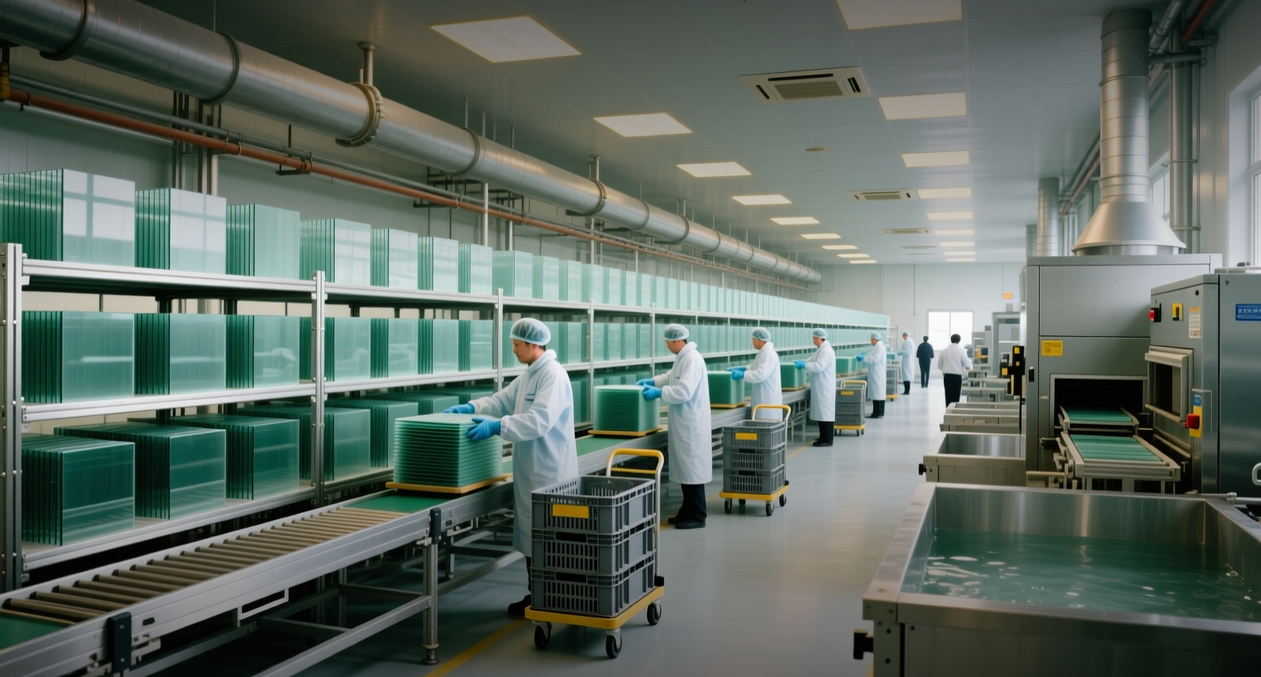
Samsung Electronics plans to lift outsourced cleaning of glass carriers — the glass supports that hold HBM DRAM wafers flat while they are ground thin — to 50,000 sheets a month next year from 20,000 this year, a 2.5-fold increase that industry analysts read as evidence the company's HBM4 and HBM4E output will at least double.
The carrier volume is the most physical signal available of the ramp, because it sits upstream of every stack Samsung ships. "As Samsung expands HBM production, it appears to be placing HBM4, a high-value product, at the center," an industry official said, according to Seoul Economic Daily.
Glass carrier requirements ran at 10,000 sheets a month as recently as last year, doubled this year and are set to rise another 2.5 times in 2027 — a fivefold increase over two years. Total HBM wafer starts, measured by average monthly input, are projected to climb nearly 40% to about 250,000 wafers next year from roughly 180,000 this year. The HBM4 family's share of shipments is expected to reach about 80% next year from around 40% this year.
The mix shift is where the money is. HBM4 costs about 2 million won per chip, more than double the price of fifth-generation HBM3E, and HBM4E is expected to price higher still. Samsung began mass-production shipments of HBM4 in February using 10-nanometer-class sixth-generation (1c) DRAM and a base die built on a 4-nanometer process, and supplied 12-layer HBM4E samples to customers including Nvidia in May.
Yields moved first, capacity second
The expansion is underwritten by yield. Samsung's HBM4 yield sat below 60% in the early weeks of mass production and has since climbed to roughly 80%, a level the industry treats as stable. HBM4E yield at the reliability evaluation stage has risen above 70%, according to the same reporting.
That matters because HBM is a stacking process: a single defective die among 12 or 16 ruins the finished package. Higher yield converts the same wafer input into more sellable product, which is why Samsung can commit to volume before customer qualification on HBM4E is complete. The company has projected third-quarter HBM4 revenue would more than triple from the prior quarter and said HBM4 should exceed 60% of total HBM revenue in the second half. Related revenue passed $1 billion about three months after the February launch, and some observers expect it to top $10 billion by year-end.
Samsung's structure helps here. It builds the 1c DRAM, the 4-nanometer base die and the advanced packaging in-house, so process optimization ran in parallel from the development stage rather than across three vendors. That is the same vertical integration TSMC and SK Hynix must approximate through partnerships.
The share gap narrows to 17 points
Competitive stakes are rising with the volume. Counterpoint Research puts Samsung's HBM revenue share at 33% in the second quarter, up from 21% in the first, while SK Hynix slipped to 50% from 58%. The gap between the two narrowed to 17 percentage points from 37.
Micron is the other pressure point. TrendForce data show global DRAM revenue jumped 59.5% quarter-on-quarter to $154.73 billion in the second quarter of 2026, with Samsung at 39.4% share, SK Hynix at 24.9% and Micron at 23.3% after a 65.5% sequential revenue surge. China's CXMT reached 9.5% DRAM share, up from 7.6%, and is preparing a NAND flash research line in Beijing — a reminder that capacity Samsung diverts to HBM leaves commodity DRAM open to others.
The commodity side cuts both ways. Every wafer moved into HBM is a wafer not making server and PC DRAM, and that scarcity is expected to strengthen Samsung's pricing power in conventional memory even as it cedes low-end share.
For investors, the arithmetic runs through memory, which generates roughly 97% of Samsung's operating profit. FnGuide's consensus puts this year's operating profit at 375.7 trillion won, 8.6 times last year's 43.6 trillion won, with next year's estimate at 561.2 trillion won. The risk is timing: HBM4E mass production depends on customer certification, and the pace at which HBM4 process experience transfers to the seventh-generation part will decide whether the 80% mix target lands in 2027 or slips.
This article is for informational purposes only and does not constitute investment advice.