Rocket One Inc. agreed to buy all of Tracer Drone Technologies LLC, adding a revenue-generating drone sales and training business that the Nasdaq-listed company says can carry its AI and counter-UAS products into public-safety budgets. The Hoboken, New Jersey-based buyer disclosed no purchase price, leaving investors to judge the deal on strategic fit alone.
"This transaction is about building a larger commercial platform at the intersection of drones, public safety, artificial intelligence and defense," Robb Knie, chief executive officer of Rocket One, said in the statement. "By combining Tracer's operating capabilities with Swarm Stage AI and our broader technology portfolio, we believe Rocket One can accelerate the path from innovation to real-world deployment."
The definitive Membership Interest Purchase Agreement was executed on Sept. 18, 2026, and announced Sept. 22. Under its terms Rocket One acquires 100 percent of Tracer's issued and outstanding membership interests, with Tracer expected to operate as a wholly owned subsidiary once customary closing conditions are satisfied or waived. Neither the equity value, the enterprise value, the payment mix of cash and stock, nor any premium to an undisturbed valuation was disclosed — the four data points that normally anchor an M&A read-through. Rocket One said additional information will appear in its filings with the U.S. Securities and Exchange Commission as applicable.
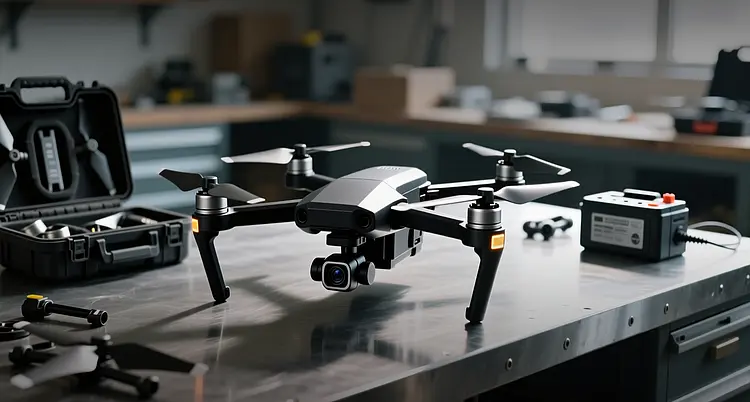
Tracer, based in New Jersey, sells drone hardware and accessories, including NDAA-compliant and Blue List options, thermal imaging systems and drone-detection equipment, and runs FAA Part 107 training, repair and maintenance. Its managed-services arm covers 3D mapping, LiDAR and gas analysis. That mix targets first-responder and enterprise programs rather than the defense primes, which is where the strategic logic sits: Rocket One's Swarm Stage AI is a drone-swarm threat-emulation and counter-UAS training platform, a product that needs buyers with drone programs already in place.
The market's initial verdict was muted. RKTO traded at $0.7460 in pre-market activity on the Nasdaq, down 0.36 percent, after closing the prior session 5.23 percent lower, according to RTTNews. A sub-$1 share price puts the company in micro-cap territory, where a stock-financed acquisition would carry meaningful dilution risk and a cash deal would raise the question of funding — neither of which the announcement addresses.
What Tracer actually adds to the income statement
The distinction Rocket One is drawing is between a technology portfolio and a business that invoices customers. Tracer's revenue comes from hardware resale, training fees, maintenance contracts and managed services — recurring, service-heavy lines that typically carry thinner gross margins than software but generate cash and, more importantly, an installed base of public-safety customers. Rocket One's own description of its assets centers on licensed spintronic and nanomagnetic computing technologies for AI acceleration and radiation-tolerant computing, plus Swarm Stage AI. Those are development-stage or early-commercial efforts. Buying a distributor is a faster route to revenue than building a sales force, and it is the standard playbook for small defense-tech issuers trying to convert a narrative into bookings.
The counter-UAS market Rocket One is targeting has drawn sustained attention from investors as drone incursions at military installations and public events pushed procurement budgets higher. That sector-level enthusiasm is a tailwind for any listed name with drone exposure, but it does not by itself validate a specific acquisition. The relevant test is whether Tracer's existing customer relationships convert into Swarm Stage AI deployments, and whether those deployments are large enough to move Rocket One's top line. No revenue figure for Tracer, no customer count and no backlog were provided.
The closing conditions are the near-term event
Until the transaction closes, Rocket One carries the deal as an announcement rather than a consolidated business. The company flagged the usual conditions: delivery of required transaction documents and other customary items. It did not specify a target closing date, a regulatory approval timeline, or whether any third-party consents — including customer or supplier contracts at Tracer — are required. For a target serving public-safety agencies, contract assignability and any government-contracting approvals are the practical gating items.
The absence of financial terms also means the deal cannot be benchmarked against comparable drone-distribution transactions, and it leaves Rocket One's share count, cash position and pro-forma leverage unchanged in the eyes of anyone modeling the company. Investors get a strategic statement without the arithmetic to test it. The next hard data points will be the SEC filings Rocket One referenced and any subsequent disclosure of Tracer's revenue contribution — until then, the acquisition is a claim about a channel, not evidence of one.
This article is for informational purposes only and does not constitute investment advice.