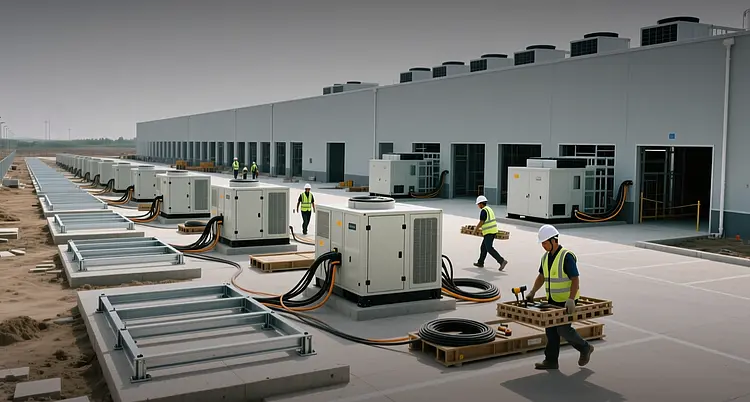
Two industrial suppliers are converting Oracle's AI spending plans into revenue. Vertiv Holdings posted second-quarter net sales of about $3.27 billion, up 24% from a year earlier, while Caterpillar is selling natural gas generators and turbines that energize data centers before utility interconnections are ready.
"Data center demand is a key driver for our power generation business," Caterpillar management said, adding that the company expects continued strength as that demand grows.
Vertiv's growth is being funded with brick and mortar. The company announced four new or expanding factories to raise capacity for power management and infrastructure products, and committed $50 million in Ohio to expand production of liquid-cooling and chilled-water systems built for high-density computing. The Ironton expansion is expected to be operational in the second quarter of 2027. Vertiv also acquired PurgeRite to strengthen its fluid management services, the plumbing layer that keeps coolant flowing through racks drawing far more power per square foot than a decade ago.
Caterpillar is scaling the other half of the problem. Grid interconnections can take years to complete, so the company supplies on-site generation that bypasses the queue. It announced a $725 million expansion of its large-engine manufacturing footprint, citing rising energy demand and the opportunity around AI and data centers, and signed an agreement with Joule Capital Partners to power a high-performance computing campus in Utah with 4 gigawatts of total energy supported by a fleet of Caterpillar natural gas generators.
The two companies are also selling the combination. Caterpillar and Vertiv announced a collaboration pairing Caterpillar's generation equipment with Vertiv's power distribution and cooling systems, aimed at deploying data centers faster and energizing them sooner. For a hyperscaler like Oracle, that means a single vendor stack for the electricity and the heat, rather than two procurement cycles.
The grid is the bottleneck, and it is priced in years
The economics of the trade rest on a timing mismatch. A gas turbine or a generator fleet can be sited and commissioned on a schedule measured in quarters; a new transmission interconnection is measured in years. Every month that gap persists, more of a hyperscaler's capital budget shifts from utility contracts toward on-site equipment — which is why Caterpillar is moving beyond backup generators into primary power for computing campuses.
That shift has a ceiling. If grid operators accelerate interconnection queues, or if utilities build generation faster than expected, the urgency premium on on-site gas generation compresses. Vertiv's exposure is less cyclical on that axis: liquid cooling demand scales with chip power density, not with how the electricity arrives. Nvidia's current accelerator generations run hot enough that air cooling becomes impractical at rack densities above roughly 30 kilowatts, a threshold the newest AI racks clear by a wide margin.
Investor positioning has started to reflect the split. With many portfolios still concentrated in chip and memory names, capital has rotated toward the power and cooling layer of the AI supply chain — the picks-and-shovels trade applied to electricity rather than silicon. Vertiv and Caterpillar both sit on that rotation, alongside electrical equipment peers and grid suppliers that sell into the same buildout.
The risk in that rotation is crowding. AI-adjacent industrials now carry valuations that assume hyperscaler capex keeps compounding, so any slippage in data center construction schedules hits order books before it hits earnings. Oracle's commitment is the demand spine here; the suppliers' revenue is a derivative of it, and derivatives move faster in both directions.
This article is for informational purposes only and does not constitute investment advice.