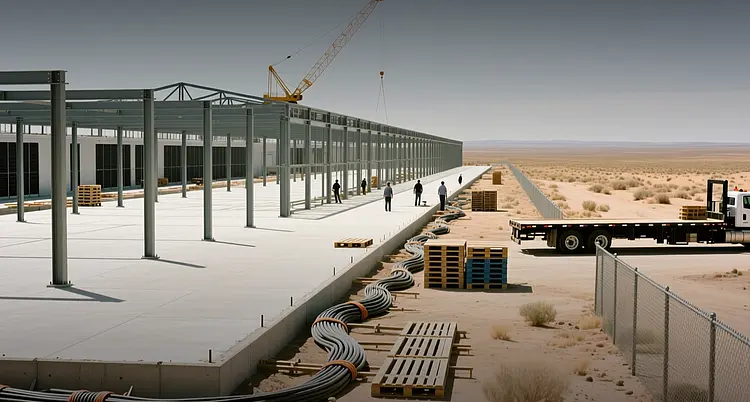
About $18 billion of loans tied to an Oracle-leased data center in New Mexico are changing hands at 89 to 91 cents on the dollar, a discount that syndicate banks including Santander and Jefferies are absorbing as they test demand for AI infrastructure credit.
The quotation, first reported by the Financial Times on Friday, puts the facility roughly 10 points below par less than a year after Oracle issued $18 billion of bonds in September 2025 against a reported $300 billion, five-year cloud contract with OpenAI. A price in the high 80s implies buyers now demand a yield consistent with single-B credit for paper underwritten on an investment-grade thesis.
"Lenders are no longer pricing the OpenAI contract, they are pricing the construction timeline," said Marta Villegas, head of European credit strategy at a Madrid-based fixed-income research firm. "Until the New Mexico site is energized and billing, the collateral is steel and permits."
The pressure on the loan is not isolated. S&P cut Oracle's credit rating to BBB- in July 2026, one notch above junk, and the company's credit default swaps widened to about 2.03 percent, near 18-year highs. Oracle's net debt is projected to exceed $105 billion by late 2025, capital expenditure for fiscal 2026 is tracking above $55 billion, and free cash flow turns negative by roughly $24 billion after that spending. Bondholders have separately sued, alleging the company understated its additional financing needs when it sold the September 2025 notes.
The syndicate carries the mark
For Santander and Jefferies, the exposure is a mark-to-market problem before it is a credit problem. A 10-point discount on an $18 billion facility implies roughly $1.8 billion of unrealized losses across the syndicate if the loans were held at that level, though banks typically distribute portions of such facilities and the final allocation is not yet disclosed. Both banks declined to comment on the pricing.
The wider syndicated loan market has been receptive to data center paper this year, which makes the Oracle discount more notable. Comparable hyperscaler-linked facilities from Microsoft and Alphabet have continued to clear near par, reflecting the gap between their balance sheets and Oracle's. Microsoft and Alphabet both carry investment-grade ratings several notches above Oracle's and generate positive free cash flow while building.
Oracle's total pipeline is larger than the New Mexico site alone. Financing requirements across planned sites in Texas, Wisconsin, and New Mexico are estimated at up to $56 billion, with Texas and Wisconsin accounting for about $38 billion of that. The company is reportedly targeting more than $40 billion in additional debt and equity raises this fiscal year.
Permits, power, and the cost of delay
Community opposition has already changed the New Mexico project's economics. Regulatory and local pressure pushed Oracle to abandon gas turbines as the site's power source in favor of renewable generation, a redesign that alters both the construction schedule and the cost profile. Similar opposition in Texas and Wisconsin has produced legal challenges and extended comment periods.
Each month of delay pushes revenue recognition further out while interest accrues. That mismatch is the core of the credit question: the OpenAI contract is a long-duration commitment, but commitments are not collected revenue, and the debt service on the facility begins before the servers do.
The Bank for International Settlements warned on Sept. 14 that the AI-driven equity rally shows growing vulnerabilities as investors question the profitability and leverage of major technology firms, noting that aggregate tech borrowing has climbed sharply and that credit default swap spreads for the sector have widened. The BIS said equity and credit markets have not shown broad stress, but risk premiums are rising.
Oracle shares have underperformed Microsoft and Alphabet over the past quarter as the credit story moved from footnote to headline. A further downgrade would push Oracle below investment grade, a threshold that triggers forced selling by a large class of institutional bondholders and mechanically raises the cost of the $40 billion-plus the company still intends to raise.
The next test comes when Oracle returns to the debt markets. If the New Mexico facility stabilizes near 90 cents, the syndicate can clear the remaining paper and the company funds its build on schedule. If it trades into the mid-80s, the pricing on every subsequent data center facility — Oracle's and its peers' — resets higher, and the economics of the AI buildout compress for everyone borrowing against it.
This article is for informational purposes only and does not constitute investment advice.