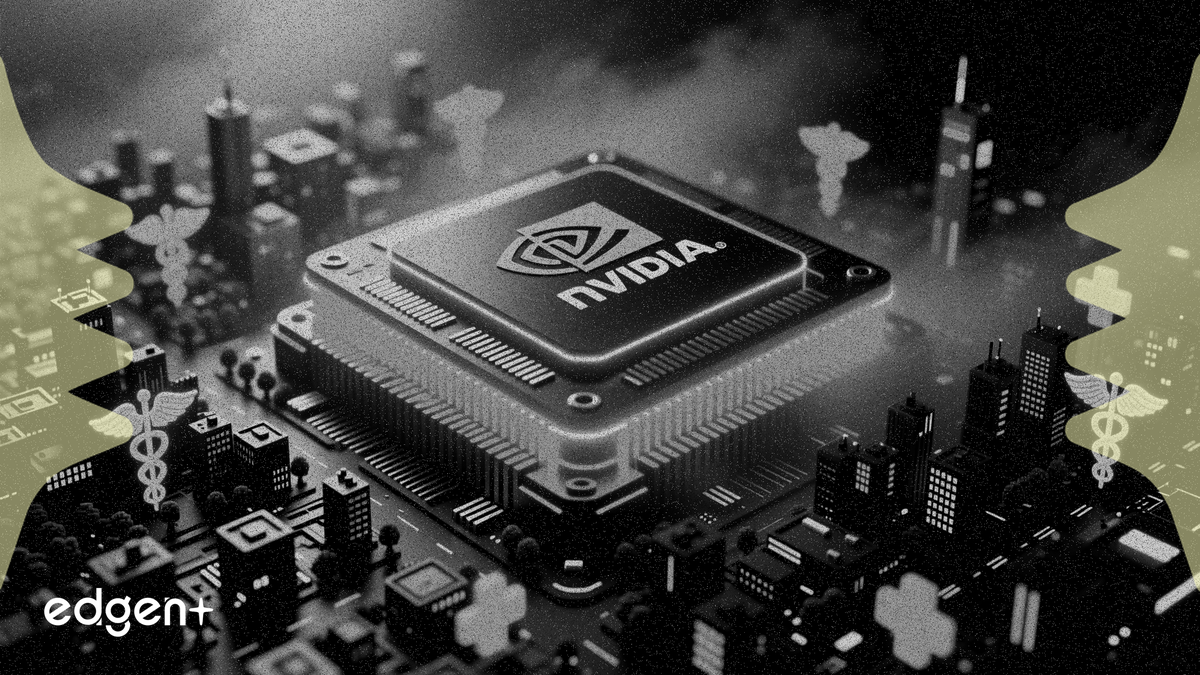
The artificial intelligence boom has pushed Nvidia's market capitalization to $5.4 trillion, making the chipmaker more valuable than the S&P 500's entire healthcare sector. The milestone shows the historic market concentration in technology, which now accounts for a record 37% of the total index.
"The tech sector has a record-high market cap of over $23 trillion," a recent Barron's analysis shows, highlighting the scale of the current market structure. When including other tech-centric giants like Amazon, Alphabet, and Meta Platforms, the effective technology weighting in the S&P 500 approaches 50 percent.
Nvidia's stock, which hit a record high Monday, has driven the State Street Technology Select Sector SPDR ETF (XLK) to a 24% gain this year. In stark contrast, the State Street Healthcare Select Sector SPDR ETF (XLV), which holds the 59 companies in the healthcare index, has fallen 7% over the same period. The entire healthcare sector is now valued at $5.2 trillion, with its largest component, Eli Lilly, valued at approximately $900 billion.
This extreme valuation gap, the widest in history, presents a critical question for investors: whether the concentration in technology stocks creates a systemic risk. The performance disparity may fuel a rotation into the out-of-favor healthcare sector, but the underlying drivers of the AI buildout suggest the trend has deep infrastructure roots.
The $700 Billion AI Infrastructure Buildout
The surge in technology valuations is not just a software story; it's a story of immense capital expenditure. Big Tech firms like Alphabet, Amazon, Microsoft, and Meta are projected to spend around $700 billion on capital projects in 2026 alone to support their AI ambitions, according to a MarketWatch report. This spending is landing directly on the U.S. power grid, creating a massive demand shock.
The effects are already visible in wholesale electricity markets. PJM Interconnection, the grid operator for much of the U.S. Mid-Atlantic, saw capacity prices surge from under $30 per megawatt-day for 2024-25 to over $300 for 2026-27. This repricing of energy flows outward, affecting industrial power bills and creating a new class of winners and losers from the AI boom.
The New Gatekeepers of the AI Grid
While hyperscale tech companies can often negotiate favorable long-term power agreements, the clearest investment case lies with the infrastructure companies that are essential to the grid's expansion. These companies are the new gatekeepers of the AI economy, providing the physical hardware that software cannot optimize away.
Grid equipment and power management firms are seeing backlogs swell. GE Vernova has reportedly sold out its gas turbine production through 2030, while companies like Eaton Corp. and Quanta Services are critical suppliers for data center electrical systems and grid connections. This positions them as direct beneficiaries of the non-discretionary spending required to power AI, regardless of which individual AI model or company ultimately succeeds. The constraints on the grid are now as significant a bottleneck as the supply of semiconductor chips.
This article is for informational purposes only and does not constitute investment advice.