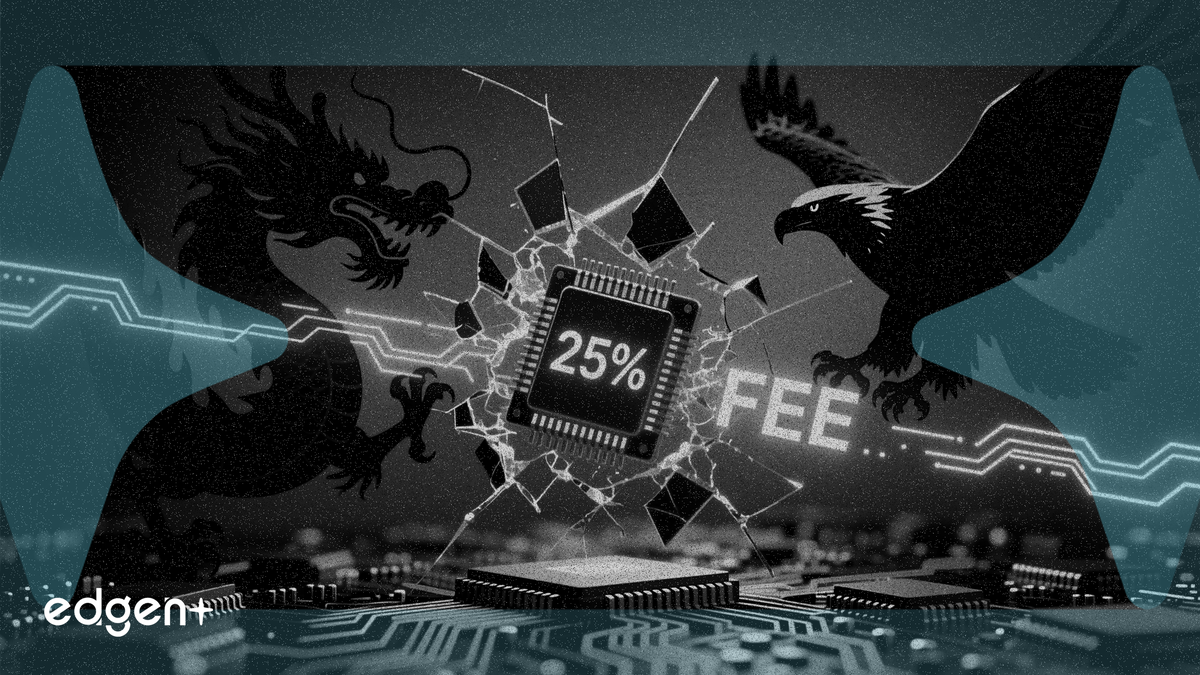
A high-stakes push by the Trump administration to sell Nvidia Corp.’s (NASDAQ:NVDA) advanced AI chips to China has unraveled after Beijing balked at the deal’s financial terms and security provisions, erasing a potential $30 billion annual revenue stream for the U.S. chipmaker and sending its stock down 4.4 percent.
"They choose not to buy because they want to develop their own," President Donald Trump told reporters Friday, confirming that Chinese authorities would not approve domestic purchases of Nvidia’s H200 accelerators. "I think something could happen on that."
The breakdown follows a U.S. Commerce Department decision to license the sale of up to 75,000 H200 chips each to roughly 10 Chinese firms, a potential windfall of $15-$20 billion in its initial phase. The framework, however, included a 25 percent fee on all revenue payable to the U.S. Treasury. Nvidia stock fell 4.4 percent Friday after the failure was confirmed, giving back its all-time high from a day earlier.
The failure of the deal crystallizes a strategic pivot by Beijing toward technological self-sufficiency, effectively foreclosing Nvidia from a market where it held 95 percent share before export curbs. For Nvidia, the immediate loss of a major growth channel is being weighed against a global market where demand for AI accelerators still far outstrips supply. The company is set to report quarterly earnings on May 20, when investors will watch for changes to its guidance, which currently assumes zero revenue from China.
A Strategic Pivot, Not a Tactical Pause
Beijing’s rejection appears to be a strategic decision rather than a tactical dispute over price. The primary objection, according to a Reuters report, was a U.S. requirement that all chips be physically routed through American territory for verification before re-export to China. This, combined with the 25 percent export fee, prompted supply-chain security concerns within the Chinese government.
The decision aligns with a broader push to nurture domestic technology champions.
- Huawei Ascend: China’s leading AI labs are increasingly optimizing models for Huawei’s Ascend-series chips. DeepSeek, a top domestic lab, launched its V4 model in April specifically for Ascend hardware.
- Increased Capex: ByteDance has lifted its 2026 AI capital expenditure to $30 billion, with a growing share directed to domestic chipmakers.
- Market Response: Prices for Huawei’s flagship Ascend 950PR chip have risen approximately 20 percent on strong demand following the DeepSeek launch.
"President Trump is handing Xi Jinping some of our most advanced AI chips," Massachusetts Democratic Sen. Elizabeth Warren said in a statement criticizing the now-failed negotiations. "That might help the president curry favor with Xi or NVIDIA’s billionaire CEO... But it also gives NVIDIA a green light to prioritize China over U.S. customers."
Global Demand Absorbs the Shock
While the collapse of the deal removes a significant upside scenario, Nvidia’s baseline business case may remain undisturbed. The company’s forward guidance for over a year has assumed near-zero data center revenue from China following earlier U.S. export controls.
The 750,000 H200 accelerators notionally reserved for Chinese buyers are now available to a global market that has been compute-constrained for two years. Every chip is expected to be reallocated to fill a long queue of existing orders from other customers.
- Hyperscaler Demand: Microsoft’s fiscal 2026 capital expenditure guidance is $190 billion, while Meta has committed $130 billion, much of it for AI infrastructure.
- Sovereign AI: National AI initiatives in Canada, the UAE, Saudi Arabia, and India have large, standing orders for frontier chips that are not being filled fast enough.
From this perspective, the event does not create a hole in Nvidia’s order book; it simply redirects already-sold inventory from one set of buyers to another. The structural read is that the China export ceiling was an optimistic case on top of a baseline that already excluded the region. That optimistic case has now been removed for the near term, but the floor remains intact.
This article is for informational purposes only and does not constitute investment advice.