

Nvidia launched Halos for Robotics, the industry's first full-stack physical AI safety system, extending its autonomous driving safety architecture to robots operating alongside humans in factories and warehouses.
Nvidia launched Halos for Robotics, the industry's first full-stack physical AI safety system, extending its autonomous driving safety architecture to robots operating alongside humans in factories and warehouses.
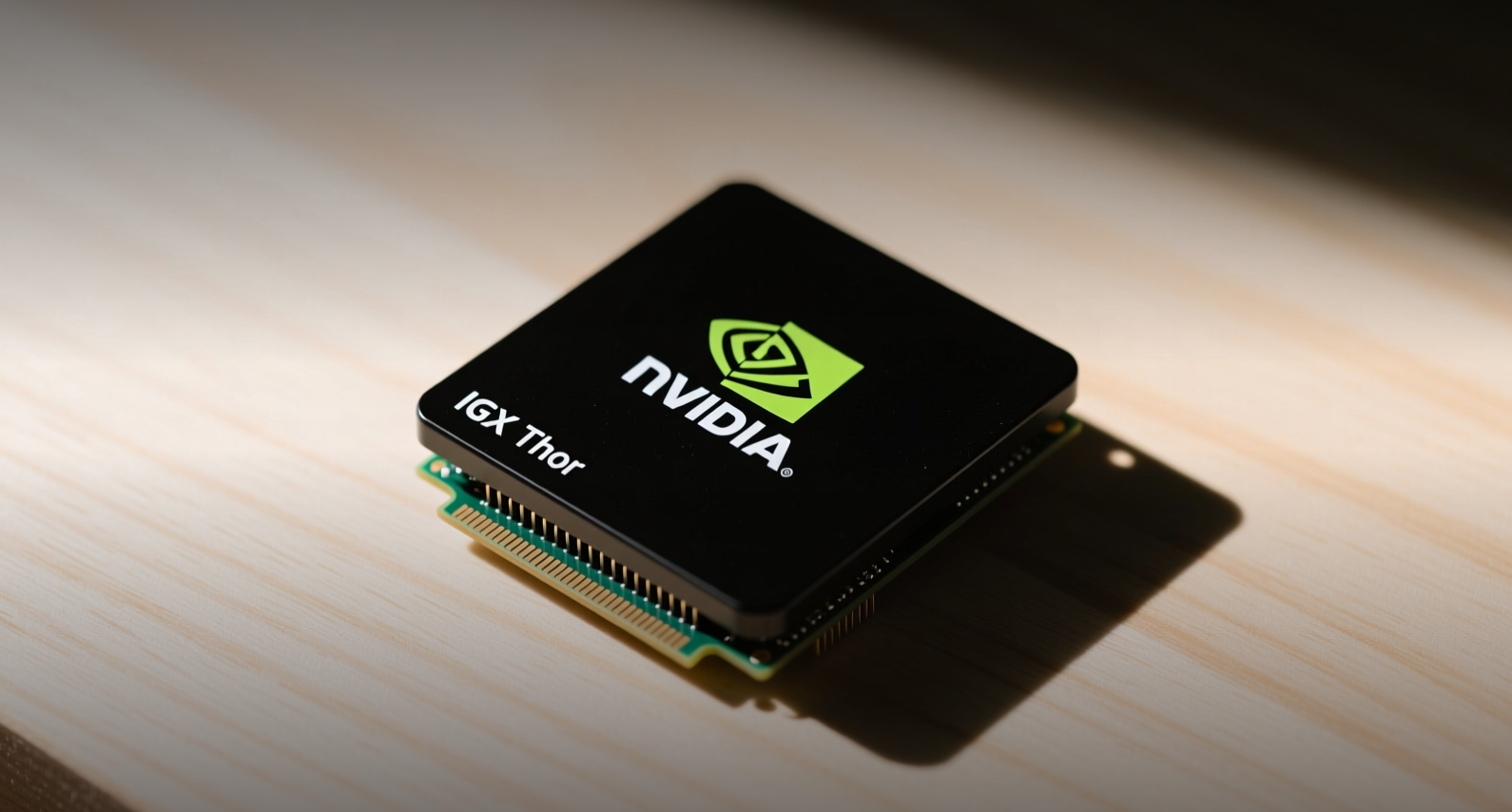
Nvidia Corp. on Monday introduced Halos for Robotics, the industry's first full-stack physical AI safety system, extending its autonomous driving safety architecture to robots that must perceive, decide and act in real time alongside human workers. The system combines Nvidia's IGX Thor compute platform, Holoscan Sensor Bridge for sensor connectivity, and Halos OS safety software into a unified framework that spans building, testing and managing AI robotics applications — addressing what Deloitte identified as the primary roadblock to broad physical AI adoption.
"Safety has always been the precondition for scale — you can't deploy robots broadly if you can't guarantee they'll operate safely around people and valuable infrastructure," Samuel Reeves, chief executive officer of FORT Robotics, said in a statement. FORT, which provides the Trust Layer for physical AI, joined the Nvidia Halos ecosystem and demonstrated an agentic safety application built with the open-source Nvidia Halos Outside-In Safety Blueprint at the Automate conference in Chicago.
The Halos system comprises several layers: the IGX Thor and Holoscan Sensor Bridge for industrial-grade AI compute and sensor connectivity; Halos OS with Halos Core for safety-related operating functions; and pluggable blueprints that extend robot perception using external cameras and AI agents to dynamically adjust robot behavior. The Halos AI Systems Inspection Lab, accredited by the American National Standards Institute National Accreditation Board, is the first facility designed specifically to verify functional safety, cybersecurity and AI compliance for autonomous systems, working with certification bodies including TUV Rheinland, UL Solutions, TUV SUD, Exida, SGS and CertX.
The stakes for robotics safety are rising as physical AI moves from pilots to production. Agility Robotics Inc., a leading humanoid robotics company, became the first to integrate Halos elements into its proprietary safety system, deploying its Digit robot at Toyota Motor Manufacturing Canada's Woodstock facility in Ontario. Agility's customers include Amazon.com Inc., GXO, Schaeffler and Toyota. "For humanoids to deliver value at scale, safety has to be built into the robot and validated across the entire system," Agility Chief Executive Peggy Johnson said.
Outside-In Safety Extends Robot Perception Beyond Onboard Sensors
Traditional safety systems rely on onboard sensors that limit robots to conservative operating constraints in bounded environments. Nvidia's Outside-In Safety Blueprint, combined with FORT's Trust Layer, uses external infrastructure sensors and visual AI agents to deliver real-time, safety-certifiable functional safety that maximizes operational throughput. The approach automatically modulates robot efficiency across dynamic environments, reducing costly slowdowns that plague conventional systems.
FORT's broader safety architecture now spans three tiers: Outside-In Safety for infrastructure-based perception; Onboard Active Safety for real-time detection and response; and Human-in-the-Loop control for remote operation and intervention. FORT has secured 27 patents since its founding in 2018 and deployed more than 19,000 units to over 600 customers across warehousing, manufacturing, agriculture and construction.
Regulatory Pressure Accelerates Safety Standardization
The European Union Machinery Regulation, effective Jan. 20, 2027, will for the first time require conformity assessment for machines with "self-evolving behavior," a category that captures any machine running on an AI foundation model. The regulation interacts closely with the EU AI Act, though it does not yet clearly define how to certify systems that trigger its requirements. Nvidia is positioning Halos as a certification platform — analogous to "Intel Inside" for AI safety — that vendors can integrate to demonstrate compliance with emerging standards.
Nvidia shares have gained 42% over the past 12 months as the company's data center business has expanded beyond GPU sales into full-stack AI infrastructure. The Halos for Robotics launch extends Nvidia's addressable market into the robotics safety layer, a segment that has lacked standardized certification frameworks. Agility's Digit operates under robots-as-a-service agreements, a model that requires demonstrable safety guarantees before insurers and customers will underwrite deployment at scale. With Halos, Nvidia is betting that the same safety architecture that underpins its autonomous vehicle platform can become the default standard for the broader physical AI economy.
This article is for informational purposes only and does not constitute investment advice.
