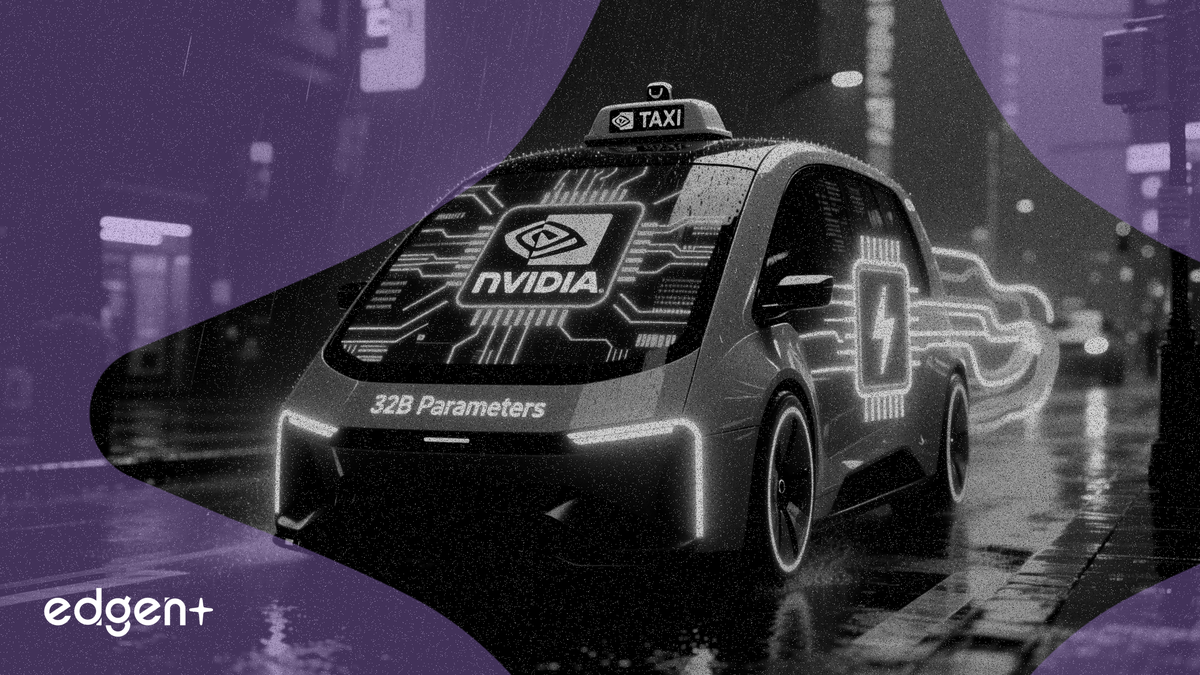
Nvidia's Alpamayo 2 Super triples its predecessor's parameter count to 32 billion, bringing reasoning-based decision-making to level 4 autonomous driving.
Nvidia's new open-source Alpamayo 2 Super model brings reasoning-based decision-making to autonomous vehicles at 32 billion parameters, three times the scale of its predecessor, threatening in-house approaches from Tesla and Waymo.
"Alpamayo is the moment cars begin to safely reason, not just drive," Jensen Huang, founder and chief executive officer of Nvidia, said at GTC Taipei.
The model expands from front-facing cameras to 360-degree surround perception and introduces Meta-Actions — high-level driving decisions such as yield, lane change and stop — alongside trajectory outputs. It also adds reasoning auto-labeling with 2D grounding that compresses annotation cycles from months to days, according to Nvidia.
Nvidia shares closed at $211.26 on May 30, down 1.45%, with volume of 265 million shares exceeding the 20-day average of 166 million by 59%. The stock has gained about 12.6% year to date, trading above its 200-day moving average of $187.65.
Alpamayo 2 Super Specs Close the Reasoning Gap
Built on Nvidia's Cosmos world foundation models, Alpamayo 2 Super is designed as a teacher model that can be distilled into compact versions running on the Nvidia DRIVE AGX Thor platform inside the vehicle. The 32-billion-parameter model improves chain-of-causation traces and trajectory quality in long-tail scenarios where traditional imitation-learning systems fail, the company said.
The Alpamayo family now spans from 10 billion to 32 billion parameters, with the new model supporting multitask capabilities including reasoning, auto-labeling, scene understanding, model critiquing and knowledge distillation. Alpamayo won the COMPUTEX Best Choice Award in the Vehicle Technology and Smart Cockpit category.
Alongside the model, Nvidia introduced AlpaGym, an open-source closed-loop reinforcement learning framework that runs models through continuous decision cycles in the AlpaSim simulator. Unlike open-loop training, which evaluates models against recorded data, AlpaGym exposes compounding errors by letting every braking, steering and navigation choice affect the environment. The company also released OmniDreams, a generative world model for photorealistic scenario generation, and the CoC Auto-Labeling Pipeline, which generates causal labels from raw driving clips without human annotation.
What This Means for the Robotaxi Race
The launch positions Nvidia as the primary AI infrastructure provider for the autonomous driving industry, competing directly with vertically integrated solutions from Tesla and Waymo. By releasing the model as open source on GitHub and Hugging Face this summer, Nvidia is betting that the broader developer ecosystem will adopt its stack rather than build proprietary systems from scratch.
For investors, the question is whether developer downloads translate into hardware revenue. Nvidia's automotive segment has historically been a small contributor relative to its data center business, but the Alpamayo platform's nearly 400,000 downloads since launch suggest growing traction. Each deployment requires Nvidia's DRIVE AGX Thor compute platform, creating a recurring hardware pull-through that could expand the company's total addressable market beyond its core data center and gaming businesses.
Alpamayo 2 Super is expected to be available this summer for inference code on GitHub and model weights on Hugging Face.
This article is for informational purposes only and does not constitute investment advice.