nVent Electric now expects reported sales growth of 37% to 39% in 2026, up from a prior range of 26% to 28%, after data center demand pushed second-quarter organic sales up 47% and the company's infrastructure unit more than doubled.
"Strong orders, backlog and customer visibility supported the decision to add more capacity," Chief Executive Officer Beth Wetzel said, according to the company's second-quarter results.
The guidance revision is the largest single-step increase nVent has issued since it began breaking out data center revenue. Organic growth guidance moved to 32% to 34% from 21% to 23%. Total second-quarter sales rose 53% year over year to $1.47 billion, with the infrastructure vertical leading on organic sales that more than doubled. Management said data center sales should exceed $2 billion in 2026, more than double the prior year. The Zacks Consensus Estimate for 2026 revenue sits at $5.45 billion, implying 39.96% growth.
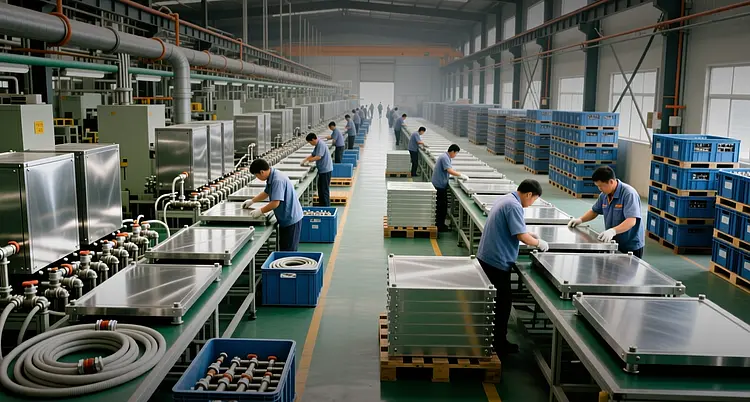
The number that matters for the supply chain is capacity, not the guidance. nVent opened a liquid cooling plant in Blaine, Minnesota, earlier this year that doubled its liquid cooling output, and has already committed to a second facility, Blaine 2, scheduled to open in the first half of 2027. Liquid cooling moves heat away from graphics processors using fluid rather than air, and it becomes necessary once rack power density passes roughly 30 kilowatts — the range Nvidia's GB200 and successor systems occupy. Air cooling cannot dissipate that load at acceptable efficiency, which is why every rack shipped at that density carries a thermal management bill of materials that did not exist three years ago.
Vertiv is the benchmark, and it is bigger
The competitive frame is Vertiv, which sells power, cooling and services as one integrated package and expects 2026 sales of about $14 billion, up 37% year over year with 31% organic growth. Vertiv has been buying thermal expertise rather than building it, including Strategic Thermal Labs, which added server-side liquid cooling and cold-plate engineering. Super Micro Computer competes on the server side of the same buildout, bundling liquid-cooled racks directly with compute.
Against that, nVent's roughly $5.45 billion in expected 2026 revenue is about 39% of Vertiv's guided total, and its exposure is narrower — enclosures, cable management, engineered buildings and cold plates rather than the full power train. The narrower scope cuts both ways. nVent captures less revenue per megawatt than Vertiv, but it also carries less execution risk on the electrical side, where long-lead switchgear and transformer shortages have delayed deployments across the industry.
Power utilities were the second engine in the quarter, growing at a double-digit rate. Management attributed that to data center load growth and an aging grid, two forces that pull in the same direction: utilities must add capacity and replace equipment simultaneously. nVent expects the infrastructure vertical to deliver strong double-digit growth in 2026 on higher AI-related data center spending and power infrastructure demand.
What the guidance does not settle
The raised outlook is a demand statement, not a margin statement. nVent did not disclose incremental margin guidance for the new liquid cooling capacity, and the Blaine 2 plant will not contribute revenue until 2027 — meaning the 2026 numbers rest on capacity that already exists. If orders keep compounding at the current rate, the company will be capacity-constrained again before Blaine 2 comes online, which is the same problem Vertiv and every other thermal supplier is managing.
For investors, the read-through extends past nVent. The company's order book is one of the few public, quarterly-updated proxies for how fast hyperscalers are actually installing liquid-cooled racks, as opposed to how much they have announced they will spend. A guidance raise of this size, backed by named capacity additions rather than commentary, is harder to dismiss as sentiment. The risk is that the entire thermal supply chain is now adding capacity against the same demand curve, and if AI capital spending plateaus in 2027, the industry will be holding plants built for a growth rate that stopped.
This article is for informational purposes only and does not constitute investment advice.