New Era Energy & Digital's subsidiary TCDC PowerCo has signed a 20-year power purchase agreement with Luminant ET Services, a Vistra Corp. affiliate, covering a minimum of 200 MW and up to 207 MW for Phase 1 of the company's Texas Critical Data Center, with firm power expected to reach the site in the third quarter of 2027.
"Having firm, contracted power for Phase 1 in New Era's name is an incredible milestone which we believe materially reduces Phase 1 development risk at TCDC," Charlie Nelson, Chairman and Chief Executive Officer of New Era, said. "With the land secured, construction permits in hand, Phase 1 power contracted for 20 years, and room to expand to multiple phases, we believe this is an attractive opportunity to any quality tenant currently in the market."
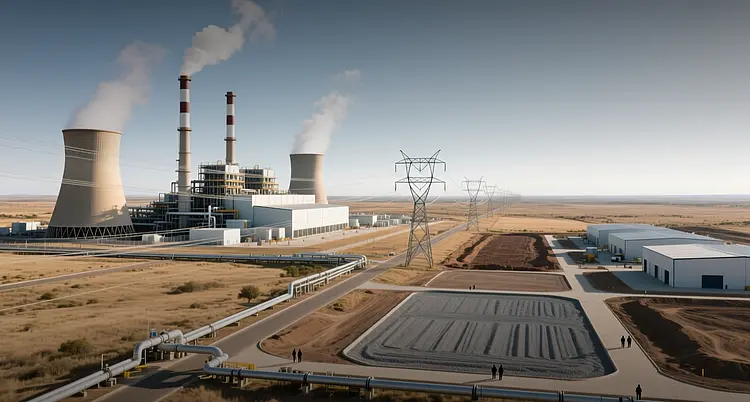
The electricity will come from Vistra's 1,180 MW natural gas-fired generating facility in Odessa, Texas, which sits immediately adjacent to the 493-acre TCDC site in the Permian Basin. The contract runs an initial 20-year term with automatic one-year renewals thereafter. New Era's stated build-out plan scales the campus to 1.4 GW of anticipated capacity over time, meaning the Phase 1 agreement covers roughly 15% of the site's eventual power envelope.
Alongside the PPA, affiliates of both companies signed a development framework agreement. Once power delivery begins, Vistra receives a 5% non-voting interest in the portion of the data center project it supplies, plus a right of first refusal on future TCDC development opportunities and a right of first offer on certain development opportunities serving other New Era projects.
"Demand for reliable power to support digital infrastructure continues to grow across the United States," Claudia Morrow, Senior Vice President of Corporate Development and Strategy at Vistra, said. "We are pleased to work with New Era on a long-term power arrangement for the TCDC project and to establish a framework that allows us to evaluate additional power opportunities together over time."
New Era shares rose 20.30% to $7.05 in pre-market trading on the Nasdaq, after closing Friday's regular session 0.86% higher. Vistra shares gained 1.42% to $142.45 in pre-market NYSE activity, following a 2.01% decline at Friday's close.
Why 207 MW in the Permian Basin matters more than the headline number
The structure of the deal is the story. New Era is not buying power from a utility at regulated tariff; it is contracting directly with a merchant generator that owns the plant next door. That arrangement, sometimes described as behind-the-meter supply, removes the interconnection queue from the critical path — a queue that in ERCOT has stretched to multi-year waits for large loads. New Era's own description of its strategy leans on exactly this: large-acreage sites paired with flexible power, deployed in modular phases to shorten time-to-power for hyperscale, enterprise and edge operators.
The counterparty carries weight too. Vistra is one of the largest competitive power producers in the United States, with a generation fleet spanning gas, nuclear and renewables, and a retail and power-marketing arm that sells electricity to millions of customers. Its 1,180 MW Odessa plant is roughly 5.7 times the size of the Phase 1 commitment, leaving physical headroom for the later phases New Era has flagged. Vistra's own framing of the deal — a framework "that allows us to evaluate additional power opportunities together over time" — points at that headroom rather than a one-off contract.
The scarcity backdrop explains the pricing power on both sides. Data center developers across Texas, Virginia and the Midwest are competing for long-dated electricity supply, and the constraint is increasingly generation and interconnection rather than land or capital. That dynamic has pushed merchant generators with existing gas fleets into a stronger negotiating position, and it has made contracted power a prerequisite for tenants evaluating a site. New Era's CEO framed the PPA as the step that turns TCDC "from a site with a power plan into permitted powered land."
For investors, the read-through is about risk transfer. A 20-year contract with a named investment-grade-adjacent counterparty converts an uncertain development cost into a known, financeable line item — the kind of visibility lenders and prospective tenants both require. It also gives New Era a defensible answer to the question that has stalled comparable projects: where does the electricity actually come from, and who is on the hook if it does not arrive?
The open items are the ones the announcement does not price. New Era has not disclosed the contract's dollar value, the power price per MWh, or the credit support required to secure its obligations — the company's own risk disclosure flags "the ability to obtain credit support to secure contractual obligations on commercially reasonable terms or at all." No anchor tenant has been named for Phase 1. And the 5% non-voting interest Vistra receives only vests once delivery starts, which ties Vistra's equity upside to a 2027 energization date that has not yet been tested by construction.
The comparison set is instructive. Vistra has been assembling large-load offtake agreements with data center operators as a way to underwrite its generation book, a strategy that has drawn scrutiny from analysts focused on whether contracted volumes can be delivered on schedule. New Era, with a market capitalization in the hundreds of millions rather than tens of billions, is the smaller party in the relationship and carries the development risk that Vistra's framework agreement is structured to limit. The 20.30% pre-market move in NUAI against Vistra's 1.42% gain captures that asymmetry precisely: for New Era, the PPA is existential; for Vistra, it is one more contract in a growing book.
What happens next is a tenant announcement and a construction schedule. Phase 1 power is due in the third quarter of 2027, and the automatic one-year renewals mean the contract's economics extend well beyond the first tenant's lease term — a structure that favors a developer able to sign long-duration commitments. Until a tenant is named and the contract's value is disclosed, the market is pricing a de-risked site, not a leased one.
This article is for informational purposes only and does not constitute investment advice.