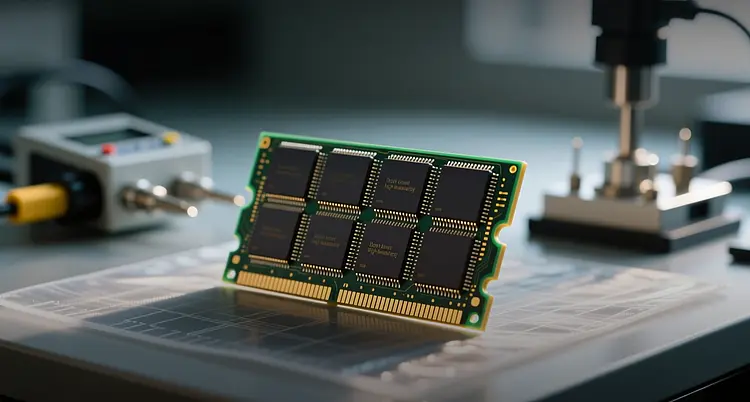
Micron Technology climbed 3.12% at its Friday session high after RBC Capital Markets argued the chipmaker trades at a discount to the AI memory business it has become.
The call rests on the gap between Micron's trading multiple and the durability of the demand it is contracted to serve. RBC's argument is that the market still prices Micron as a cyclical DRAM supplier rather than as a supplier of high-bandwidth memory (HBM) into AI accelerators, where supply remains sold out and pricing is set by long-term agreements rather than spot markets.
The fundamental record behind that argument is already on the tape. Micron reported record fiscal third-quarter revenue of $41.46 billion, with gross margin at 85%, and guided fiscal fourth-quarter revenue to roughly $50 billion at 86% margins. The company has disclosed $22 billion in strategic customer agreements that lock in volume and pricing across multiple years, and said its HBM4 products are already shipping in high volume.
Supply conditions support the re-rating case. Micron has said supply-demand tightness for both DRAM and NAND will persist beyond calendar 2027, and management has described demand as exceeding capacity by roughly 50%, with capacity sold out through 2027. The company carries more than $100 billion in logged orders, including 16 long-term supply contracts with set pricing.
The read-across extends across the memory complex. SanDisk guided fiscal first-quarter revenue of $10.3 billion to $10.8 billion, with sequential growth coming from both bit growth and modest price increases, and expects mid-teens sellable bit growth for fiscal 2027. Netlist reported second-quarter revenue of $109.8 million, up 163% year over year, with gross profit up 1,544% to $22.9 million, largely on resale of difficult-to-source DRAM — a direct signal of how constrained the merchant market has become.
Micron shares have roughly doubled over the trailing 12 months, and the stock trades at a price-to-earnings ratio near 21, according to MarketBeat data. The consensus rating among 38 covering analysts is Buy, with a consensus price target of $1,295.63 against a recent price of $929.20, implying about 40% upside. The high end of the target range sits at $2,000.
Not every model agrees on the near term. A Finbold AI agent survey published this month projected Micron at an average $915.31 by October 1, a 0.93% decline from $923.88, with individual forecasts ranging from $955 to $895.42 — a spread that reflects how much of the AI memory trade is already reflected in the price.
For holders, the RBC note is a valuation argument rather than a new disclosure, so its persistence depends on confirmation from memory pricing data and Micron's own numbers. The next test is Micron's fiscal fourth-quarter earnings report on September 30, when investors will look for whether the $50 billion revenue guide and 86% margin target hold, and whether the company extends its sold-out capacity position into 2028.
This article is for informational purposes only and does not constitute investment advice.