

The burger chain's investor day laid out a 2030 profitability goal well above its 2025 result, backed by a decade-long package of rent relief and direct capital for restaurant modernization.
The burger chain's investor day laid out a 2030 profitability goal well above its 2025 result, backed by a decade-long package of rent relief and direct capital for restaurant modernization.
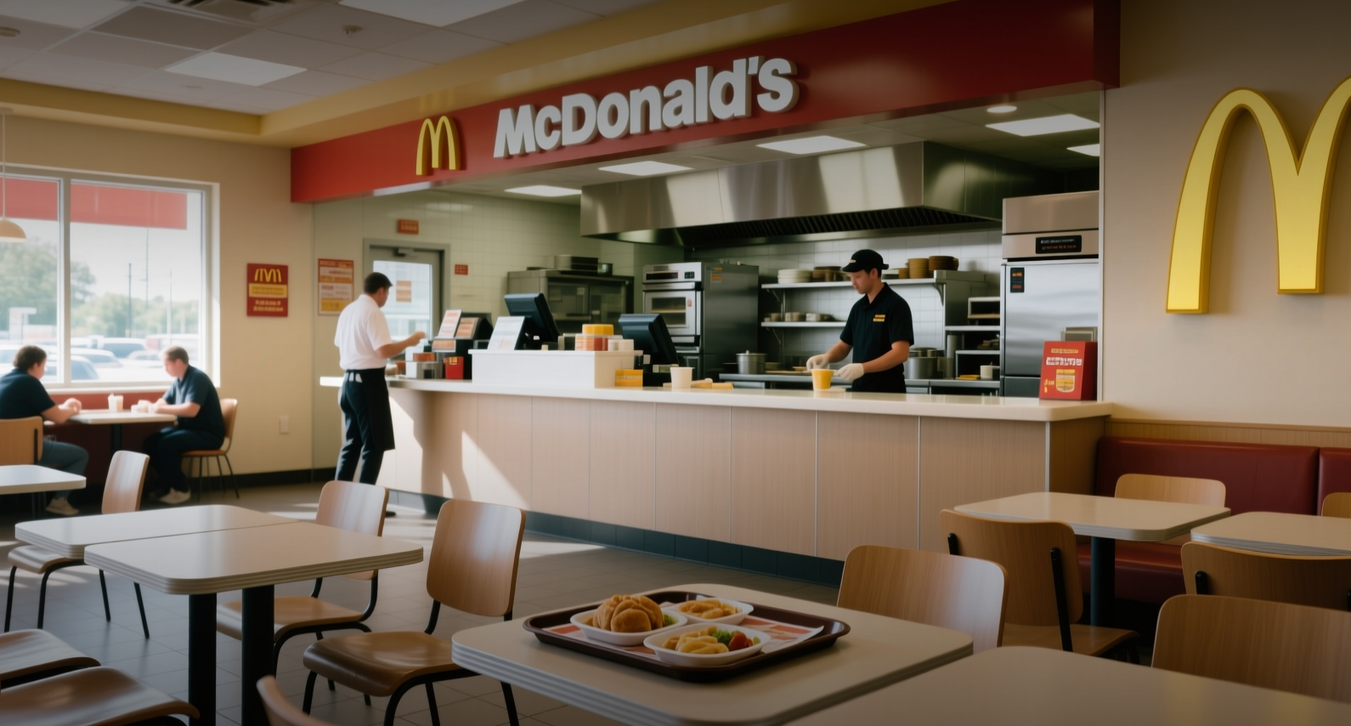
Investors got the number they had been waiting three months for: McDonald's aims to push operating margin into the low-to-mid 50% range by 2030, from 46.1% in 2025, and will commit as much as $8.5 billion through 2036 to fund franchisees' equipment, technology and remodel spending.
The capital support, disclosed Sept. 23 ahead of the company's investor day at its Chicago headquarters, splits into roughly $5 billion through 2030 and the remainder through 2036, delivered as a mix of direct capital and rent relief. "We are asking franchisees to invest at a level they have not been asked to invest before, and we have to be a partner in that," Chief Executive Chris Kempczinski said at the presentation.
The program sits inside McDonald's > NEXT, the growth strategy unveiled in June. Its centerpiece is Restaurant > NEXT, a package of kitchen, equipment and operations upgrades built around ArchIQ, an artificial-intelligence operating system for restaurants. Remodels, which McDonald's mandates roughly every decade, run alongside it. The company projects the efficiency gains will add about $100,000 in annual cash flow to the average U.S. restaurant, with a roughly four-year payback on franchisee investment.
Capital spending rises to between $600 million and $900 million a year in 2027 and 2028, on top of about $3 billion in typical annual capex. McDonald's reported $3.4 billion of capital expenditures in 2025. From 2027 through 2030, it projects $1.5 billion to $2 billion of incremental spending to accelerate NEXT.
The margin math leans on overhead rather than sales. McDonald's targets general and administrative costs at about 1.9% of systemwide sales by 2030, down from a forecast 2.2% in 2026. Free cash flow conversion is guided to the mid-to-high 80% range. New restaurants are expected to contribute about 2.5% of systemwide sales growth in 2027, moderating to roughly 2% by 2030.
Unit growth carries the rest. The chain expects to reach 50,000 restaurants globally by 2028, up from more than 44,000 today, with about 2,100 net additions in 2026 — approximately 2,600 gross openings, including around 750 in the U.S. and international operated markets. McDonald's pushed the 50,000 target back from the end of 2027, citing rising construction costs.
The expansion lands against a soft U.S. business. Comparable sales in the most recent quarter rose 0.8% in the U.S. while traffic fell. Management attributed the weakness to execution around value offers rather than the strategy itself, and said restaurants were overwhelmed by too many product launches, slowing service and dragging customer satisfaction. McDonald's replaced its U.S. chief in August with company veteran Skye Anderson.
Menu mix is the second lever. McDonald's wants to grow global market share in chicken and beverages by about 1.5 percentage points each by 2030, categories where Raising Cane's and 7 Brew are expanding quickly. It is testing hand-breaded chicken while defending its beef leadership. "Make It Golden," a multiyear training program on consistency and hospitality, begins rolling out Oct. 5 — the 124th birthday of Ray Kroc.
Franchisees fund most of the build, so the pace of openings depends on their willingness and ability to invest. Beef and labor costs are already compressing restaurant-level profit, and the remodel mandate arrives on top of standard cosmetic work. The $8.5 billion in support is designed to close that gap, but it also means McDonald's absorbs capital it would otherwise return to shareholders.
Peers face the same arithmetic. Restaurant Brands International, Wendy's and Yum Brands have all leaned on remodels and digital loyalty to defend traffic, and a program of this size raises the bar for matching investment across quick-service restaurants. Equipment and technology suppliers stand to capture the spending, though McDonald's has not disclosed how the $8.5 billion splits by vendor or category.
The company did not detail where the cost cuts beyond G&A will come from, and it has not published a segment-level margin bridge to the 2030 target. Investors will get the first read on execution when McDonald's reports fourth-quarter results, with the 2026 G&A ratio and U.S. comparable sales the two numbers that test whether the margin path is holding.
This article is for informational purposes only and does not constitute investment advice.