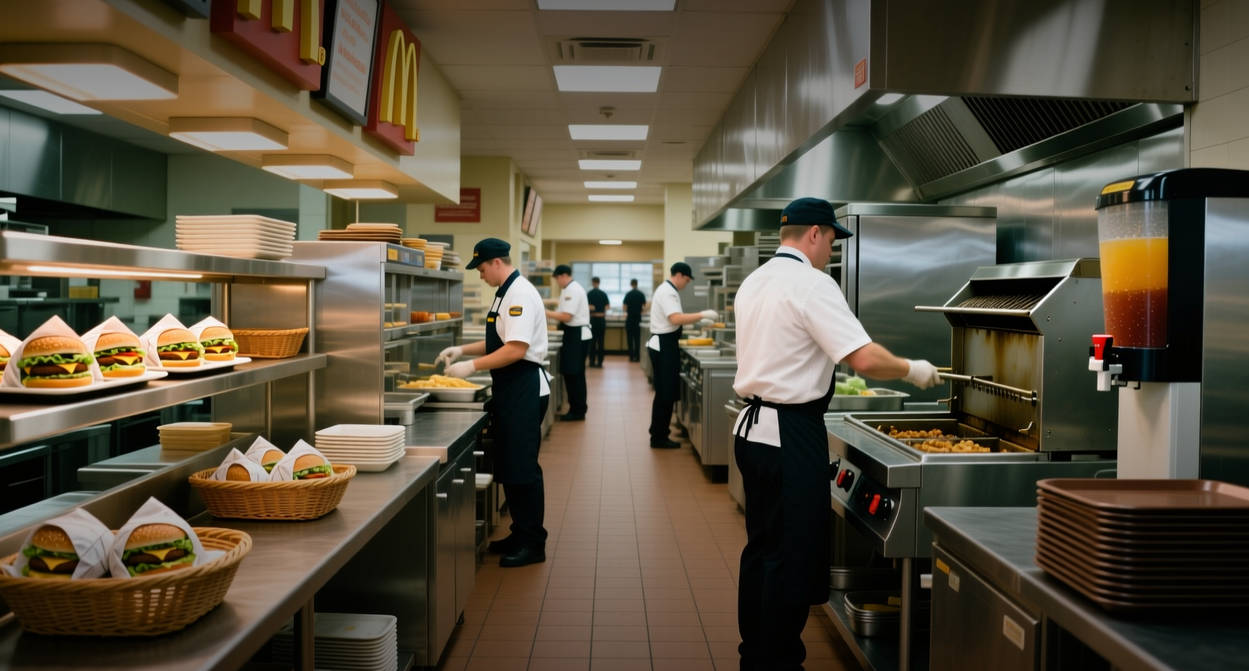
McDonald's told investors it will commit as much as $8.5 billion to restaurant upgrades and franchisee support through 2036, a decade-long capital pledge that sent the shares lower as holders weighed the cost against a 2030 margin target.
Roughly $5 billion of that total is scheduled for deployment before 2030 and combines rent concessions with direct capital injections, according to the company's investor presentation. Management framed the outlay as self-funding: it projects the program, branded Restaurant > NEXT, will lift restaurant-level efficiency by about 250 basis points once fully rolled out in primary markets, worth roughly $100,000 in annual cash flow for a typical U.S. location.
The stock traded near $251 in after-hours action, up about 0.5%, after closing Tuesday around $250. The shares remain down roughly 18% year to date in 2026, and the negative reception to the spending plan extends a stretch in which the Golden Arches has struggled to restore customer traffic.
Executives set a 2030 operating margin target in the low-to-mid 50% range, against an adjusted operating margin of 46.9% in fiscal 2025. General and administrative costs are targeted at about 1.9% of systemwide revenue by 2030, with free cash flow conversion projected in the mid-to-high 80% range. Franchisees are expected to recoup their own investments in about four years after McDonald's assistance, which management argues will leave operators with more capacity to fund new units.
The program leans on technology as much as brick and mortar. Restaurant > NEXT covers remodeled locations, streamlined kitchen workflows and wider deployment of ArchIQ, the company's generative-AI operations platform, which management expects to speed service and simplify store management. On the menu side, McDonald's aims to capture 1.5 percentage points of global market share in both poultry and beverages by 2030 while defending its beef position.
Capital spending stays heavy alongside the franchisee support. Management forecasts about $3 billion in annual baseline capital investment from 2027 through 2030, plus an additional $1.5 billion to $2 billion in cumulative capital backing for Restaurant > NEXT. New store openings are expected to add nearly 2.5% to systemwide revenue growth in 2027, settling near 2% a year by 2030.
The disclosure lands after second-quarter U.S. comparable sales growth missed analyst projections, with traffic still pressured by price increases, aggressive value promotions from rivals and softer spending among budget-conscious diners. That combination makes execution the central risk: the $8.5 billion can improve restaurant-level economics only if traffic recovers, the AI and equipment rollout delivers the promised efficiency, and franchisees hit the projected payback.
For holders, the near-term signal is a heavier capital burden before any margin payoff, with the low-to-mid 50% operating margin goal now the benchmark to judge management against. The next checkpoints are the company's quarterly U.S. comparable sales prints and updates on Restaurant > NEXT deployment, which will show whether the 250 basis points of restaurant-level efficiency are arriving on schedule.
This article is for informational purposes only and does not constitute investment advice.