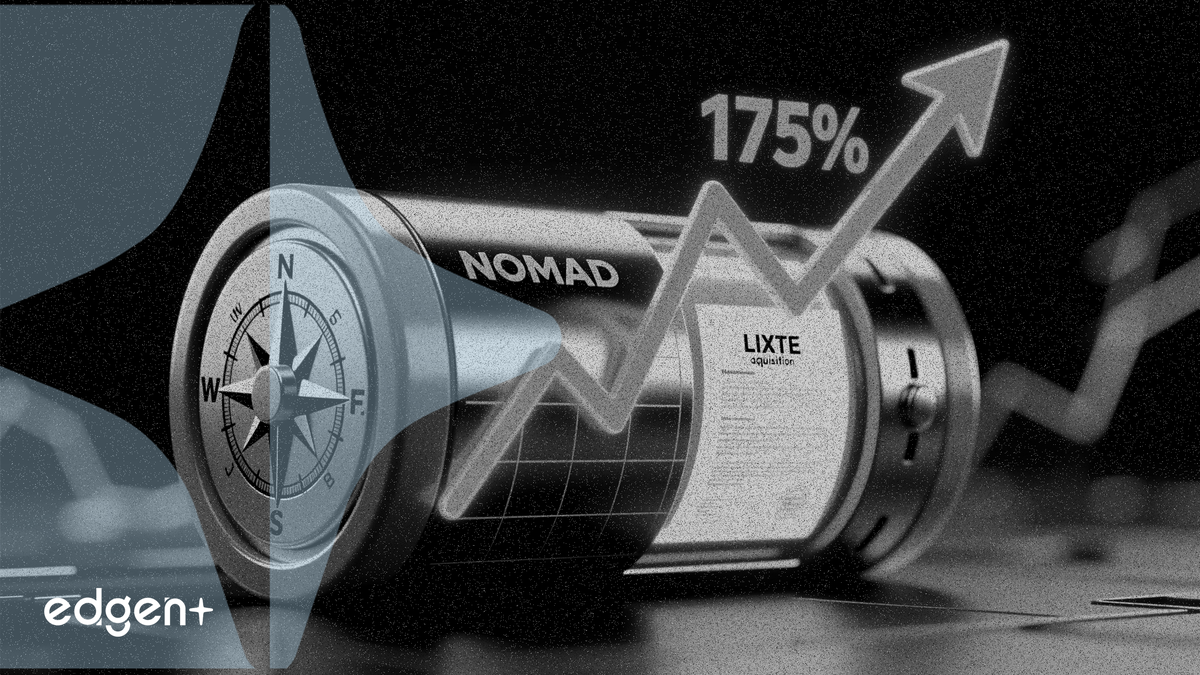
NOMAD's mobile, utility-grade 1 MW battery system bypasses the multi-year permitting delays that have sidelined 1 GW of permanent storage in New York alone.
LIXTE Biotechnology Holdings agreed to acquire NOMAD Transportable Power Systems, the first company to bring a mobile, utility-grade 1 MW battery energy storage system to market, in a deal that creates a publicly traded pure-play on deployable power infrastructure.
"This transaction creates one of the first publicly traded companies singularly focused on solving one of the most significant constraints facing economic growth today — access to reliable electrical power," Geordan Pursglove, chief executive officer of LIXTE Biotechnology, said.
NOMAD's revenue grew approximately 175% year-over-year in 2025, with management projecting further growth of about 135% in 2026. About 75% of sales activity is inbound, and the company is engaged on more than 30 active utility, infrastructure and strategic customer opportunities across North America. The UL 9540-validated platform serves investor-owned utilities, electric cooperatives, municipal utilities and large industrial energy users.
The acquisition positions the renamed entity — NOMAD Power Solutions — at the center of a power availability crisis where approximately 2.3 terawatts of generation and storage capacity sit in U.S. interconnection queues and project timelines have stretched to five to seven years. LIXTE shares closed at $7.25 on June 12, up 5.2%, as the market began pricing in the energy storage pivot.
The Permitting Advantage Driving Adoption
Permanent BESS projects routinely require two to five years for development, constrained by land use entitlements, environmental review and interconnection queues. In New York State alone, 108 local jurisdictions have enacted moratoria or bans on permanent BESS, sidelining approximately 1 GW of capacity. NOMAD's mobile architecture is deployed as equipment rather than permanent infrastructure, generally bypassing those hurdles while meeting UL 9540, NFPA 855 and IEEE 1547 standards.
"Management believes this structural permitting and deployment advantage is one of the most underappreciated drivers of customer adoption," the company said in the announcement.
Scaling to Meet Inbound Demand
Manufacturing capacity has scaled exponentially to accommodate demand, supported by existing supply chain partnerships. NOMAD offers equipment sales, rentals and Energy-as-a-Service to utilities, industrial operators, government agencies and AI-driven data center applications — a customer base that smaller, non-utility-grade mobile battery solutions cannot address.
John Travaglini, chief executive officer of NOMAD, said the transaction provides "the capital and public-market visibility to scale manufacturing, deepen our customer relationships and continue defining the category we created."
Investment Implications
LIXTE, previously a clinical-stage pharmaceutical company focused on cancer drug development, will shed its biotech identity upon closing. The company maintains a current ratio of 2.78, with liquid assets exceeding short-term obligations, and recently raised $16.6 million through a registered direct offering at $6.31 per share. The stock trades at a valuation that reflects the pending transformation: a biotech shell acquiring a high-growth energy infrastructure business with 175% revenue growth and a multi-hundred-billion-dollar addressable market in power capacity.
Stu Porter, a LIXTE director, framed the deal as a response to structural grid constraints. "As AI workloads and data center buildout accelerate power consumption at an unprecedented pace, our grid simply cannot absorb that demand through fixed assets alone," he said.
The transaction is expected to close subject to required approvals, after which the company will change its name to NOMAD Power Solutions and provide details on any ticker symbol change.
This article is for informational purposes only and does not constitute investment advice.