

Key Takeaways:
- Li Auto targets Tesla FSD V14 parity by Q4 2026
- OTA updates in July, September and December 2026
- Embodied intelligence redefines vehicles as 4-in-1 machines
Key Takeaways:
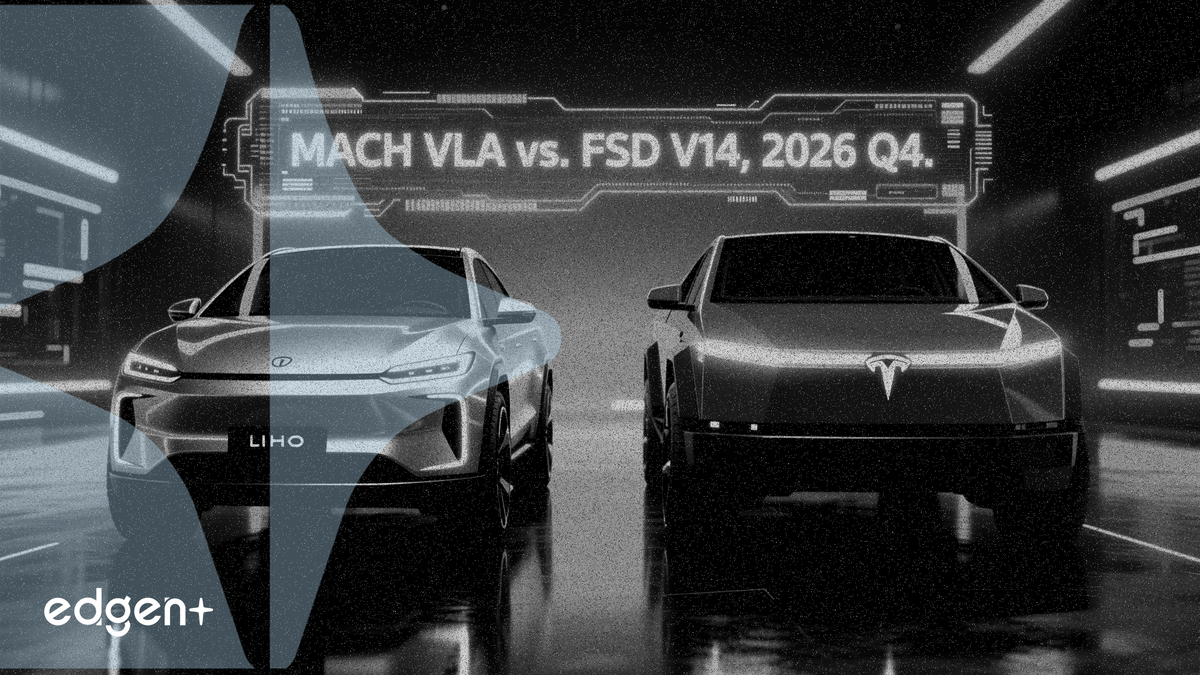
Li Auto plans to match Tesla's full self-driving capability by end-2026, betting embodied intelligence will redefine the smart vehicle market.
Li Auto redefined the smart vehicle as a "4-in-1" machine — EV, professional driver, AI computer and life assistant — and set a December 2026 target for autonomous safety and efficiency that surpasses human drivers.
"Today's smartphones and smart vehicles are not truly intelligent — they remain function-driven rather than life-like intelligent agents," Chairman and Chief Executive Officer Li Xiang said at the company's Livis Day event on June 15.
The Beijing-based EV maker plans to roll out a new Mach VLA model on its AD Max platform in the third quarter of 2026, with fourth-quarter capabilities expected to benchmark Tesla Inc.'s FSD V14, according to Zhan Kun, head of foundation model at Li Auto. The July over-the-air update will deliver a 30% improvement in intelligent driving efficiency, followed by a September update themed "reverse like a human" and a December milestone where safety and efficiency "surpass humans."
Li Xiang said the three most important dimensions of intelligent vehicles are safety, capability and efficiency. Over the past decade, Li Auto created what it calls a "mobile home"; in the next decade, the group plans to imbue both vehicles and homes with life-like intelligence, he said.
The embodied intelligent vehicle framework splits the system into "body" — the EV and AI computer — and "intelligence" — the professional driver and life assistant. This architecture mirrors the approach taken by Tesla, which has long positioned its vehicles as computers on wheels with Full Self-Driving as the primary software differentiator.
Zhan said Mach VLA capabilities will continue to evolve through the second half of 2026. The VLA — vision-language-action — model architecture represents a shift from traditional autonomous driving stacks that separate perception, planning and control into discrete modules. By unifying these functions, Li Auto aims to achieve more human-like driving behavior, particularly in complex urban scenarios where Chinese traffic conditions pose unique challenges.
The OTA roadmap gives investors a clear timeline to track execution. The July update focuses on efficiency gains — a 30% improvement that could translate to smoother highway driving and reduced energy consumption. September's "reverse like a human" update targets one of the most difficult maneuvers for autonomous systems: backing up and parking in tight spaces. December's "surpass humans" milestone, if achieved, would position Li Auto among a small group of companies claiming Level 4 or higher autonomous capability.
Tesla's FSD V14, expected around the same timeframe, represents the latest iteration of the company's end-to-end neural network approach. Li Auto's decision to publicly benchmark against Tesla signals confidence in its technology roadmap but also raises the stakes: any delay or underperformance relative to the December target could weigh on the stock.
Li Auto shares closed 0.7% lower at HK$56.40 on Monday, with short selling accounting for 38% of turnover. The company is betting that its embodied intelligence strategy — what Li calls "giving life to vehicles and homes" — can narrow the valuation gap with Tesla, which commands a market cap roughly 20 times larger.
This article is for informational purposes only and does not constitute investment advice.
