
**South Korea's currency tumbled to its lowest level in more than 17 years as the Middle East conflict and surging oil prices overwhelmed the government's verbal intervention efforts.
**South Korea's currency tumbled to its lowest level in more than 17 years as the Middle East conflict and surging oil prices overwhelmed the government's verbal intervention efforts.
South Korea's currency tumbled to its lowest level in more than 17 years as the Middle East conflict and surging oil prices overwhelmed the government's verbal intervention efforts.
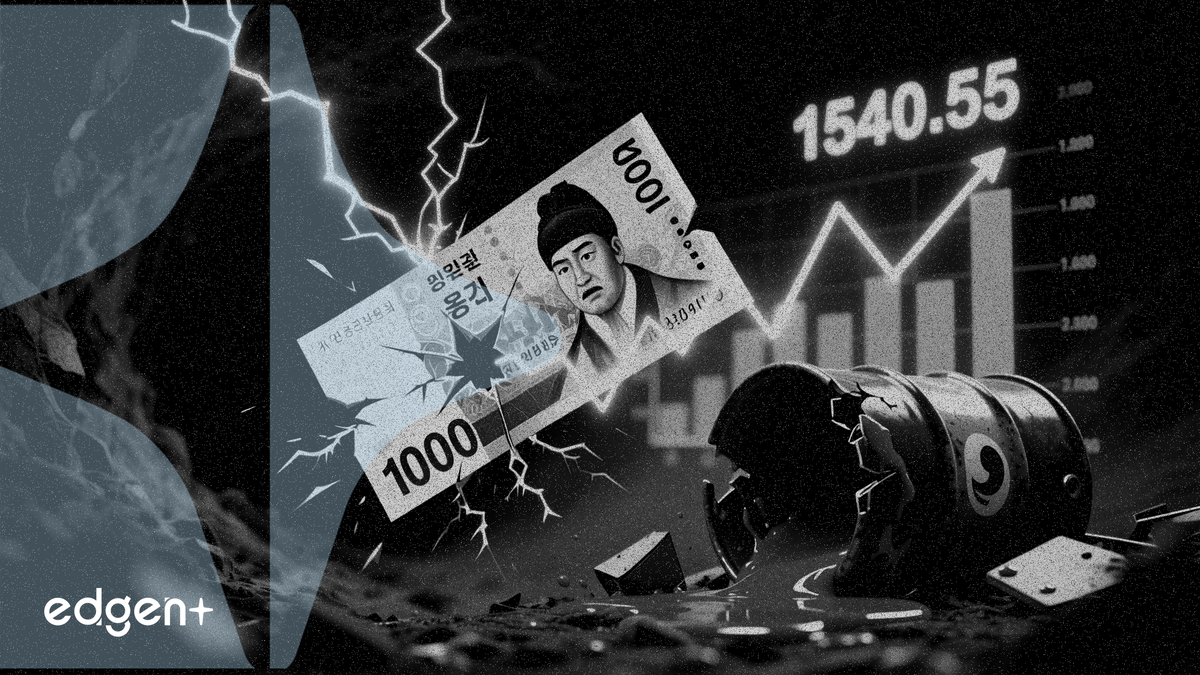
The won slid as much as 1.4% to 1540.55 per dollar Thursday, the weakest since March 2009, before paring some losses. Foreign investors dumped $4.6 billion of Korean stocks in a single session, bringing this year's net selling to $74 billion, according to exchange data. The 3-year Korean government bond yield jumped 9 basis points to 3.86% as the selloff extended to fixed income.
"KRW is underperforming across the board, with USD/KRW surging to 1540.55, the highest level since March 2009," said Elias Haddad, a strategist at Brown Brothers Harriman. "The slide in KRW largely reflects South Korea's negative net energy balance and negative real rates."
The won has lost more than 6% against the dollar this year, making it one of Asia's worst-performing currencies as the region's energy-importing economies bear the brunt of elevated crude prices. South Korea, the world's fourth-largest crude importer, is especially vulnerable: every $10 increase in oil prices adds roughly $8 billion to its annual import bill, according to Korea Energy Economics Institute estimates.
Finance Minister Koo Yun Cheol said authorities were monitoring the foreign-exchange market with "heightened vigilance" and pledged to take necessary steps if one-sided moves became excessive. The warning echoed a rare joint text message issued on May 22 that characterized the won's decline as "excessive volatility deviating from economic fundamentals."
Yet the intervention has done little to stem the tide. South Korea's negative net energy balance means higher oil prices directly pressure the currency, while negative real rates — the policy rate stands at 2.75% against inflation above 3% — reduce the appeal of won-denominated assets. BBH's Haddad said intervention was more likely to slow depreciation than reverse it "until the energy shock fades."
The won's weakness is part of a broader pattern across Asia. Indonesia and the Philippines have also stepped up defenses of their currencies as the Middle East conflict keeps oil elevated. For South Korea, the challenge is compounded by a hawkish Federal Reserve that keeps the dollar strong and a domestic stock market whose rally — the Kospi has gained about 10% this year, fueled by retail investors — has prompted foreign funds to take profits and rebalance portfolios.
"The authorities have done what they can, but given the won's weakness is largely driven by external factors, it's very difficult to effectively manage the exchange rate," said So Jaeyong, chief economist at Shinhan Bank.
Choi Kyuho, an economist at Hanwha Investment Securities, said the won could slide further to 1550 in the near term, with the Fed's hawkish stance and persistent foreign equity outflows creating a formidable headwind. The last time the won traded at those levels was during the global financial crisis, when it breached 1570 in March 2009 before recovering as the Fed launched quantitative easing.
The government has taken steps beyond verbal intervention. It cut June bond issuance by 21% from May and stepped up monitoring through daily phone calls and messaging groups. But analysts said such marginal adjustments were unlikely to reverse the trend without a meaningful improvement in the external environment.
For now, the won's trajectory hinges on two variables largely outside Seoul's control: the path of oil prices and the Fed's policy stance. Until one shifts, Asia's energy importers will continue to bear the cost of the region's most acute currency stress in nearly two decades.
This article is for informational purposes only and does not constitute investment advice.
