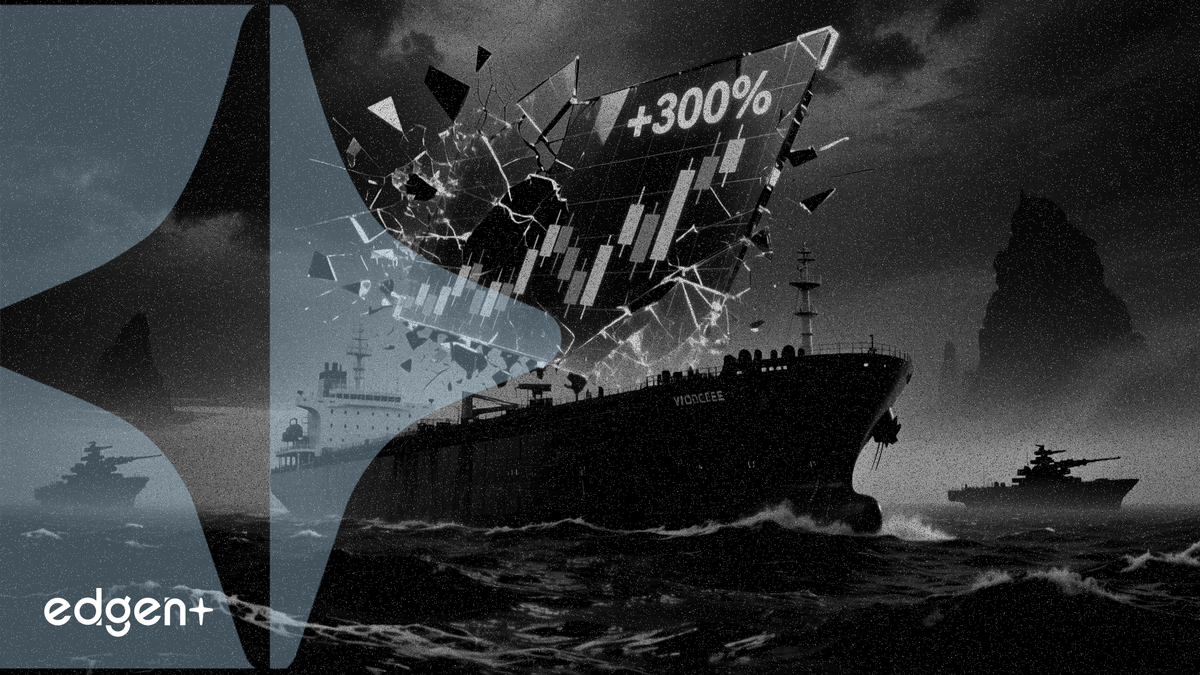
The U.S.-Iran conflict is evolving beyond traditional military engagement into an economic war of attrition, with Iran’s control of the Strait of Hormuz driving up shipping insurance costs over 300 percent and creating significant headwinds for global stocks.
"A global bond sell-off will lead to headwinds for international stocks," Michelle Gibley, an analyst at Charles Schwab, said. She explained that the U.S.-Iran War and the resulting inflation woes continue to serve as the key headwind to growth.
The market reaction has been swift but targeted. Insurance premiums for Gulf vessels surged after Iran demonstrated its ability to control the chokepoint, through which a fifth of the world's seaborne oil passes. Benchmark Brent crude crossed the $100-a-barrel mark for the first time since 2022. Prediction markets reflect the tension, with the contract for an Iran Airspace Closure in May priced at 40 percent YES, up from 36 percent a day ago. However, traders appear to doubt a catastrophic oil price spike, with the market for WTI Crude Oil hitting $150 in May pricing at just 1.4 percent.
At stake is a new form of asymmetrical conflict that strategists are calling "structural leverage warfare." By weaponizing its geography, Iran can hold two of the world's most critical economic streams—energy and data—hostage. This strategy allows a militarily outmatched nation to impose significant costs on a global scale, a playbook that could be studied by other countries and which forces a reassessment of geopolitical risk beyond kinetic warfare.
A New Warfare Playbook
Iran's strategy hinges on exploiting structural overlaps between geography and economic chokepoints. Rather than sinking tankers, it can make shipping unaffordable by driving up insurance and charter rates. The Strait of Hormuz narrows to just 21 kilometers, allowing Iran to use a combination of mines, drones, and fast-attack boats to assert control. The warning from Ryanair's CEO about challenges for European airlines shows the cascading impact on logistics and operations far beyond the immediate conflict zone.
This doctrine mirrors historical examples of using geography as a force multiplier, such as the Spartans' stand at the Battle of Thermopylae. By funneling a larger force into a narrow pass, a smaller army neutralized a numerical advantage. Iran is applying this principle to global commerce. Beyond the Hormuz, it has also demonstrated the ability to threaten undersea fiber-optic cables, which transmit hundreds of thousands of gigabytes of data per hour, creating a dual threat to both physical and digital supply chains.
Markets React to De-escalation Chatter
The market remains highly sensitive to any signs of a shift in the conflict's trajectory. Indian equity futures, for instance, jumped nearly one percent following unconfirmed reports of potential U.S. relief on Iran oil sanctions. This highlights the relief rally that could occur if diplomatic solutions gain traction.
For now, the situation remains a key variable for the global economy. Washington went to war to prevent Iran from acquiring nuclear weapons but may have inadvertently pushed Tehran to perfect an economic weapon with global reach. Observers are closely watching for any developments in U.S.-Iran diplomatic talks and changes in military posture, which could dictate the next move in this high-stakes confrontation.
This article is for informational purposes only and does not constitute investment advice.