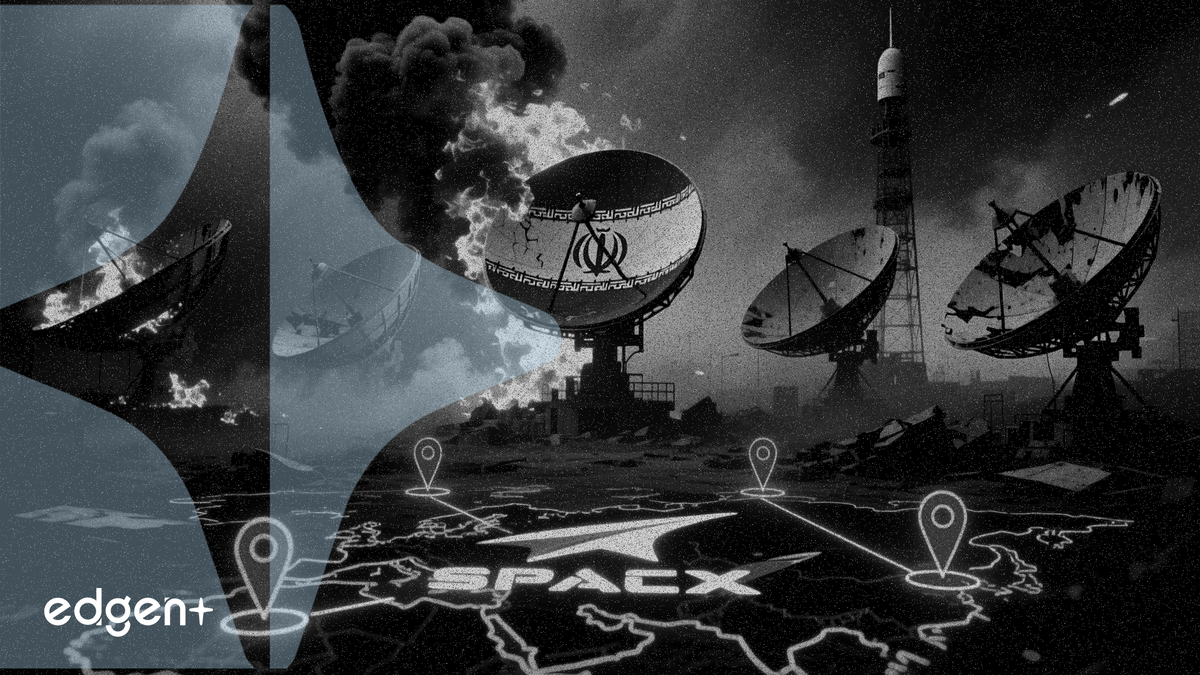
Iran's military is evaluating SpaceX and Starlink infrastructure across five Middle Eastern nations as potential targets, state media reported Thursday, marking a dramatic escalation in the shadow war between Tehran and Washington.
Iran placed Elon Musk's SpaceX and Starlink facilities on a military target list Thursday, threatening ground stations across Israel, Qatar, Jordan, the United Arab Emirates and Oman as US airstrikes against Tehran entered a second day.
"The use of Starlink infrastructure and the X platform by the US and Israeli military, as well as Musk's alleged cooperation with the US government, is enough justification to add his assets to a military target bank," an unnamed source told the state-run Fars News Agency.
The target list includes Starlink ground stations in all five countries as well as infrastructure linked to SpaceX investors, Fars reported. The unnamed source claimed the US military used Musk-linked companies to carry out attacks on water infrastructure in southern Iran this week, allegations that could not be independently verified.
The threat directly endangers SpaceX's Starshield program, which won a $2.29 billion Space Force contract in May to build a military internet constellation in low Earth orbit. With SpaceX set to go public Friday at a valuation between $1.75 trillion and $2 trillion, the geopolitical risk premium on Musk's defense-linked assets is rising sharply.
The escalation comes as President Donald Trump threatened to attack Iran "VERY HARD TONIGHT" on Truth Social, vowing to seize Kharg Island — which handles roughly 90 percent of Iranian oil exports — and other critical infrastructure. The US has already conducted two consecutive days of airstrikes, according to Forbes.
Brent crude prices face upward pressure as the confrontation threatens both oil infrastructure and satellite communications networks critical to military operations. The Strait of Hormuz, through which about 21 percent of global oil trade passes, sits at the center of the escalating standoff.
SpaceX has become an increasingly important US defense contractor through Starshield, a version of its Starlink satellite network designed for government and intelligence customers. The system provides Earth observation, communications and hosted payloads for military use. Militaries have increasingly relied on Starlink since Ukraine's widespread use of the network after Russia's 2022 invasion, according to Reuters.
The last time Iran directly threatened US-linked corporate infrastructure at this scale was during the 2019 drone attacks on Saudi Aramco's Abqaiq and Khurais facilities, which temporarily knocked out 5.7 million barrels per day of production and sent oil prices surging 15 percent in a single session. While the current threat targets communications rather than oil infrastructure, the broadening of Iran's target set signals a more aggressive posture that could further destabilize regional markets.
For investors, the key risk lies in the potential disruption to Starlink services across the Middle East, where the network provides critical internet connectivity. Any actual strike on ground stations would not only damage SpaceX's commercial operations but also threaten US and allied military communications that depend on the Starshield network. The $2.29 billion Space Force contract underscores how deeply Musk's companies are now embedded in US defense infrastructure.
This article is for informational purposes only and does not constitute investment advice.