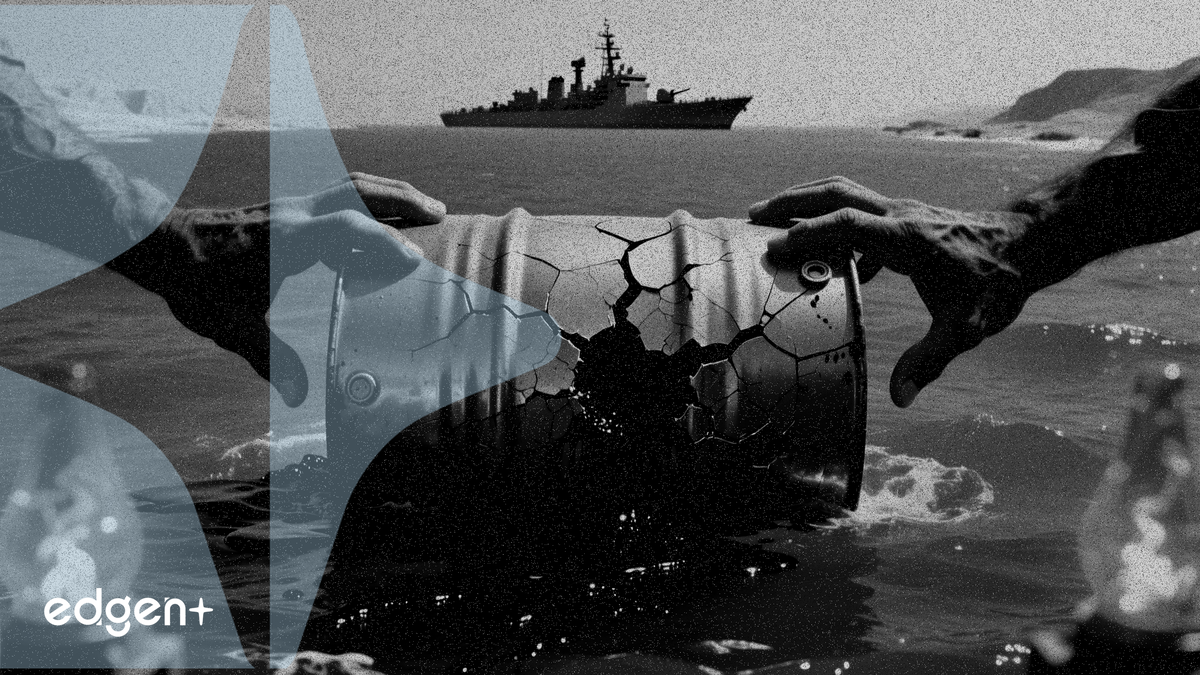
Iran's top diplomat opened a new front in the battle over the Strait of Hormuz on Thursday, arguing that charging service fees for passage through the waterway is fully permitted under international law — even as the Islamic Republic faces mounting economic pressure from a US blockade that has slashed its oil exports by 800,000 barrels a day.
"From the perspective of international law, charging transit tolls is unacceptable, but collecting service fees is completely permissible," Foreign Minister Abbas Araghchi said in a televised interview, according to state media. He added that Iran has begun consultations with multiple countries on navigation rules for the strait, through which roughly a fifth of the world's oil and natural gas once flowed.
The proposal comes as Iran's oil industry reels from an American blockade that has cut output by 800,000 barrels a day since February, according to Wood Mackenzie. Onshore storage has swelled to 69 million barrels, the highest level since former President Donald Trump's "maximum pressure" campaign in 2020, while dozens of tankers sit idle off Kharg Island. "The mounting economic cost of falling output, restricted exports and tightening storage capacity is increasing pressure on Tehran to seek a diplomatic solution," Alexandre Araman of Wood Mackenzie said.
The Strait of Hormuz has been effectively shut to routine commercial traffic since Iran began attacking shipping in February, creating an energy crunch that fueled global inflation. But the calculus may be shifting. Trump said this week that a "secret mission" using US military overwatch had enabled more than 200 vessels carrying over 100 million barrels of crude to transit the strait since early May. Kpler, a commodities data firm, tracked roughly 96 million barrels of non-Iranian crude exports leaving the region in that period, broadly consistent with Trump's claim, according to analyst Amena Bakr.
The Service Fee Gambit
Araghchi's service fee proposal appears designed to establish a legal framework for Iran to extract revenue from the strait without explicitly closing it — a move that would risk a broader military confrontation. The distinction between tolls and service fees is unlikely to gain international recognition. The US and its allies consider the strait an international waterway under the Law of the Sea, a position Araghchi explicitly rejected this week, insisting the waterway is not international.
The timing is notable. Iran's President Masoud Pezeshkian acknowledged the severity of the situation in a rare public address Wednesday, saying "our routes have been blocked" and that the country faces "a difficult test." China, historically the largest buyer of Iranian sanctioned crude, imported just 6.8 million barrels a day of seaborne crude in May — the lowest level since October 2016, per Kpler data. The last time Iran faced a comparable export squeeze was during Trump's 2018-2020 maximum pressure campaign, when exports fell below 300,000 barrels a day before a diplomatic track eventually opened.
A Diplomatic Off-Ramp
Araghchi also signaled openness to a resolution on two fronts. He said frozen Iranian assets could begin to be unfrozen based on a potential memorandum of understanding with the US, though he stressed that details must be fully discussed. On the nuclear file, he reiterated that Iran's only acceptable method for handling its stockpile of high-enriched uranium is dilution or conversion within the country — rejecting any proposal to ship the material abroad.
Oil prices have remained below $100 a barrel during the current crisis, partly on expectations of a deal and as strategic reserves have cushioned the blow. But with global inventories drawing down and the US presidential election approaching, the window for a negotiated solution may be narrowing. If Iran's export capacity continues to shrink, the economic pressure could force Tehran back to the negotiating table — or push it toward further escalation in the strait.
This article is for informational purposes only and does not constitute investment advice.