
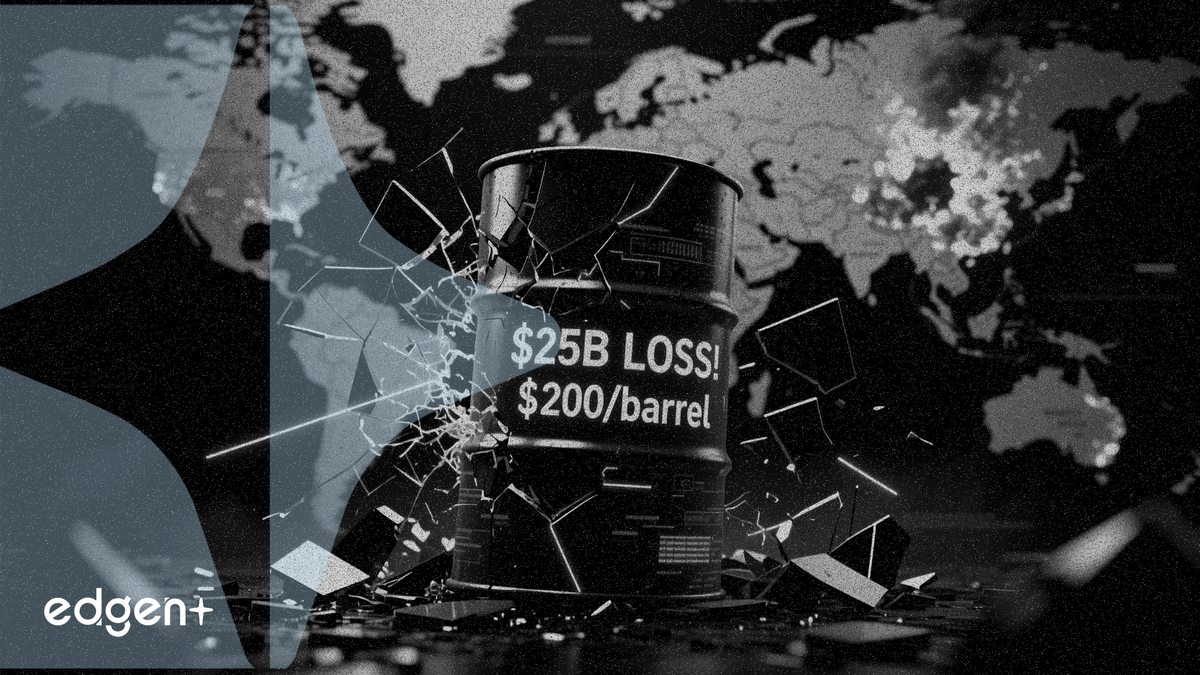
A US-Israeli war with Iran, confirmed by an attack that injured the nation’s supreme leader, has already inflicted $25 billion in corporate losses, threatening to push crude oil to $200 a barrel and cut global GDP growth by 0.3 percentage points.
A US-Israeli war with Iran, confirmed by an attack that injured the nation’s supreme leader, has already inflicted $25 billion in corporate losses, threatening to push crude oil to $200 a barrel and cut global GDP growth by 0.3 percentage points.
An attack on Iran that injured Supreme Leader Mojtaba has escalated a conflict with the US and Israel that is already imposing a $25 billion cost on global companies through snarled trade and surging energy prices, according to market analysis. The confirmation of the leader's injury on May 18 marks a significant turning point in a war that now threatens to tip the global economy into recession.
"There is little prospect of a swift and durable settlement between the US and Iran," a recent Moody’s Ratings report on geopolitical risk stated, noting the unlikelihood of the Strait of Hormuz fully reopening in the near term.
The fallout has been immediate and severe. Oil price forecasts now range from $100 to $200 per barrel as the conflict chokes the Strait of Hormuz, a chokepoint for roughly 20 percent of the world's petroleum. Shipping giant CMA CGM has imposed emergency surcharges between $2,000 and $4,000 per container, a cost that ripples through global supply chains. The International Atomic Energy Agency (IAEA) has also expressed “grave concern” after a drone strike caused a fire at a generator near the UAE’s Barakah Nuclear Power Plant.
The conflict represents a material drag on the world economy. Both the World Trade Organization and the International Monetary Fund have warned that a prolonged war could slow global GDP growth by up to 0.3 percentage points in 2026. In a severe scenario, global growth could fall to around 2 percent while inflation climbs above 6 percent, driven by sustained high energy and logistics costs.
Tensions are centered on the Strait of Hormuz, where Iran plans to unveil a toll mechanism to prohibit “enemy” weapons shipments from passing through. This move follows a series of escalations, including the drone strike in the UAE and Israeli strikes in southern Lebanon that wounded dozens of civilians. The conflict, dubbed "Operation Rising Lion," appears to have been long-planned, with reports indicating Israel established covert military bases in western Iraq as early as late 2024 to support air operations against Iran.
For energy importers, the crisis is forcing a strategic rethink. "We expect oil importers — particularly China, India, Japan and Korea — to negotiate passage bilaterally with Iran, potentially through coordinated transit corridors," Moody's said in its report. An Indian tanker, the Symi, recently arrived at the Kandla Port carrying 20,000 tonnes of LPG after crossing the strait, showing that some critical shipments are still navigating the high-risk environment.
Despite the economic carnage, diplomatic off-ramps appear blocked. US President Donald Trump has issued stark warnings, telling Iran on social media that the "Clock is Ticking" and that failure to make a deal would mean "there won’t be anything left of them."
Tehran, in turn, has issued its own list of non-negotiable demands. According to Iranian media, these include a complete cessation of hostilities across the Middle East, the lifting of all US sanctions, the release of frozen Iranian funds, and compensation for war damages. The US has reportedly rejected at least two of these conditions outright. With Pakistan-led efforts to mediate talks stalling, the conflict appears set for a protracted and costly stalemate.
This article is for informational purposes only and does not constitute investment advice.
