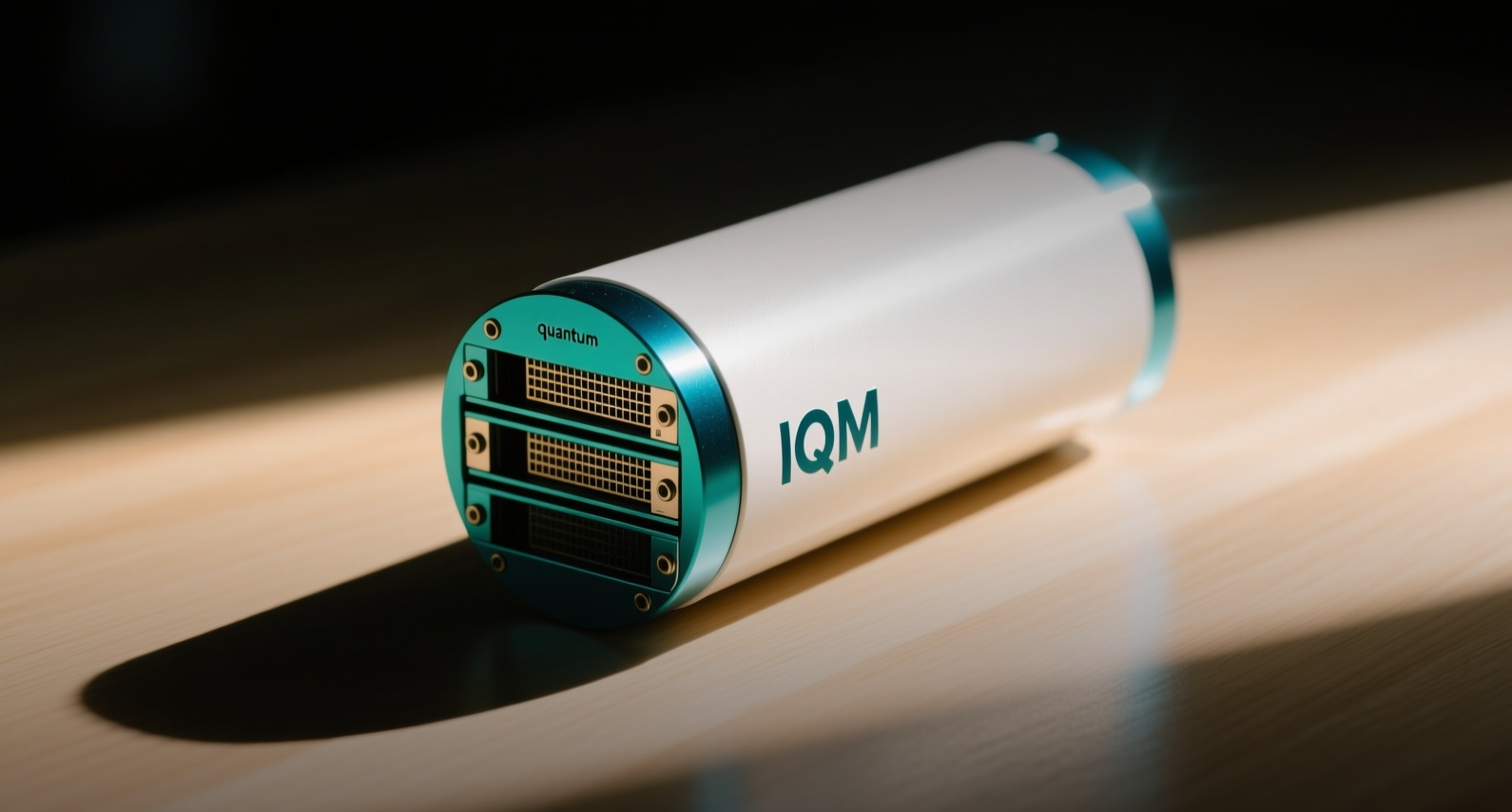
IQM, the Finnish quantum computing leader, is set to become the first European quantum firm on a major U.S. exchange — and it's betting its data-center strategy will set it apart from larger rivals.
IQM has sold 23 on-premises quantum systems, more than IBM, and now plans to list on Nasdaq through a $146 million SPAC merger, positioning itself as both a quantum pure-play and an AI data-center infrastructure bet.
"The ultimate goal is to build a sustainable, healthy, growing business which stands on its own feet, but there's still some steps in between," IQM Chief Executive Officer Jan Goetz said in an interview.
Shareholders of Real Asset Acquisition Corp. (RAAQ) are set to vote on the merger at the end of June. If approved, the combined company will trade on the Nasdaq in New York and Helsinki under the ticker IQMX, marking the first listing of a European quantum firm on a major U.S. exchange. IQM has already secured $146 million in private investment in public equity, up from an initial $134 million, signaling strong institutional demand.
The listing comes as IQM pushes into the data-center market, where it believes pairing superconducting quantum processors with classical chips from partners like Nvidia and Amazon Web Services can cut power consumption while accelerating compute times. In April, Poland's Galaxy Systemy Informatyczne became the first private company to purchase an IQM system, signaling early commercial traction beyond research institutions.
Why Data Centers Are the Next Frontier
IQM's strategy hinges on selling physical hardware directly to customers rather than offering cloud-only access, a model that contrasts with IBM's approach. IBM's fleet of quantum computers is primarily accessible over the cloud, while IQM has sold 23 gate-based machines to research institutions and now private companies. One notable customer is Germany's Jülich Supercomputing Centre, which also purchased a D-Wave Advantage System last year.
"It's about the price of operation, which basically means the electricity bill in the end," Goetz said. "For a data center, you buy machines in the beginning — this is where you invest — but then most of the costs come from the electricity bill down the line."
IQM's superconducting quantum technology, when paired with classical processors from Nvidia and AWS, is designed to reduce power consumption through greater efficiency. In the long term, quantum systems are expected to sit alongside classical processors in data centers to solve complex problems in tandem, a shift that could reshape how hyperscalers approach compute infrastructure.
The Marathon Ahead
Like other quantum pure-plays, IQM has yet to turn a yearly profit and continues to burn through cash. The SPAC merger provides a faster route to public markets and much-needed capital, following a playbook familiar to the sector. Beyond fundraising, the Nasdaq listing gives IQM a U.S. presence at a time when the federal government has injected $2 billion into the domestic quantum sector, even taking direct equity stakes in smaller developers.
Goetz, a physicist who co-founded IQM after realizing university labs at Aalto University and VTT Technical Research Centre lacked the infrastructure to scale quantum systems, views the competitive landscape through a long lens.
"It's a marathon, not a sprint, that will go on for decades," he said. "The question is who has the firepower, but also the breadth to do it for the long fun. This means we need to advance the technology — the whole community needs to advance the technology."
He likened the market to high-performance computing, where several players — Lenovo, Dell, HP — coexist rather than a single winner taking all. "It's not a winner-takes-all game," Goetz said. "This is not how compute works."
IQM hosted its inaugural Capital Markets Day in New York on June 15 alongside Nvidia and AWS, showcasing its industry partnerships. The company's ability to secure government backing from the European Commission, Finland, and Germany — combined with its lead in on-premises system sales — gives it a distinct position among quantum contenders. But with IBM, Alphabet's Google, and D-Wave all competing for the same long-term opportunity, the race is far from decided.
This article is for informational purposes only and does not constitute investment advice.