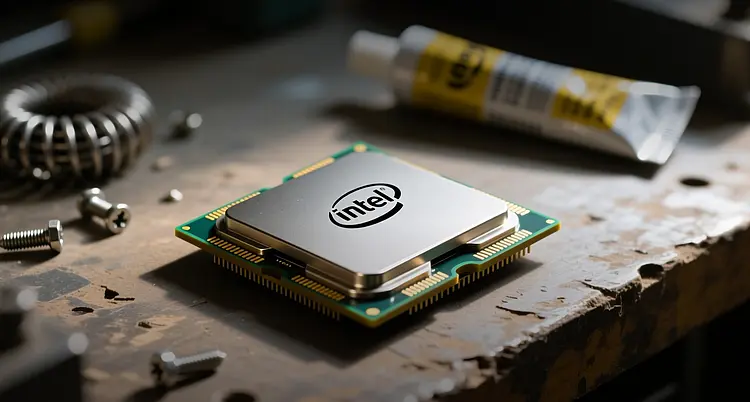
Intel closed Monday at $121.78, a 12.14% single-session gain that capped a 25.3% five-day run, after Meta's Muse AI agent revived demand expectations for central processing units.
"The target led, and the price is now chasing the thesis rather than the other way around," Tigress Financial wrote in a note setting a $145 price target on Intel, a level that implies roughly 19% upside from Monday's close.
The rally was not Intel-specific. Advanced Micro Devices rose 24.75% over the same five sessions, Nvidia added 7.78%, and Taiwan Semiconductor Manufacturing gained 6.77%, according to 24/7 Wall St. data. Intel outran the group, but the sector rotation did most of the work. Bernstein chip analyst Stacy Rasgon, speaking on CNBC, tied the move to consumer adoption of agentic software: "If you start to get the normies using agentic AI, using agents, it's being read as having the potential to put the CPU shortage and CPU demand into overdrive." Agentic tasks require many more sequential steps than a single chatbot query — planning, running code, querying external databases — and those steps run on CPUs rather than graphics accelerators.
Consensus does not follow Tigress. Alpha Vantage lists an average analyst target of $116.37 against a 52-week high of $142.35, with a ratings split of 1 strong buy, 13 buy, 32 hold, 1 sell and 1 strong sell across 48 analysts. The $145 print is one shop's view, not the herd.
The gap between the target and the fundamentals sits in Intel Foundry. The unit generated $5.8 billion in revenue in the second quarter but lost $2.1 billion, and external foundry revenue was just $293 million. CEO Lip-Bu Tan said 18A output "increased meaningfully in the quarter" and that yields "continue to track ahead of expectations," with 14A defect density "all outpacing 18A development." Nvidia's $5 billion equity stake and Xeon 6's selection for Nvidia's DGX Rubin NVL8 systems are the confirmed anchors. Ohio memory production talks remain unconfirmed.
Trailing EPS is negative $2.09 and the forward P/E is 57x. Consensus 2027 EPS sits at $2.0621, revised up from $1.5236 ninety days ago. At that revised figure, $121.78 is a demanding multiple for a business absorbing $2.1 billion in quarterly foundry losses.
The bull case rests on the second quarter delivering the strongest revenue growth in more than 15 years, with Data Center and AI revenue up 59% year over year and non-GAAP EPS of $0.42 beating consensus by 93.1%. If 18A ramps and 14A wins two named external customers, $145 stops looking aggressive. The bear case is that foundry losses persist, PC consumption falls into the low double digits in 2026, and more than $20 billion in capital expenditure requires access to capital markets.
For holders, the deciding variable is external foundry revenue conversion. Until $293 million becomes a multi-billion run rate with named customers, Intel trades on a narrative that is priced as a fundamental. The next checkpoint is 14A PDK 0.9 in October; a slip there would compress the multiple quickly, while two named 14A customers would do more to justify $145 than any CPU rotation.
This article is for informational purposes only and does not constitute investment advice.