
Boston Dynamics' Atlas humanoid robot performed goal celebrations and delivered the match ball at the FIFA World Cup, marking the first live integration of robotics into the tournament.
Boston Dynamics' Atlas humanoid robot performed goal celebrations and delivered the match ball at the FIFA World Cup, marking the first live integration of robotics into the tournament.
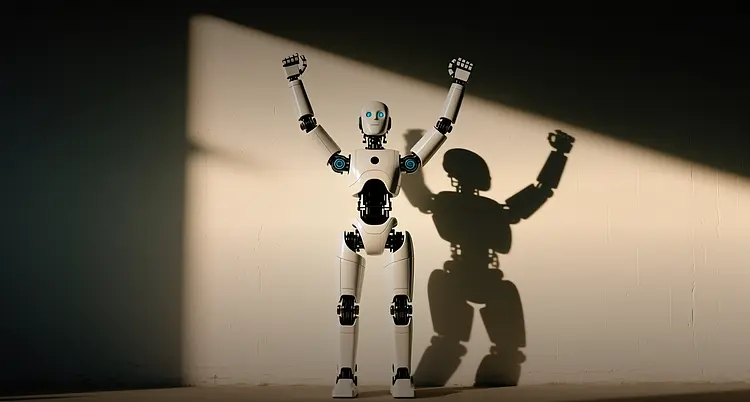
Hyundai Motor Co. deployed Boston Dynamics' Atlas humanoid robot at the FIFA World Cup halftime show, demonstrating how reinforcement learning and whole-body control can operate reliably in unpredictable, live-event environments.
"We wanted Atlas's performance on the world's biggest stage to demonstrate that the future isn't something we imagine — it starts now," Sungwon Jee, executive vice president and global chief marketing officer at Hyundai Motor Co., said.
The 6-foot-2, 200-pound robot executed a sequence of goal celebrations inspired by Harry Kane, Erling Haaland, Matheus Cunha and Son Heung-min before delivering the match ball to the referee at New York/New Jersey Stadium. The performance relied on retargeting technology to translate human movements into robotic motion, reinforcement learning trained across thousands of simulations, and whole-body control to maintain balance in a dynamic stadium environment with 80,633 fans.
Hyundai acquired a controlling stake in Boston Dynamics in 2021 and has positioned robotics as a pillar of its long-term strategy alongside electric vehicles and autonomous systems. The company plans to build 30,000 robots annually, signaling that humanoid robotics is moving from research labs toward commercial production.
The Technology Behind the Performance
Atlas' halftime appearance was the first public demonstration of the production version of the robot, which was first introduced at CES 2026. Unlike its predecessor — a research platform known for parkour and backflips — this generation is designed for real-world industrial applications. Boston Dynamics said the same AI training methods used to teach Atlas football celebrations are being applied to warehouse automation and manufacturing tasks.
"Working with Hyundai Motor Group and FIFA to create such a unique moment for fans was an exciting challenge for our team," Alberto Rodriguez, director of robotics behavior at Boston Dynamics, said. "The way we trained Atlas to perform these fun movements at the match is similar to how we teach the robot to take on real-world industrial applications."
The robot can lift 66 pounds and is designed to handle the unpredictable demands of factory floors. Hyundai has also deployed its dog-inspired Spot robots for autonomous security patrols at select World Cup venues, according to Boston Dynamics.
From Stunt to Strategy
The activation is the centerpiece of Hyundai's "Next Starts Now" campaign, which includes a five-part social film series called "School of Football" that follows Atlas learning soccer skills. Hyundai and BBC StoryWorks Commercial Productions will release "The Training Ground," a documentary-style film on July 7 showing the technical preparation behind the World Cup appearance.
For Hyundai, the World Cup deployment serves a dual purpose: it generates global brand visibility while demonstrating that its robotics division can deliver functional, reliable hardware outside controlled lab settings. The company has said it aims to transform from an automaker into a future mobility company spanning electric vehicles, autonomous driving and robotics.
Hyundai shares trade on the Korea Exchange. Boston Dynamics does not disclose standalone financial results, but Hyundai Motor Group's advanced robotics investment is part of a broader push into physical AI that analysts expect to reach a $154 billion market by 2030, according to Goldman Sachs Research estimates. The World Cup demonstration provides the most visible proof yet that Hyundai's robotics ambitions extend well beyond concept videos.
This article is for informational purposes only and does not constitute investment advice.
