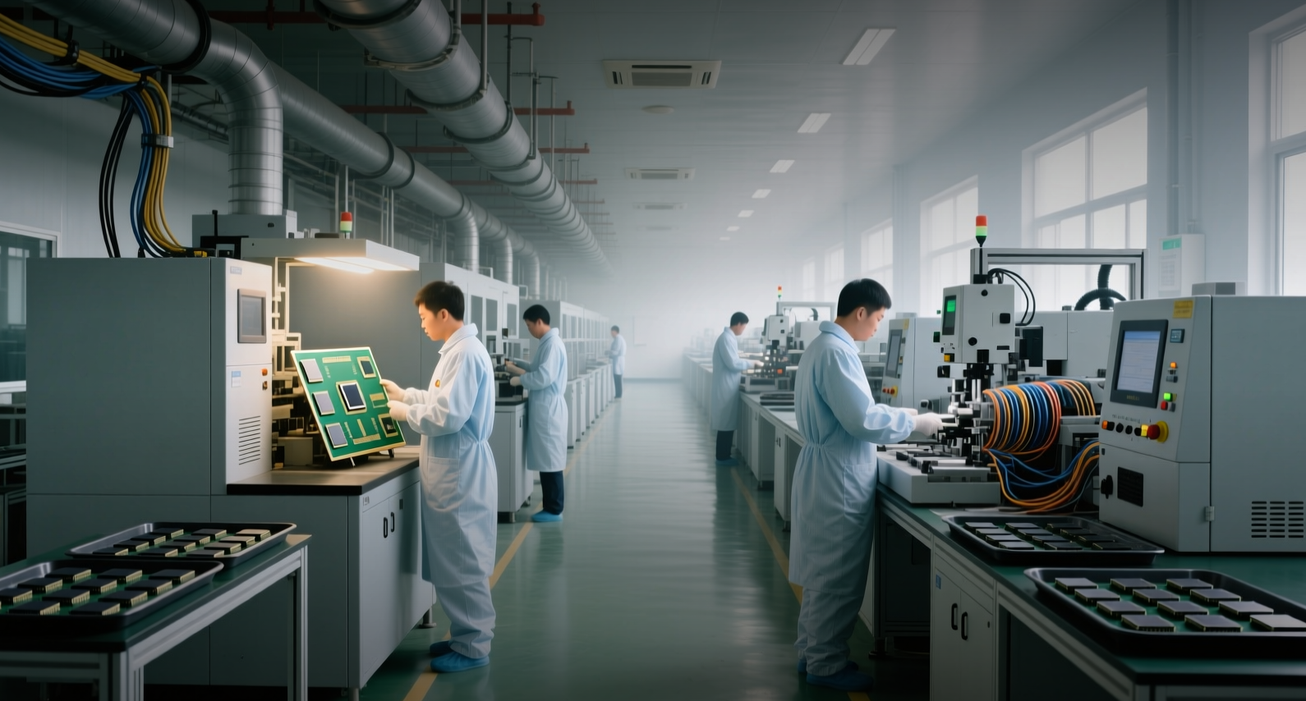
Three Chinese technology champions timed their flagship AI hardware releases to land within days of Xi Jinping's arrival in Washington, giving Beijing a fresh argument that US export restrictions slow Chinese progress without halting it.
Huawei Technologies said at its Huawei Connect conference last week that its Ascent 960DT AI chip will ship in the first quarter of 2027, three quarters earlier than originally planned. Alibaba Group's chip unit unveiled the Zhenwu V900 processor at its Apsara Conference in Hangzhou on Tuesday, claiming triple the performance of its predecessor with sales beginning in early 2027. DeepSeek, the startup whose low-cost model rattled global markets last year, has assembled the largest known cluster of Huawei chips built to date, according to CNBC.
"For Xi, the leverage is not 'we have caught up with you' — it's 'you can't simply technologically choke us off,'" said Lizzi Lee, a fellow at the Asia Society Policy Institute.
The timing is deliberate, according to George Chen, partner and chair of digital practice at Washington-based policy consultancy The Asia Group. "You need to have cards when you sit at a table, and Xi has many cards," Chen said, describing the release schedule as a confidence boost ahead of the leaders' meeting.
The gap Nvidia still owns
The announcements do not close the performance gap. Each Huawei chip delivers roughly half the compute of Nvidia's equivalent, and Huawei's latest SuperPoD computing architecture links far fewer processors than originally planned. Chairman Eric Xu has acknowledged the company may not produce enough chips to meet domestic demand.
Chris Miller, a Tufts University professor and author of "Chip War," said US models remain ahead on technical benchmarks and profitability, with firms such as Anthropic and OpenAI generating 50 to 100 times the revenue of comparable Chinese companies. "China is still highly dependent on the U.S. for advanced chips," Miller said, noting Chinese developers rely on smuggled chips or data center access outside China.
Xiaomeng Lu, a director at Eurasia Group, said Chinese chipmakers "haven't made any groundbreaking progress in the past few years" and that the fundamental competitive landscape is unchanged. Sigrid Wang, an analyst at China-focused Hutong Research, offered a narrower read: "There does seem to be genuine acceleration in its production timeline."
Chinese firms have tried to offset weaker individual chips by linking thousands of processors into large clusters over faster connections — a strategy that trades efficiency for aggregate compute. Alibaba did not disclose the test conditions behind its claim that the Zhenwu V900 triples its predecessor's performance.
Export controls stay off the agenda
Washington has for years restricted China's access to Nvidia's most advanced AI chips and the equipment to make them, betting that limiting computing power would keep Chinese AI a generation behind. Silicon Valley executives have also accused Chinese AI companies of "distillation" — training models on the output of more advanced US systems — a claim Beijing rejects.
Those controls are not on the summit agenda. Treasury Secretary Scott Bessent and US Trade Representative Jamieson Greer met Vice Premier He Lifeng in New York over the weekend and established a formal AI channel for incident warnings, but Greer said export controls on advanced chips and chipmaking equipment are not under discussion. The two sides also agreed to extend a trade truce to Jan. 10, Bessent said, preserving a suspension of certain US tariffs in exchange for a steady flow of Chinese rare earth minerals.
Beijing's immediate priorities may lie elsewhere. Lyle Morris, a senior fellow at the Asia Society Policy Institute, said Xi is likely to press Trump on Taiwan and may offer help on Iran, including restoring shipping movement through the Strait of Hormuz. "The recalibration of U.S.-China tech relations takes a lot of substantial work," Lee said. "Not a summit deliverable, I am afraid — at least not this time."
What the market is pricing
Alibaba's Hong Kong-listed shares (09988.HK) drew $433.78 million in short-selling turnover with a short-selling ratio of 21.855%, according to AASTOCKS data as of Sept. 24 — a heavy bearish tilt into a week of product announcements. The stock traded up 0.273% at HK$110.30. Citi reiterated a Buy rating on the name, saying the Apsara Conference reinforced Alibaba's multi-layer monetization capabilities.
For Nvidia, the read is two-sided. A credible domestic Chinese alternative erodes the scarcity value of export-restricted parts, but the controls themselves remain in place and Greer's comments suggest no near-term loosening. Huawei's own capacity constraint — Xu's admission that supply may fall short of domestic demand — limits how much share the Ascent 960DT can take from Nvidia in the near term.
The next checkpoints are concrete: Huawei's Q1 2027 shipping window, Alibaba's early-2027 Zhenwu V900 sales start, and the Jan. 10 expiry of the extended trade truce. If the truce lapses without a broader deal, the export-control question returns to the table with both sides holding more chips than they did this week.
This article is for informational purposes only and does not constitute investment advice.