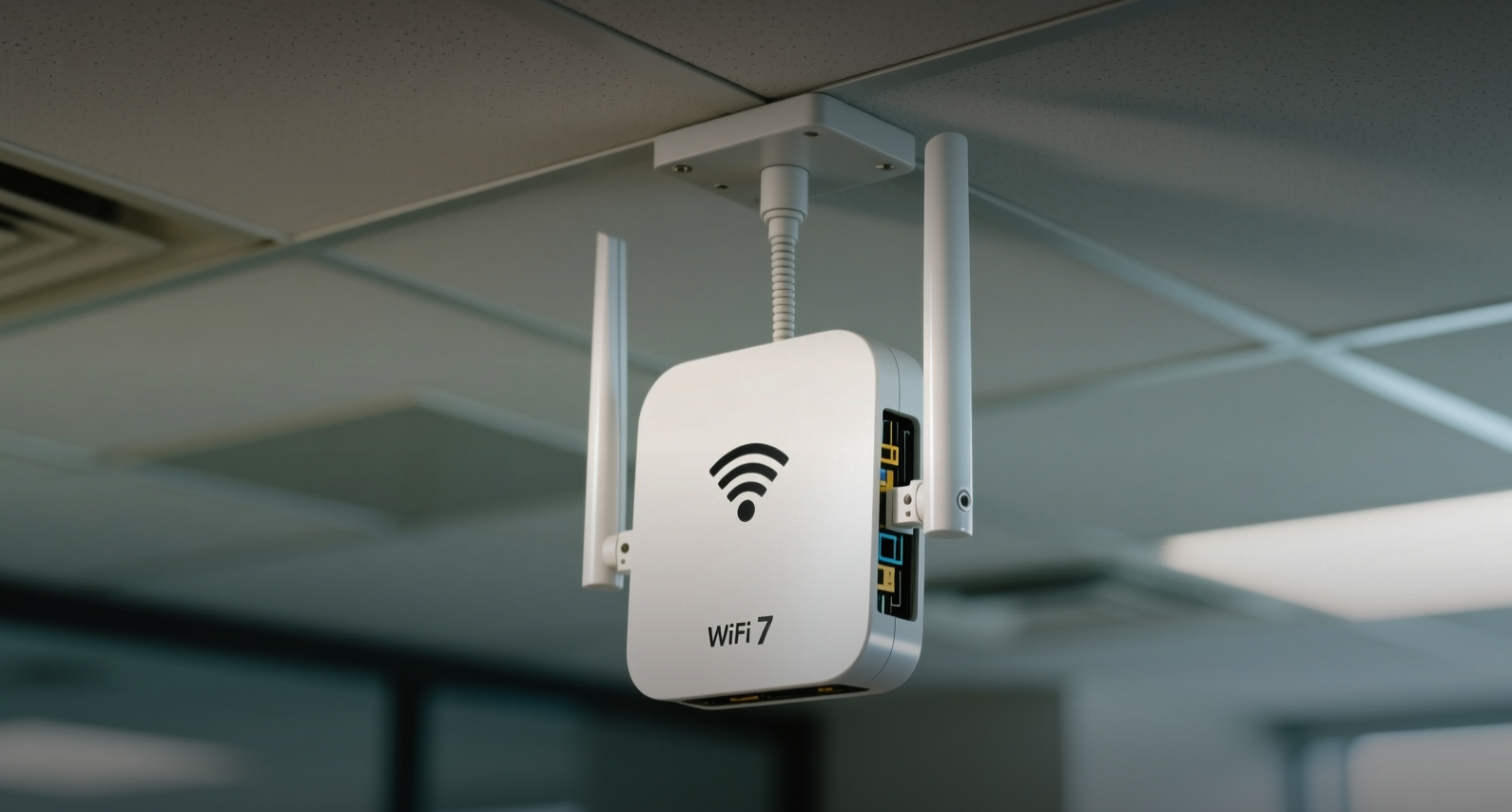
Huawei used HUAWEI CONNECT 2026 in Shanghai to push its upgraded Stellar AI Campus Network Solution into the campus layer of enterprise AI, claiming wireless throughput twice that of rival gear and a 90% cut in mean time to repair. The Chinese vendor is selling the stack on three pillars — Wi-Fi 7 Advanced radio scheduling, full-scope security spanning physical and digital assets, and AI-driven network autonomy — aimed at enterprises wiring multi-agent AI workloads into office buildings rather than data halls.
"Driven by AI, today's campuses are evolving into a super agent that can perceive, think, self-heal, and dynamically adapt," Leon Wang, President of Huawei's Data Communication Product Line, said at the event. Shawn Zhao, who leads campus network product marketing at the company, framed the launch around three constraints: "The AI era has placed higher demands for campus networks, especially bandwidth capacity, security defense, and O&M efficiency."
The headline claim sits in the radio. Huawei's Wi-Fi 7 Advanced adds intelligent Coordinated Scheduling and Spatial Reuse, or iCSSR, which the company says delivers twice the networking performance of industry peers. Huawei did not disclose the test conditions, the comparison product, or the client mix behind that figure, so the claim remains unverified against published benchmarks from Cisco, HPE's Aruba unit, or Juniper Networks. The company also debuted the eCampusLink platform and a HiSpaceX appliance for unified access, spatial modeling, and orchestration of campus elements — a bid to sell the management layer alongside the access points.
On security, Huawei is pitching asset, connectivity, spatial, and privacy controls as one system. Its upgraded Asset Security Solution claims second-level blocking of anomalous terminal behavior plus collaborative tracing that links network telemetry to physical security events. That framing targets a real budget line: campus networks now carry agent traffic that authenticates as a machine, not a person, and most installed access-control stacks were built for human logins.
The autonomy pillar carries the most concrete numbers. Huawei's iFlow and distributed real-time simulation tools cover pre-event detection, in-event localization, and post-event service verification, which the company says yields 24/7 AI-powered operations with a 95% troubleshooting accuracy rate and a 90% reduction in MTTR. For a 5,000-employee campus running a typical three-to-five-person IT network team, a 90% MTTR cut is the difference between a two-hour floor outage and a twelve-minute one — the kind of figure that shows up in service-level agreements rather than product brochures.
Huawei's campus push lands against a crowded field. Cisco still holds the largest share of enterprise campus switching and wireless, with Aruba and Juniper competing on AIOps tooling of their own, and Arista Networks extending from the data center into campus adjacency. None of those vendors has published a directly comparable MTTR or throughput claim, which leaves Huawei's numbers as marketing until third-party testing appears. The competitive question is less about raw radio performance than about whether buyers will accept a Chinese vendor's management plane inside the same network that carries agent credentials and building-access telemetry.
For investors, the read-through is indirect. Huawei's networking arm is unlisted, so the tradable exposure runs through its supply chain — optical module makers, Wi-Fi chip suppliers, and Chinese system integrators that build campus deployments — and through the Western vendors whose campus refresh cycles this launch targets. Cisco trades at roughly 16x forward earnings on a business growing in the low single digits, a multiple that already assumes campus is a mature, defensible franchise. A credible low-cost alternative with autonomous operations bundled in is the kind of thing that compresses that assumption over several refresh cycles rather than one quarter.
Huawei did not disclose pricing, availability dates, or revenue targets for the upgraded solution, and no customer deployments were named at the launch. The company said it will continue working with global customers and partners on campus builds, without specifying which markets the upgraded stack will reach first — a material gap given export controls that already restrict Huawei networking gear in several Western markets.
This article is for informational purposes only and does not constitute investment advice.