


China's crackdown on cross-border capital flows could cut HSBC and StanChart's 2028 pretax profit by about 2%, Citigroup estimates.
China's crackdown on cross-border capital flows could cut HSBC and StanChart's 2028 pretax profit by about 2%, Citigroup estimates.
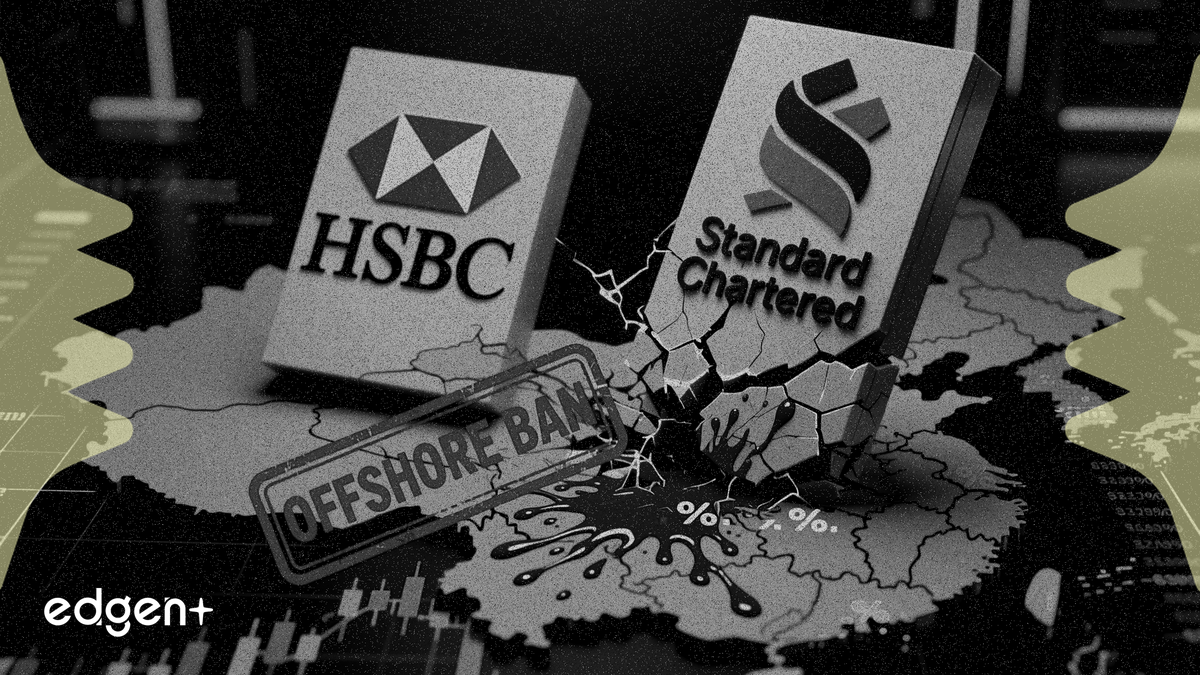
China's crackdown on cross-border capital flows could cut HSBC and StanChart's 2028 pretax profit by about 2%, Citigroup estimates.
China's push to shut down unauthorized cross-border investment could reduce HSBC Holdings Plc's 2028 pretax profit by about $1 billion and Standard Chartered Plc's by $200 million, Citigroup estimated, as regulators extend scrutiny from brokerages to bank accounts.
"Under a simple assumption of zero new account openings by non-Hong Kong resident mainland Chinese retail and Premier customers, this would reduce our 2028 revenue forecast for HSBC by about $1 billion, equivalent to around 2% of group PBT," Citigroup analysts wrote in a report. For StanChart, the reduction would be about $200 million, also roughly 2%.
Shares of HSBC fell 2.7% in Hong Kong on Thursday, while StanChart dropped 4.6%, Prudential Plc lost 4.5% and AIA Group Ltd. slid 2.9%. The declines followed media reports that some banks had suspended Hong Kong account openings for mainland customers, extending a regulatory crackdown that began May 22 when the China Securities Regulatory Commission announced plans to eliminate unauthorized cross-border brokerage activities within two years. The Hong Kong Securities and Futures Commission issued a circular to brokers, and the Hong Kong Monetary Authority sent letters to banks requesting reviews of existing mainland customer accounts.
HSBC said it holds all necessary licenses across the businesses and markets in which it operates and has identified mainland Chinese customers as a growth opportunity. StanChart's chief financial officer said at a meeting Thursday that most of the business under review relates to brokerage rather than banking, and that its existing policies already comply with regulatory requirements. He added that closing zero-balance accounts and requiring customer declarations are new regulatory demands.
The selloff in Hong Kong-listed financial stocks reflected investor concern that the regulatory net is widening beyond brokerages. Short selling activity intensified, with HSBC seeing $550.5 million in short trades, representing 31.6% of total turnover, while AIA recorded $1.15 billion in short sales, or 23.1% of its trading volume — both elevated readings that suggest institutional hedging against further downside.
The current crackdown differs markedly from the CSRC's 2022 warnings against Futu Securities and Tiger Brokers, which allowed existing mainland clients to continue trading and making deposits. This time, regulators imposed combined fines of 2.26 billion yuan ($332.7 million) on three brokerages — Futu, Tiger and Longbridge — and set a two-year deadline to fully phase out unlicensed operations, including closing websites and servers accessible from the mainland. An estimated HKD 200 billion to HKD 250 billion ($25.5 billion to $31.9 billion) in Hong Kong assets held by mainland Chinese clients through cross-border brokerages could be affected, according to CITIC Securities.
For HSBC and StanChart, the direct earnings impact appears manageable. Futu's mainland clients accounted for about 13% of asset holders at the end of March, while Tiger's mainland retail clients made up about 10% of total assets at the end of 2025, according to their financial reports. S&P Global said in a May 26 report that Futu's non-mainland business, which boosted revenue by over 65% in 2025, should help the company cope with the regulatory strain.
Goldman Sachs said in a separate note that the new rules have limited practical impact on Hong Kong banks and insurers, while UBS warned the measures increase friction in capital flows. The regulatory push comes as China's ruling party prepares for its 21st congress next year, with stability in financial markets a binding requirement for policymakers, according to Eurasia Group's China director Dan Wang, who described the measures as "a decisive cleanup" that goes beyond past verbal warnings.
Looking ahead, the two-year phaseout timeline means the full impact on bank earnings will unfold gradually. Citigroup's analysis assumes the most severe scenario of zero new account openings, but actual outcomes will depend on how strictly the HKMA and SFC enforce the new requirements on existing accounts. The CSRC has indicated the crackdown could extend to any player involved in the cross-border investment supply chain, including online influencers making referrals to brokerage platforms, suggesting enforcement will be broad.
This article is for informational purposes only and does not constitute investment advice.
