

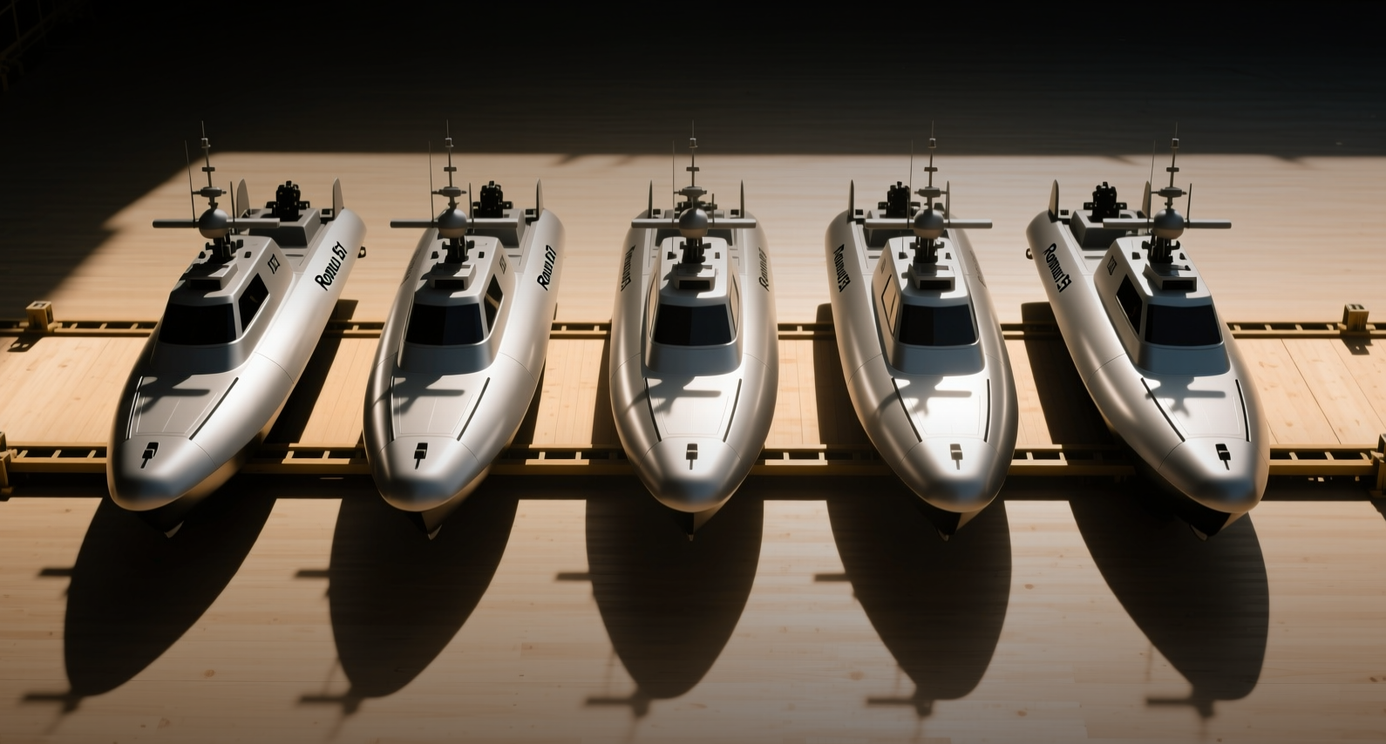
HII is scaling serial production of its AI-enabled unmanned surface vessels by adding a third Gulf Coast shipyard, with five Romulus 151 boats already under construction.
HII is scaling serial production of its AI-enabled unmanned surface vessels by adding a third Gulf Coast shipyard, with five Romulus 151 boats already under construction.
HII is scaling serial production of its AI-enabled unmanned surface vessels by adding a third Gulf Coast shipyard, with five Romulus 151 boats already under construction.
HII, America's largest military shipbuilder, added Halimar Shipyard of Morgan City, Louisiana, to its production network for the Romulus family of unmanned surface vessels, expanding Gulf Coast manufacturing capacity as five Romulus 151 vessels already near completion at Breaux Brothers Enterprises.
"Our partnership with Halimar Shipyard represents another important step in building the industrial capacity needed to deliver autonomous maritime capability at scale," said Andy Green, executive vice president of HII and president of its Mission Technologies division. "Halimar's proven shipbuilding expertise, skilled workforce, and strategic Gulf Coast location strengthen our ability to accelerate production, improve supply chain resilience, and provide affordable, mission-ready autonomous systems."
Halimar will construct complete Romulus 151 vessels under the partnership, joining Breaux Brothers, Bayou Metals, and Sydney-based design firm Incat Crowther in HII's distributed manufacturing model. The multi-site approach is designed to reduce lead times, increase surge capacity, and support consistent serial delivery across multiple shipyards, the company said. William Hidalgo Jr., executive vice president and chief operating officer of Halimar Shipyard, said his team's decades of vessel construction experience will help deliver reliable, scalable production capacity.
Romulus platform and mission profile
The Romulus platform is a modular family of unmanned surface vessels — essentially autonomous boats that operate without onboard crews — engineered for missions including intelligence, surveillance and reconnaissance; mine countermeasures; strike operations; and the launch and recovery of unmanned underwater and aerial vehicles. HII said the common manufacturing architecture and autonomy baseline enable scalability across multiple vessel sizes while reducing production complexity.
The Romulus 151, the variant now entering serial production, is designed for endurance and global reach. Its modular design allows the Navy to reconfigure the vessel for different mission types without rebuilding the platform, a feature that reduces lifecycle costs compared with single-purpose vessels. The platform's AI-enabled autonomy allows it to operate with minimal human supervision, a capability the Navy views as critical for operating in contested environments where communications may be degraded.
Distributed manufacturing and industrial base impact
HII's distributed shipbuilding model brings together specialized fabricators, designers, and technology providers across multiple Gulf Coast locations. By working with Halimar, Breaux Brothers, and Bayou Metals, the company is reducing lead times and advancing major assembly work ahead of final integration. This approach enhances throughput and enables efficient serial delivery across multiple shipyards, HII said.
The partnership also strengthens the broader U.S. shipbuilding industrial base by expanding regional manufacturing capacity and creating opportunities to sustain a skilled workforce. HII, with a workforce of 44,000 and more than 140 years of shipbuilding history, is the largest producer of unmanned underwater vehicles for the U.S. Navy and operates across all-domain mission technologies including C6ISR, artificial intelligence, electronic warfare, and synthetic training.
Competitive positioning
HII's push into unmanned surface vessels places it in competition with several defense contractors developing similar capabilities. L3Harris Technologies has developed the Arabian Fox MAST-13 unmanned vessel, while Textron Systems produces the Common Unmanned Surface Vessel for the Navy. Leidos has also secured contracts for autonomous maritime systems. The market for unmanned maritime systems is projected to grow as the Navy shifts toward distributed fleet architectures that rely on smaller, autonomous platforms rather than large manned ships alone. HII shares trade on the New York Stock Exchange under the ticker HII.
This article is for informational purposes only and does not constitute investment advice.
